Holocaust survivor Andras Lacko shares story at Dallas museum's speaker series

"History" from the mouths of those who lived it somehow hits differently – or at least it should.
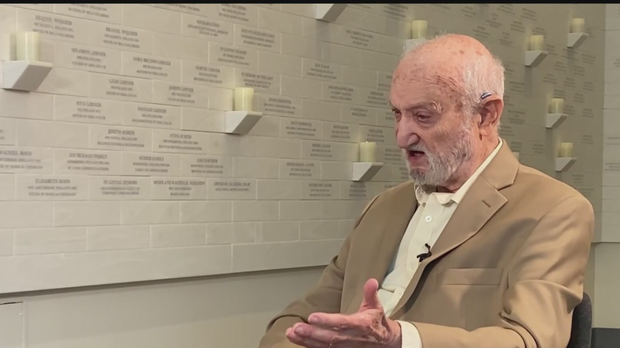
That's why the Dallas Holocaust and Human Rights Museum often brings in survivors to share their stories, including retired biochemistry professor Andras Lacko, PhD.
"Just to continue to document and provide remembrances of a period in history when hate was carried to such an extreme that over 6 million Jewish people and many millions of others perished," Lacko said during a recent visit to the museum.
Born in Hungary in 1936, Lacko and his family were relatively safe as the horrors of the Holocaust swept through Europe. Hungary was a one‑time German ally.
"Even though there was anti-Semitism and some persecution of Jews," Lacko said, "that was far from life-threatening. That all changed on March 19th, 1944."
The German army invaded, deciding Hungary could no longer be trusted. And that meant peril for the Jews.
"The Jewish population in the countryside was nearly totally eliminated in a period of about two months," Lacko said. "That was around 800,000 people."
He had already been separated from his father, who had been forced to work for the Hungarian army. Lacko and his mother were living in the city, in what was designated as a "Jewish house."
"That was used in Budapest to concentrate the Jewish population into smaller spaces," Lacko said, "getting people ready for either concentration camps, death camps, or just execution."
One morning, his mother was ordered to report to the train station. Call it fate or luck – neither assessment offended Lacko – and he added one of his own: "...perhaps due to God's hand, the people ran out of time who were organizing this transport. So, she was told to go home, but come back the next morning."
Instead, he said his mother tore off the yellow star they had been ordered to wear and, with a suitcase full of silver she could use for a bribe, they started walking.
On the street, they ran into the family's former housekeeper, who had been given a luxurious apartment that once belonged to a Jewish doctor and his family. Lacko said that family had already been sent to Auschwitz. The former housekeeper invited them in, fed them lunch and gave his mother papers allowing her to assume the identity of the housekeeper's sister. Masquerading as a Christian, she managed to survive.
Luck struck again when Lacko contracted scarlet fever.
"And when the Hungarian Nazis came to transport everybody to the ghetto," Lacko said, "they barely opened the door because they knew that scarlet fever was a highly contagious disease."
Lacko recovered in a military hospital, later reunited with his mother and eventually his father. He knows he was far luckier than most, pointing to a photo from his parents' wedding – a gathering of about 20 of his mother's relatives.
"Of all those, only three didn't make it," Lacko said. "The rest of the people survived because the Holocaust came very late to Budapest, Hungary, and most of us had an opportunity to survive one way or another."
Decades later, the biochemistry professor continues to share his lived history.
"I mean, one third of the Jewish population of the world was destroyed during the Second World War," Lacko said. "So, to have people understand the amount of hate or blindness or just inhuman behavior. And how actually ignorance – which unfortunately prevails even today – can lead to similar consequences."
He is part of the Summer Survivor Speaker Series at the Dallas Holocaust and Human Rights Museum and is slated to share more of his story with visitors on Friday, July 31.
"We think it's incredibly important for all of us to learn from these brave individuals who survived the Holocaust while we can," said Mary Pat Higgins, museum president and CEO. "They endured this experience that people are denying. And I want as many people from North Texas as possible to come and learn the truth."
"At the end," Lacko said, "I try to remind people as to what might be waiting for us unless we are careful."


