California sees thousands of lightning strikes during spring storm
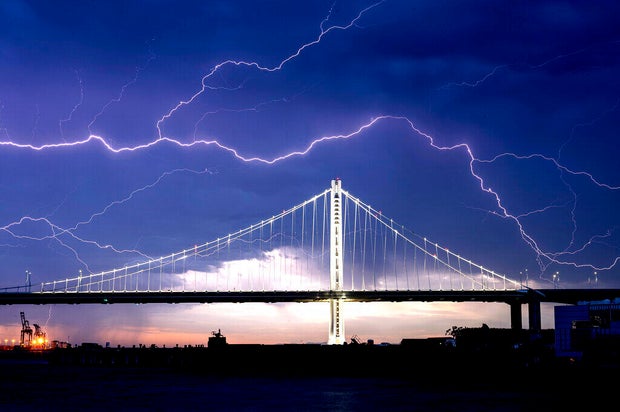
Since Friday, there have been just over 30,000 recorded lightning strikes throughout California and part of Western Nevada, according to the National Weather Service.
While there were tens of thousands of lightning strikes, only about 10% of them were cloud-to-ground strikes. Of those 3,200 ground strikes, 450 of them were positive strikes, and 2,800 were negative strikes.
Positive strikes usually make up less than 5% of all strikes, according to the National Oceanic and Atmospheric Administration, but are considered to be more dangerous as they can have a higher peak charge and a longer flash duration.
"Since it originates in the upper levels of a storm, the amount of air it must burn through to reach the ground is usually much greater," NOAA explains. "Therefore, electric fields associated with positive Cloud-to-Ground (CG) strikes are typically much stronger than those associated with negative strikes."
Californians could see thousands more lightning strikes as more thunderstorms are expected throughout the weekend. Differentiating between positive and negative strikes with the naked eye may be hard, but one way to tell, according to NOAA, is if the lightning is flickering, it's likely a negative strike.
"A negative … flash consists of one or perhaps as many as 20 return strokes. We see lightning flicker when the process rapidly repeats itself several times along the same path," the NWS says.
Positive strikes usually consist of a single return stroke, according to NOAA.
"Remember - 'Thunder roars, go indoors' or 'See a flash, dash inside,'" the NWS advises.


