Philadelphia's trash, Chester's burden: Residents demand change as city weighs new waste contracts

Every year, Philadelphia sends thousands of tons of garbage to Chester, where it is burned at one of the largest waste-to-energy incinerators in the United States.
For decades, residents living near the facility have raised concerns about the air they breathe, their health and the impact on their community. Now, with Philadelphia City Council preparing for a critical hearing Wednesday on the city's next waste disposal contracts, those residents are demanding a voice in a decision that could determine where Philadelphia's trash goes for years to come.
At the center of the debate is the Reworld incinerator in Chester, approximately 20 miles southwest of Philadelphia.
Last year, Philadelphia sent roughly 180,000 tons of garbage to the facility. According to city officials, nearly 30% of Philadelphia's daily waste is sent to Chester.
For residents like Zuleen Mayfield, who has spent more than three decades fighting the incinerator, the consequences extend far beyond the facility's property lines.
"It has diminished our community," said Mayfield, chairperson of Chester Residents Concerned for Quality Living.
Mayfield described what she says happens when odors and emissions from the facility reach nearby homes.
"Immediately it irritates your eyes. It gets in your throat, nose, and you feel it in the pit of your throat," she said.
The impact, she says, has changed how residents experience everyday life.
"You don't want to have people over your house if you're not from the area, because immediately you smell the stench," Mayfield said.
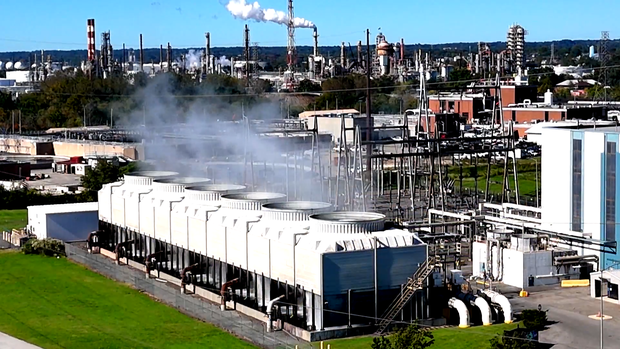
Health concerns in a community surrounded by industry
Chester has a long history of industrial activity, and residents have repeatedly raised concerns about the cumulative effects of pollution in their community.
Dr. Kristen Motley, Chester's health commissioner, says the health challenges facing residents demand attention.
"It is not normal to experience the health impacts that are happening to Chester residents," Motley said.
"People are dying in their 30s, in their 40s with small children from diseases like cancer, rare cancer. This is preventable. And if we don't do anything now, we ought to be ashamed of ourselves," Motley said.
Motley also pointed to concerns about cancer, heart disease and kidney disease among Chester residents. She believes Philadelphia's upcoming decision on the waste contract presents an opportunity to address longstanding environmental concerns.
"This is an opportunity for Philadelphia to really make a difference in people's lives," Motley said.
While residents and health officials have raised concerns about illnesses in the community, the available records reviewed by CBS News Philadelphia do not establish that emissions from the Reworld facility caused those health conditions.
CBS News investigation finds history of environmental violations
Records from the Pennsylvania Department of Environmental Protection obtained by CBS News Philadelphia detail a history of environmental violations at the Chester incinerator.
The records list penalties totaling more than $423,000.
The findings raise questions about the facility's environmental compliance history as Philadelphia considers whether to continue sending garbage there. However, the violations themselves do not establish a direct connection between the facility's emissions and specific illnesses reported by Chester residents.
Reworld declined to comment on the violations when contacted by CBS News Philadelphia.
Philadelphia faces a decision over where its trash goes next
The debate comes as Philadelphia considers new waste disposal contracts that could determine how the city handles its garbage for another four to seven years.
Cost is a major factor: Sending garbage to the Chester incinerator remains one of Philadelphia's least expensive disposal options, with a proposed rate of approximately $47 per ton next year.
But city officials are also considering a longer-term approach designed to reduce the amount of waste sent to incinerators and landfills.
Councilmember Mark Squilla, who represents Philadelphia's 1st District, has proposed the Zero Waste and Circular Economy Act, supported by Mayor Cherelle Parker's administration.
The proposal aims to divert 60% of the city's waste from landfills and incinerators by expanding recycling, composting and other waste management alternatives.
That includes exploring ways to convert food and other organic waste into renewable energy rather than disposing of it through traditional methods.
Squilla argues that reducing Philadelphia's dependence on incinerators will require more than simply prohibiting the city from sending trash to Chester.
"The bill that we are talking about now that would stop us from sending trash to the incinerator doesn't stop us from sending trash to landfills, and it doesn't even reduce any waste that we are generating here in the city of Philadelphia," Squilla said. "We want to stop sending all trash to landfills and incinerators, but we have to send it somewhere."
Squilla believes the proposed legislation offers a path toward reducing the amount of garbage Philadelphia generates and ultimately disposes of.
When CBS News Philadelphia asked what he would say to Chester families who feel their health and quality of life are being sacrificed for Philadelphia, Squilla pointed to the legislation.
"The Zero Waste Circular Economy Act gets them to where they want to be," he said.
But building the infrastructure necessary to meet those goals could take years.
In the meantime, Philadelphia could approve new contracts that continue sending trash to Reworld.
That possibility has frustrated Chester residents who say they have already spent decades waiting for change.
A fight over environmental justice and who gets a say
For Mayfield and other advocates, the debate is about more than garbage collection, recycling rates or the cost of waste disposal.
It is also about environmental justice — and whether residents of one community should continue bearing the environmental burden of another city's waste. Chester residents do not vote in Philadelphia's municipal elections, but decisions made by Philadelphia officials can directly impact their community.
Mayfield argues that the connection between the two cities makes it impossible to separate Philadelphia's waste policies from the people living near the incinerator.
As City Council prepares to consider the next chapter of Philadelphia's waste management system, Chester residents say their concerns deserve a place in that discussion.
And after more than 30 years of organizing, Mayfield says she is no longer interested in simply hoping for a different outcome.
When asked what she wants to happen next, she answered directly.
"Well, we are not going to hope. We are going to work for it," Mayfield said. "Our intention is to convince the councilmembers of Philadelphia to do the right damn thing."
For Philadelphia, Wednesday's hearing is about the future of its trash. For Mayfield and her neighbors in Chester, it is about the future of their community and the air they breathe.