Hurricane Melissa threatens to bring catastrophic flooding, landslides to Jamaica, Haiti, Cuba
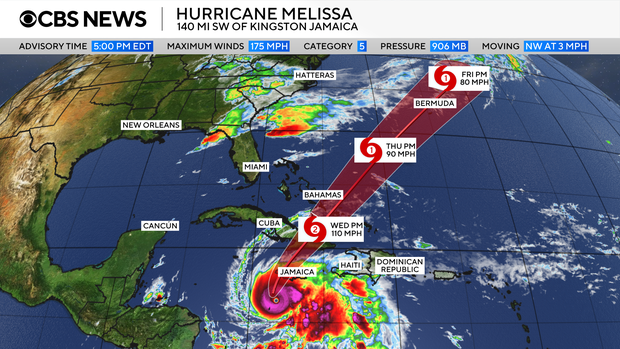
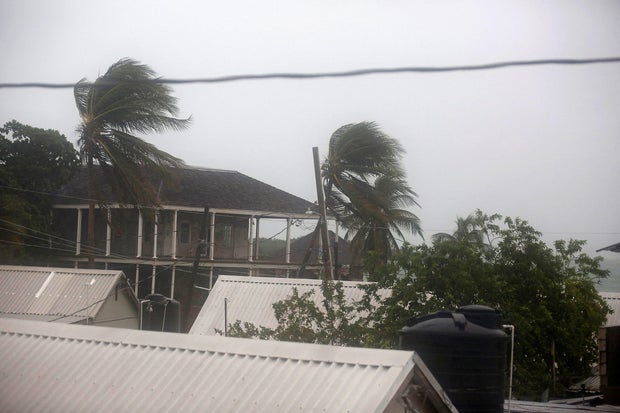
Hurricane Melissa intensified to Category 5 early Monday as it neared Jamaica, threatening to bring catastrophic flooding, landslides and widespread damage to homes and infrastructure. The storm is forecast to dump up to 30 inches of rain on Jamaica, along with life-threatening storm surge along its southern coast.
Melissa is expected to make landfall on the island on Tuesday and cross southeastern Cuba and the Bahamas through Wednesday. The U.S. State Department on Monday issued natural disaster travel alerts for Cuba, Jamaica, Haiti and the Bahamas, urging U.S. citizens to consider leaving while flights were still available, or be prepared to shelter in place.
As of the National Hurricane Center's latest update, the hurricane had maximum sustained winds of 175 mph and was inching north-northeast at a slow pace, just 2 mph.
Category 5 is the highest on the Saffir-Simpson scale, for storms with sustained winds of at least 157 mph — catastrophic strength capable of destroying many of the homes in its path.
"Destructive winds and storm surge and catastrophic flooding will worsen in Jamaica through the day and into tonight," CBS News meteorologist Nikki Nolan said Monday.
Melissa is expected to be the most powerful storm to ever hit Jamaica, and, potentially, the most powerful storm on record to ever make landfall anywhere, CBS News Philadelphia meteorologist Grant Gilmore said Monday. The storm's slow pace, which it was forecast to maintain while traversing Jamaica, increased the likelihood that it would bring "profound" devastation to the island, according to Gilmore.
"All of the threats that a hurricane can unleash on an island, it's all going to happen in Jamaica over the next 36 hours," he said.
Melissa forces Hurricane Hunters aircraft to turn around, NOAA says
CBS News confirmed that a Hurricane Hunters aircraft from the National Oceanic and Atmospheric Administration was forced on Monday to abort its mission when it experienced "severe turbulence" in the storm's southwestern eyewall.
The crew on one of NOAA's P-3 aircraft, the N42RF "Kermit," experienced the turbulence, which triggered a mandatory maintenance action, and they had to return to the Aircraft Operations Center in Lakeland, Florida, a NOAA spokesman told CBS News. The aircraft underwent inspection and maintenance and was scheduled to continue with planned missions on Monday. Another of NOAA's P-3 aircraft, the N43RF "Miss Piggy," was slated to support flights into Hurricane Melissa starting Tuesday.
Storm surge in Jamaica could peak up to 13 feet, forecasters say
In addition to the rainfall, Melissa is likely to cause a life-threatening storm surge on Jamaica's southern coast, peaking as much as 13 feet above ground level, near and to the east of where the center of Melissa makes landfall, forecasters said.
Mandatory evacuations were ordered in seven flood-prone communities, where buses carried people to shelters, according to Jamaica's Office of Disaster Preparedness and Emergency Management there.

In addition to the impact on Jamaica, western Haiti could get 16 inches of rain, bringing the threat of catastrophic flash flooding and landslides there, too, the hurricane center warned.
The slow-moving storm has already killed at least three people in Haiti and a fourth in the Dominican Republic, where another person remains missing, according to authorities.
"I want to urge Jamaicans to take this seriously," said Desmond McKenzie, deputy chairman of Jamaica's Disaster Risk Management Council. "Do not gamble with Melissa. It's not a safe bet."
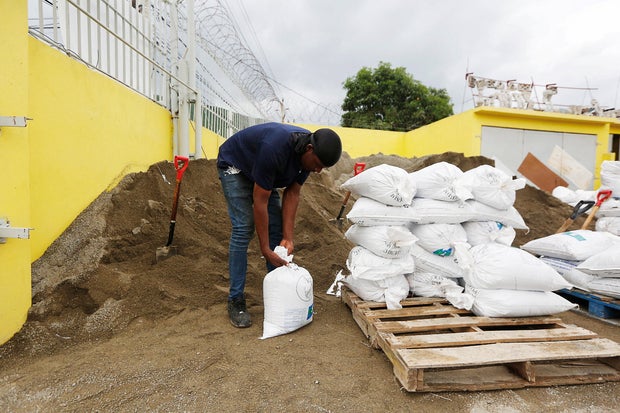
The hurricane was expected to make another landfall later Tuesday in eastern Cuba, where authorities have ordered some 650,000 people to evacuate, according to the country's president. A hurricane warning was in effect for Granma, Santiago de Cuba, Guantánamo and Holguin provinces, while a tropical storm warning was in effect for Las Tunas. Up to 20 inches of rain were forecast for parts of Cuba, along with a significant storm surge along the coast.
Around 1,000 U.S. military personnel have been evacuated from Guantanamo Bay, Cuba, ahead of Melissa's arrival, a U.S. defense official told CBS News. Meanwhile, some U.S. Navy ships in the region were repositioned out of the hurricane's direct path but remained actively deployed, the official said.
Evan Thompson, principal director at Jamaica's meteorological service, also warned Melissa could be the strongest hurricane Jamaica has experienced in decades. He said cleanup and damage assessment could be severely delayed because of anticipated landslides, flooding and blocked roads.
"Don't make foolish decisions," warned Daryl Vaz, Jamaica's transport minister. "We are in a very, very serious time over the next few days."

The storm has already dropped heavy rain in the Dominican Republic, where schools and government offices were ordered to remain closed on Monday in four of nine provinces still under red alert. The Dominican Republic shares the island of Hispaniola with Haiti.
Melissa damaged more than 750 homes across the Dominican Republic, displacing more than 3,760 people and leaving more than half a million without drinking water services, emergency officials said. Floodwaters have also cut access to at least 48 communities, officials said.
In Haiti, the storm destroyed crops in three regions, including 37 acres of maize, at a time when at least 5.7 million people — more than half the country's population — are experiencing crisis-level hunger, with 1.9 million of those facing emergency-level hunger.
"Flooding is obstructing access to farmland and markets, jeopardizing harvests and the winter agricultural season," the United Nation's Food and Agriculture Organization said.
Melissa was expected to keep dumping torrential rain over southern Haiti and the southern Dominican Republic in the upcoming days.