Alex Scott's doctors using money from ALSF to make "huge impact" in childhood cancer research

Alex Scott's wish was that she could hold lemonade stands to raise money so that doctors could help kids like her, and that is what's happening.
Children all over the country are holding lemonade stands and donating the money to Alex's Lemonade Stand Foundation. The fundraising is helping doctors and scientists create new cancer treatments and cures.
The doctors who treated Alex say her dream is slowly coming true.
"The thing I remember the most about her is just how precocious she was," Dr. John Maris said.
"She was very determined even at such a young age," Dr. Yael Mosse said.
Maris and Mosse were Alex's doctors, but the relationship went beyond doctor-patient. They were close with Alex and her family, especially Maris.
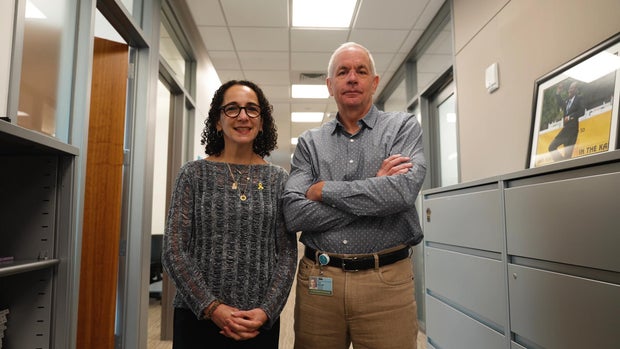
"She was very particular," Mosse said. "And so, Dr. Maris was her doctor. And only when Dr. Maris was away could I step in on Dr. Maris' behalf and help."
Maris even attended what would be Alex's final lemonade stand.
The doctors say that despite battling her own cancer, she wanted to help other children.
"It was profound at that young age that Alex was thinking about the children that she played with in the playroom when she was waiting for her visits," Maris said.
Alex wanted to hold lemonade stands and give the money to her doctors.
"Liz and Jay, I think, assumed that she wanted the money to go toward neuroblastoma research and to help her," Maris said, "and she said, 'No, there are other cancers and other kids have different cancers and … the money has to go to all the cancers.'"
From Alex's dream to a growing reality, her parents, Liz and Jay, started Alex's Lemonade Stand Foundation.
"It's just made a huge impact across the field of childhood cancer research," Maris said.
Mosse has been at the forefront of neuroblastoma research. Her team made a major discovery.
"Pat Brophy, who was Alex's nurse, and when Pat was dying, which was just a couple of weeks after we had made this discovery, I was sitting with her and she said to me, 'Yeah, it sounds like this is going to be something big, you know, do you think so?" Mosse said. "And I said, you know what, Pat, I do. I think this is going to be something big, and it has turned out to be something really big."
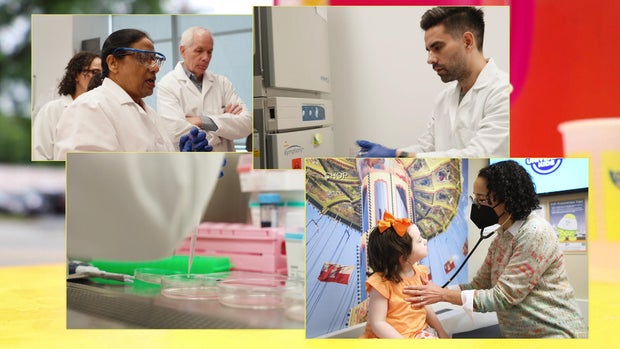
The discovery led to a therapy that is curing some children of cancer. Kids like Edie and Philip, whose parents were told he was out of treatment options.
It's giving others more time with their families.
Maris and Mosse are working on what might be the next big thing in pediatric cancer research, a game-changer they hope gets rid of a certain gene mutation that causes cancer: a new class of drugs called "degraders."
"[Degraders] completely take the ALK gene and, rather than just inhibit its activity, it actually allows the body to recognize it as being foreign and completely gets rid of it," Mosse said. "It just clears it."
Research, much of which is funded by Alex's Lemonade Stand Foundation, is making advances like this possible.
"The foundation is the foundation for childhood cancer research," Maris said. "Liz and Jay have built the best foundation. It's the most innovative, it's the most creative. It gets this cycle of the foundation pushing the scientists to do more and scientists, then going back to the foundation with new ideas, and it's been a remarkable, remarkable journey. It's lasting. It's going to be here for a long, long time."
Join CBS Philadelphia for the 20th annual Alex Scott A Stand for Hope Telethon, from 6 a.m. to 8 p.m. Wednesday. Funds are being raised for childhood cancer research. To donate, visit here.


