As Ukraine sinks Russian ships, some NATO nations voice anxiety over war's spread to new regions

Some NATO countries are voicing increasing anxiety as hostilities in the nearly five-year war sparked by Russia's full-scale invasion of Ukraine spread beyond the two countries' borders.
Polish authorities accused Russia again Tuesday of deliberately violating the nation's airspace as officials said a surveillance drone briefly crossed the Polish border before turning back into Ukraine. Poland, a member of the U.S.-led NATO alliance and a neighbor and close ally of Ukraine, accused Moscow of a deliberate provocation late last week after three Russian missiles landed on Polish soil.
Polish Deputy Defense Minister Paweł Zalewski said in a radio interview on Tuesday that the Russian drone crossed the border for a "very short time" and was "monitored from the very beginning."
"I spoke with the Operational Command of the Armed Forces, and the decision was made not to shoot it down, as they did not want to risk any casualties or damage on the civilian side," Zalewski told Radio Poland. "We assume this was an intentional act."
A "need for stability in our near areas"
Norway's Defense Minister Tore Sandvik said Tuesday, meanwhile, that the Scandinavian country was speaking with Ukrainian officials about the "need for stability in our near areas," following a strike on Saturday that hit a U.S.-sanctioned Russian cargo ship in international waters in the Gulf of Finland.
Ukrainian President Volodymyr Zelenskyy acknowledged Ukraine had carried out that strike in a social media post on Monday, saying the country's forces used seven domestically produced naval drones to attack the ship.
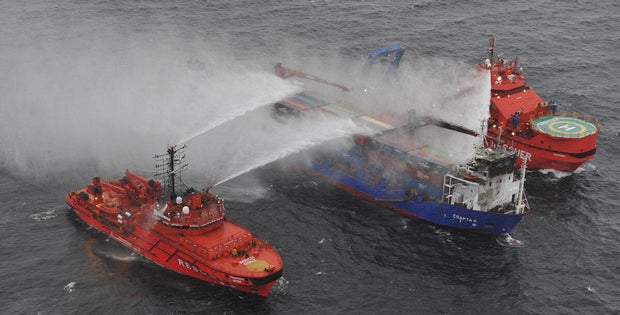
The Sparta II cargo vessel, which is operated by Russian defense logistics firm Oboronlogistika, has been under U.S. sanctions since 2022 for illicit transportation of military hardware. Russian authorities confirmed that it had been towed back to a Russian port on Tuesday.
Italian Foreign Minister Antonio Tajani spoke Tuesday with his Ukrainian counterpart Andriy Sybiha, meanwhile, in a phone call to express Italy's concern over another Ukrainian attack carried out over the weekend, this one off the coast of Libya.
Zelenskyy lauded Ukrainian forces on Monday for that attack, which sank a Russian warship and damaged another U.S.-sanctioned Russian cargo vessel, the MV Angara, off the North African nation's Mediterranean coast, where Russia has a naval base.
"The minister emphasized to his Ukrainian counterpart how crucial it is for Italy to keep working to prevent the conflict with Russia from spreading into the Mediterranean," Italy's Foreign Ministry said Tuesday in a readout of the ministers' call.
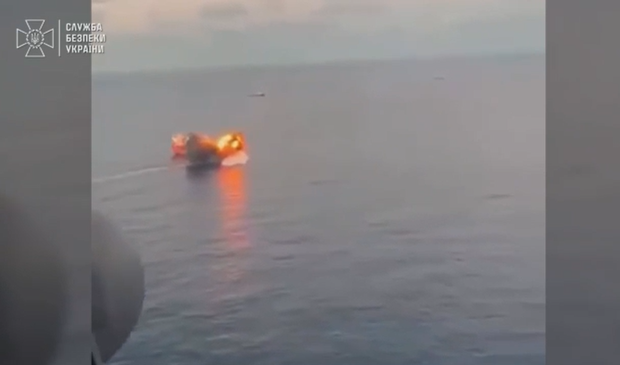
Zelenskyy framed the strikes on the Russian ships as legitimate defensive actions in response to Russia's ongoing deadly missile and drone strikes, which it launches from land, sea and air.
"Despite all the enemy's efforts to counter the attack, the Russian corvette Merkury was sunk," Zelenskyy said. "We continue our operations in designated waters. We are responding to Russia's aggression. We are developing Ukrainian weapons."
The Russian Foreign Ministry this week accused Estonia, another NATO ally, of being "on the verge of triggering open war" after the small Baltic country announced it would close its land border with Russia starting Dec. 1.
Estonia accused Russian intelligence agencies last week of a plot to infiltrate and sabotage the domestic defense company Threod Systems.
"Any attempt to threaten Estonia's security, sow fear, or act hostilely against us will be met with a decisive response," Estonian Foreign Minister Margus Tsahkna said in a statement last week. "By closing the border crossings, we are sending a clear message to the Kremlin: Russia's hostile actions come at a cost. The more aggressively Russia behaves, the narrower its room for manoeuvre becomes."
The Estonian move came only a couple of weeks after Poland's prime minister said a large-scale security operation launched along the Polish-Russian border may have prevented a sabotage or provocation operation by Russian operatives.
"Ukraine is doing exactly what they need to do"
While NATO members' concern over the spread of the war has been more clearly iterated in recent weeks, Ben Hodges, a former top commander of the U.S. Army in Europe, told CBS News on Tuesday that, in his opinion, all of Ukraine's actions constitute a legitimate defense in the face of Russia's aggression.
"Ukraine is doing exactly what they need to do to disrupt Russian oil/gas exports and other international activities to degrade Russia's ability to sustain its war effort," Hodges said. "This is also an important signal to anyone who would willingly support Russia's shadow fleet."
Moscow uses its so-called shadow fleet — hundreds of dubiously registered tankers — to evade international sanctions on its oil sales, keeping money flowing in to power its war machine.
Hodges told CBS News that Kyiv has likely calculated the risks involved in attacking Russian vessels in neutral waters.
"The risk is that Russia will attempt to use these as an excuse for its attacks against the Ukrainian economy and civilian infrastructure," he told CBS News. "But Ukraine knows this and anticipates it."
"Most European countries also already understand this and will not be moved by it," he added.