Tripoli under fire as rebels hunt Qaddafi
Updated at 11 a.m. ET
Fresh fighting erupted in Tripoli on Tuesday as NATO depicted Muammar Qaddafi's forces as being severely degraded and losing strength through desertions and defections.
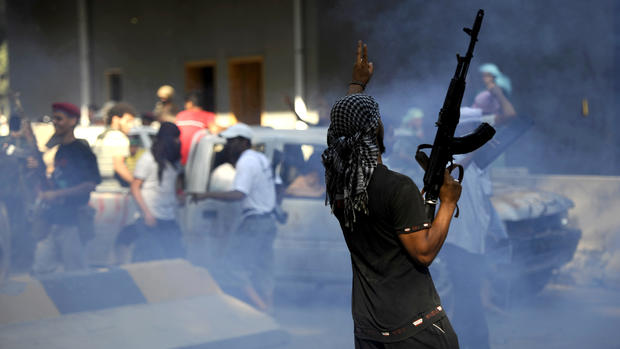
Rebels and pro-regime troops fought fierce street battles in several parts of the city, a day after opposition fighters swept into the capital with relative ease, claiming to have most of it under their control. Some of the heaviest fighting was around Qaddafi's Bab al-Aziziya main compound and military barracks.
Reporting with the rebels from the front line in the capital, CBS News correspondent Barry Petersen described the area about 300 yards from Qaddafi's main compound as though it was out of the 1979 apocalyptic film "Mad Max."
(Click on the video above to listen to Petersen's report)
"They're kneeling down because this is really Dead Man's Alley," Petersen told CBS Radio News. "They're open to sniper fire. The government troops are up in high-rise buildings. This area in front of me, a highway, is open season once you get out there."
Complete coverage: Anger in the Arab World
Will Libya's rebels remain united?
The unclear fate of Libya's 4 most-wanted men
Meanwhile, the Russian head of the World Chess Federation, Kirsan Ilyumzhinov, said he spoke with Qaddafi by telephone and he remains in Tripoli and defiant.
Ilyumzhinov said in an interview with the Interfax news agency that Qaddafi called him at around 6 p.m. Moscow time (10 a.m. Eastern) on Tuesday and said he was "alive and well and still in Tripoli." Ilyumzhinov has known Qaddafi for years. His visit to Tripoli in July was among the last times the Libyan leader was seen in public.
NATO said it will bomb Qaddafi's forces if they keep fighting. The announcement came hours after the strongman's son turned up free to thwart Libyan rebel claims he had been captured, a move that seems to have energized forces still loyal to the embattled regime.
Thick clouds of gray and white smoke filled the Tripoli sky as heavy gunfire and explosions shook several districts of the city of 2 million people.
NATO warned the situation in Tripoli remains very dangerous and promised the alliance will continue bombing forces loyal to the 69-year-old Libyan leader if they keep fighting.
"Snipers, shelling, missiles could do much damage, but they can't change the course of history or the outcome of this campaign," spokesman Col. Roland Lavoie told reporters at a news conference in Naples, Italy.
Sky News' Alex Crawford reports rebel forces are staging an attack on Bab al-Aziziya on Tuesday. From her vantage point just several blocks away from the compound, heavy gunfire and explosions were clearly heard.
Crawford said Qaddafi's failure to unleash more serious firepower on the advancing rebels was a strong indicator that the fighters genuinely maintained the momentum, and it was possible that most of the strongman's remaining forces were being penned-in at Bab al-Aziziya - setting the stage for a final showdown.
The compound, which has been heavily damaged by NATO airstrikes, has emerged as one of the centers of government resistance since tanks rolled out Monday and began firing at rebels trying to get in.
Petersen reports that the fighting has been contained to only a few areas of the capital.
"In some parts of Tripoli, you wouldn't know it was a war zone," Petersen told CBS Radio News. "The city fell so quickly, neighborhoods intact, people out living their normal lives. Other areas, not so good. Still sporadic fighting, especially around the hospital and at times around the compound where Qaddafi has his stronghold. That means that there are still casualties being taken, still places that people can't go to. But, in general, for most people of Tripoli, life in general has rapidly come back to normal."
Petersen reports that Tripoli's main hospital has been hit by mortar fire, and two doctors were killed by sniper fire. Debris littered the choked hospital corridors and the few doctors and nurses available are desperate for help.
"We have a shortage of everything," a doctor who said he was the only surgeon working at the hospital late Monday night told Sky News. "It's a disaster, in short."
Saif al-Islam's sudden — even surreal — arrival at a Tripoli hotel where foreign journalists are staying threw the situation in the capital into confusion. The appearance of Qaddafi's son and former heir apparent underlined the potential for the longtime Libyan leader, whose whereabouts remain unknown, to strike back even as his grip on power seemed to be slipping fast.
(At left, watch a report on Saif al-Islam's appearance)
"A brief appearance in the dead of night doesn't indicate somebody in control of the capital or anything at all," she said. "It shows that they are on the run (and) as we've seen in the Balkans recently, those on the run from international justice can do so for some time, but they can't hide."
NATO: Libya strikes to continue as battle rages
Rebels say they control most of Tripoli, but they faced pockets of fierce resistance from regime loyalists firing mortars and anti-aircraft guns. Rebel spokesman Mohammed Abdel-Rahman, who was in Tripoli, said the "danger is still there" as long as the longtime Libyan leader remains on the run.
He warned that pro-Qaddafi brigades are positioned on Tripoli's outskirts and could "be in the middle of the city in half an hour."
The rebel leadership seemed stunned that Saif al-Islam was free. A spokesman, Sadeq al-Kabir, had no explanation and could only say, "This could be all lies."
He could not confirm whether Saif al-Islam escaped rebel custody, but he did say that another captured Qaddafi son, Mohammed, had escaped the home arrest that rebels had placed him in a day earlier. On Monday, the rebels had said Saif al-Islam was captured, but did not give details on where he was held.

Saif al-Islam, with a full beard and wearing an olive-green T-shirt and camouflage trousers, turned up early Tuesday morning at the Rixos hotel, where about 30 foreign journalists are staying in Tripoli under the close watch of regime minders.
Riding in a white limousine amid a convoy of armored SUVs, he took reporters on a drive through parts of the city still under the regime's control, saying, "We are going to hit the hottest spots in Tripoli." Associated Press reporters were among the journalists who saw him and went on the tour.
The tour covered mainly the area that was known to still be under the regime's control — the district around the Rixos hotel and nearby Bab al-Aziziya, Qaddafi's residential compound and military barracks. The tour went through streets full of armed Qaddafi backers, controlled by roadblocks, and into the Qaddafi stronghold neighborhood Bu Slim.
At Bab al-Aziziya, at least a hundred men were waiting in lines for guns being distributed to volunteers to defend the regime. Saif al-Islam shook hands with supporters, beaming and flashing the "V for victory" sign.
"We are here. This is our country. This is our people, and we live here, and we die here," he told AP Television News. "And we are going to win, because the people are with us. That's why were are going to win. Look at them — look at them, in the streets, everywhere!"
When asked about the ICC's claim that he was arrested by rebels, he told reporters: "The ICC can go to hell," and added "We are going to break the backbone of the rebels."
In Benghazi, the de facto rebel capital hundreds of miles east of Tripoli, the head of the rebel Transitional National Council said the rebels have no idea where the 69-year-old Qaddafi is or whether he is even in Tripoli.
"The real moment of victory is when Qaddafi is captured," Mustafa Abdel-Jalil said. An Obama administration official said the U.S. had no indication that Qaddafi had left Libya.
President Barack Obama said the situation in Libya reached a tipping point in recent days after a five month NATO-led bombing campaign. However, he acknowledged that the situation remained fluid and that elements of the regime remained a threat.
The Obama administration official said the U.S. believes 90 percent of the capital is under rebel control, while regime loyalists still control Sirte and the southern city of Sebha. The official spoke on the condition of anonymity because the official was not authorized to speak publicly.
Qaddafi's forces remained active, firing off a short-range Scud missile Monday near Sirte, Qaddafi's hometown and one of the few remaining cities still under his control, said U.S. military officials, who declined to be identified in order to discuss military operations. It was unclear where the missile landed or if anyone was hurt.
It was only the second Scud missile fired during this year's conflict. On Aug. 15, Libyan government forces launched one near Sirte that landed in the desert outside Brega, injuring no one.
NATO vowed to keep up its air campaign until all pro-Qaddafi forces surrender or return to their barracks. The alliance's warplanes have hit at least 40 targets in and around Tripoli in the past two days — the highest number on a single geographic location since the bombing started in March, NATO said.
But the situation in Tripoli, a metropolis of 2 million, remained volatile and rebels appeared to be on the defensive, ducking for cover during frequent clashes with regime fighters. Stores were shuttered and large areas were lifeless, including the old gold market, in the past a draw for tourists.
The International Organization for Migration said Tuesday that a rescue mission to pluck 300 foreign nationals from the Libyan capital has been delayed by fighting. The Geneva-based group says an IOM-chartered ship will remain off the coast of Tripoli "until security conditions have improved and the safety of staff and migrants can be guaranteed."
The rebels have sent reinforcements to the city from the north, south and southeast, and a rebel field commander said Monday that more than 4,000 fighters were part of the final push to bring down the regime. Rebels manned checkpoints on the western approaches to the city Monday, handing out candy to motorists and inquiring about their destinations.
Around midday Monday, rebel fighters took over a women's police college near the Mediterranean and declared that they would set up their new headquarters there.
But the rebels' optimistic mood of the morning quickly changed. By mid-afternoon, the college came under heavy fire. Snipers from nearby high-rises aimed at motorists speeding by. An anti-aircraft gun pounded the compound, creating a deafening noise. A handful of rebel fighters inside seemed jumpy and unsure what to do.
Qaddafi loyalists also launched attacks in two other areas of Tripoli, said Ashraf Hussein, a rebel fighter who sat pressed against an inner wall of the compound for safety.
Still, revelers flocked to Green Square, the symbolic heart of the fading Qaddafi regime that fell under rebel control late Sunday. They flashed the "V" for victory sign and motorists circled the plaza, honking horns and waving rebel flags.
Outside of Tripoli, almost all of eastern and western Libya is now under rebel control. The east of the country from the Egyptian border to Benghazi fell into rebel hands at the beginning of the uprising. In the weeks leading up to Sunday's lightning advance on Tripoli, the rebels consolidated control of the western Nafusa mountain range near the border with Tunisia. It was from there they staged the run on the capital. Most of the rest of the country was quickly falling into their hands.
The city of Sirte, Qaddafi's hometown to the east of Tripoli, was the most important loyalist bastion to remain fully under his control.
On Monday, the city was without power and full of heavily guarded Qaddafi checkpoints, said Hassan al-Daroui, an official with the rebel council in Benghazi who was in touch with people there by satellite phone. Many people there were not even aware that rebels had pushed into the capital, 250 miles to the northwest, he said.
On Saturday rebels said they gained control of the oil refineries and airport at the oil terminal of Brega, on the road heading out of Benghazi west toward Tripoli.
The rebels' startling breakthrough on Sunday, after a long deadlock in Libya's 6-month-old civil war, was the culmination of a closely coordinated plan by rebels, NATO and anti-Qaddafi residents inside Tripoli, rebel leaders said.