Sacha Baron Cohen on using characters to get real people to reveal their real beliefs
Sacha Baron Cohen says he's just doing silly voices. But the British comedian behind Ali G, Borat and Bruno has invented his own brand of undercover comedy in the hopes of making viewers both laugh and think.
Over the decades, Baron Cohen has deployed his creations: the hip-hop idiot Ali G, the lovable but ignorant Kazakhstani reporter Borat and the fame-obsessed narcissist Bruno to get real people to reveal their thoughts and feelings. It's a far cry from being the lawyer his parents had initially hoped he'd be.
"It's just a bizarre journey that I ended up doing this," Baron Cohen said. "My dream was 'Could I make one classic comedy?' And I felt like with Borat, I was like, 'I did it.' You know, so anything else is really gravy. And yeah, I feel very, very lucky."
Decades of Ali G
Baron Cohen's first iconic character was Ali G, a persona he experimented with for years. An early version, known as MC Jocelyn Cheadle-Hume, was upper class but had many of the same catchphrases as Ali G. He took the prototype for a test drive to the skateboarders of London with the intention of airing the sketch on a youth culture show he was hosting on cable.
"And I start skateboarding terribly. And they go, 'You're, you're crap, man. You're whack.' After about 5 minutes, I said, I went back to my real voice, I said, 'Guys, I'm pretending. This is, this is a character.' They were shocked."
Baron Cohen said his boss threatened to fire him over the sketch.
"And then I knew I was onto something," he said.
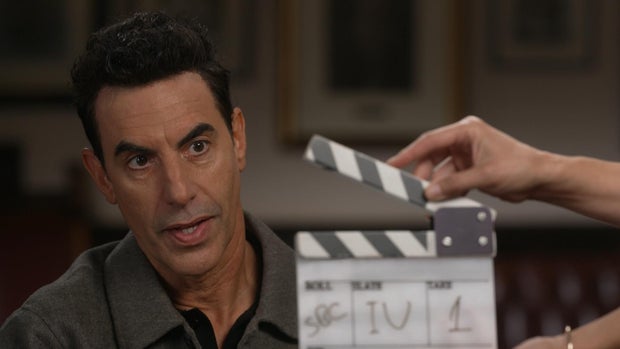
MC Jocelyn Cheadle-Hume was honed into the character millions have come to know now as Ali G: a White imbecile and hip-hop journalist who wants to be a Black rapper. Ali G's 1998 debut on a satirical late-night show was the stepping stone to "Da Ali G Show," which spawned an HBO series and a feature film.
"The core idea of Ali G was, I thought, 'Would it be funny to have the world expert in something with the biggest idiot in the world, you know? Would that juxtaposition be really funny, if the world expert takes it seriously?'"
As Ali G, Baron Cohen interacted with a range of public figures, politicians, and celebrities, including former United States Surgeon General C. Everett Koop.
"I kept on telling him these stupid questions, like you know, 'Ain't the heart a bit crap, you know? Don't, shouldn't it have a different rhythm? Because at the moment, it's boom-boom, but what about a [beatbox rhythm,]" Baron Cohen said.
He also once pitched then-businessman Donald Trump on a business idea Ali G thought was brilliant: special gloves a person could wear to keep ice cream from getting your hands sticky.
"I never fall for scams. I am the only person who immediately walked out of my 'Ali G' interview," Mr. Trump later said in a social media post.
In 2007, Baron Cohen said he was retiring Ali G because the persona was too well known to trick people. But years have passed and Baron Cohen is bringing the character back for his directorial debut, "Ali G: Who Iz I?"
The actor plays three characters who interact with unsuspecting strangers. The result, designed to expose extremism at both ends of the political spectrum, is as disturbing as it is funny.
"Number one, I wanted the people to laugh really, really hard," he said. "And I wanted to also just examine this idea of conspiracies and lies, whether we, in a matter of hours, could turn intelligent people who believed in the theory of race replacement into murderers. Doesn't sound that funny. There's loads of laughs in the movie as well."
The complexities involved in Baron Cohen's brand of undercover comedy
The scale of the challenge to create the new movie, which is out later this week, was unlike anything Baron Cohen says he had undertaken before.
"We had to have, you know, prosthetic teams working on this for years. We had animatronic teams. There are hundreds and hundreds of things that can go wrong, and each of them has to go right," he said.
At 55, Baron Cohen has been doing his undercover comedy for more than half his life. In that time, the complexity, moral stakes and physical danger involved in his deceptions have increased. Baron Cohen has sometimes required trap doors and getaway vans to escape the situations he's created.
He meticulously planned when creating Borat, the beloved, bumbling, antisemitic Kazakh reporter who made his grand entrance touring America in 2006 in his smash hit film "Borat: Cultural Learnings of America for Make Benefit Glorious Nation of Kazakhstan". He says it was a novel filmmaking experiment where interactions with real people move the plot forward.
He explained they put a lot of thought into who they interview.
"There's a huge amount of stuff that you don't see, which is us behind the scenes looking at who we are interviewing, going, 'They – not them. Not them,'" Baron Cohen said.
"Borat is, again, a funny character," Baron Cohen said. "He also shows the kindness of people as well, who are so nice to him, but also can expose, you know, the layer of hate and bigotry below the surface that people normally wouldn't go on air and show."
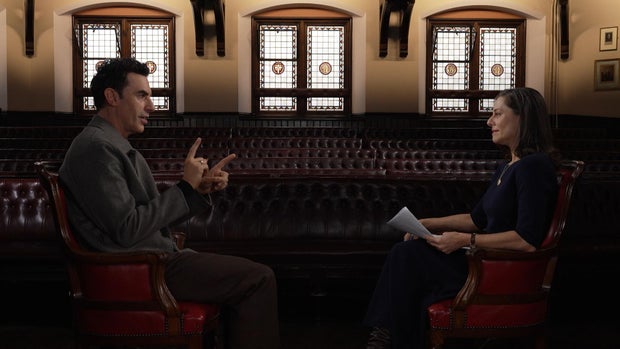
The undercover comedy ventures into morally complex territory as Baron Cohen's incognito encounters create an ethically questionable bargain: the worse the people he interacts with look, the better it is for Baron Cohen.
"I think a lot of the times they're not making fools of themselves. I think a lot of those in the Ali G interviews they come across well, actually. I think the same with Borat," he said.
Baron Cohen followed up Borat with Bruno.The character, a flamboyant fashion reporter who said he wanted to become "the biggest Austrian superstar since Hitler." The actor said the movie was conceived as a gay rom-com.
The kiss at the end of a traditional rom-com is usually sentimental. Baron Cohen had something different in mind for his main character.
"We did it in a cage match and it was me and my love interest, and we kiss," he said. "We wanted to see what would happen with the crowd? Would they become violent?"
The real people in the crowd reacted with anger, throwing cups and chairs.
"I'm thinking about the scene almost entirely in that moment. I mean, I can remember it vividly now," Baron Cohen said. "I remember lying down, and I'm kissing him, and I'm looking at the chairs. And I'm thinking, 'This is great.'"
How Baron Cohen got into acting and comedy
Baron Cohen, the youngest of three boys, grew up in northwest London. He had a passion for breakdancing and hip-hop, and even provided the entertainment at his own bar mitzvah.
He discovered the stage while at Cambridge University, where he studied history.
"I realized I loved making people laugh, but I also really liked making them cry onstage," he said.
Baron Cohen's mom, a fitness instructor, and his father, an accountant, hoped their son would become a lawyer, and thought the idea of pursuing entertainment was ridiculous.
"It would've been irresponsible for them to support me, because the likelihood of success was, seemed impossible," he said.
Baron Cohen also felt embarrassed to tell people he wanted to be a comedian.
"It's a bit like saying, 'I want to be a supermodel.' You know, and people go, 'Well, you're not actually very good-looking,'" Baron Cohen said.
Baron Cohen grew up admiring the actor Peter Sellers and trained under renowned clown teacher Philippe Gaulier.
It's worked out for Baron Cohen. His work has earned Golden Globes and BAFTA awards, along with Oscar nominations.
"The primary objective of all of this is to get people to laugh really hard," Baron Cohen said of his latest film. "And smuggled in there is a bit of satire, is a bit of, hopefully the people come out of the movie theater and think."


