Perseverance Mars rover sets new driving record on surface of another world
NASA's Perseverance rover set an otherworldly driving record this week, traveling the farthest of any vehicle ever on the surface of another planet.
The space agency said its rover, which has been exploring Mars since 2021, had driven 28.1 miles as of Sunday, exceeding the previous record set by NASA's Opportunity rover, which drove 28.06 miles during its 15-year exploration of the red planet, from 2004 to 2018.
Perseverance reached the milestone distance while traveling along the western rim of of Mars' Jezero Crater, where the rover has been tasked with investigating what scientists believe may be some of the oldest terrain in the solar system. They hope Perseverance will find traces of ancient hydrothermal systems — underground networks that heat water — in that area.
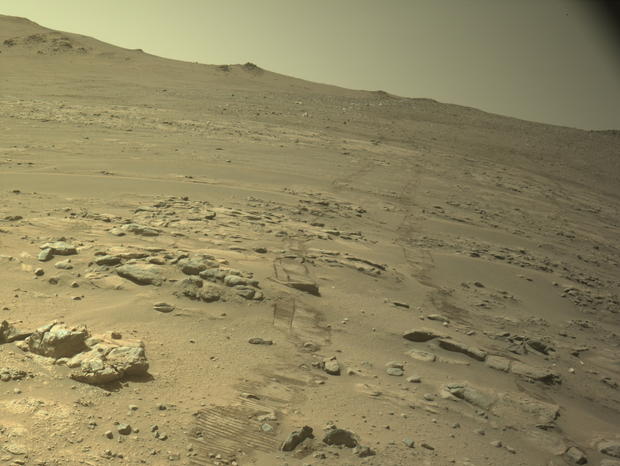
The rover has made important discoveries at the Jezero Crater since first landing on Mars in February 2021. Several years into its mission, Perseverance had collected enough data for scientists to develop a timeline of the crater's formation, dividing its history into "three major periods" after water originally entered it. In 2023, NASA said it was possible that microbial life once existed there.
Perseverance has been able to cover as much ground as it has in a relatively short time, compared with its predecessors, because of its self-driving capabilities. The rover is equipped with an autonomous navigation system, called AutoNav, that allows it to collect images of surrounding terrain, map out hazards and plan its own route as it's rolling along.
Scientists overseeing the rover have dubbed that skill "thinking while driving." They said Perseverance is also able to navigate itself while traveling at top speeds, up to 1,351 feet over the course of one sol, which is how scientists count a single solar day on Mars.
"It is an honor to be working on Perseverance at a moment when the technology has evolved to the point that drives like these are routine," said Steven Lee, the project manager of the Curiosity and Perseverance rovers at NASA's Jet Propulsion Laboratory, in a statement.
Lee said the rover has "blown well past" the 12.4 miles of driving initially expected during the mission, and now, it's likely that Perseverance will "keep adding to this record for many years to come."
NASA said it recently extended the Perseverance mission to allow to explore the rim of the Jezero Crater until the end of 2028.