As the U.S. invests in rare earths, a mine that was broke and underwater 10 years ago is now a game-changer

About a decade after he bought a shuttered rare earths mine that was, literally, partially underwater, MP Materials CEO James Litinsky has transformed his business into a pivotal player in America's national security.
Since taking over the rare earth industry from the United States in the 1990s, China has dominated the entire supply chain. That includes the mining, processing and especially the making of super-powered magnets using these elemental metals, which are essential components inside smartphones, robotics, fighter jets and drones. When President Trump enacted his tariff plans in April 2025, China responded by restricting sales of some rare earth elements and magnets to the U.S. – and requiring companies to file detailed disclosures for how they would be used.
"As it stands today, we need permission from the Chinese government to make things. We need permission from the Chinese government to make military things," Litinsky said. "The practical reality is, that is not an acceptable condition."
What are rare earths and where are they in the U.S.
Despite the name, rare earths aren't rare; what's actually rare are sites with high enough concentrations of rare earths, and accessible enough locations, to make extraction worthwhile. In all, there are 17 rare earth elements, each one an elemental metal on the periodic table.
These are not well-known metals like iron, copper and aluminum. There's europium, which enhanced the color red in early television sets, and neodymium, which strengthens and miniaturizes magnets. These so-called "rare earth permanent magnets" are used in everything from high-speed rail and electric vehicles to the tiny motors that make iPhones buzz, according to Julie Klinger, a professor of environmental studies at the University of Wisconsin-Madison and a rare earths expert.
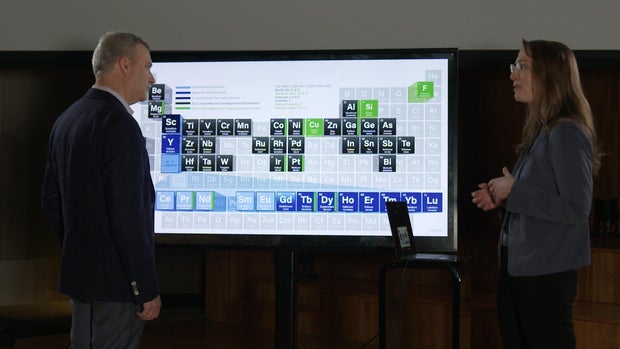
"The thing that distinguishes rare earth elements are their fantastic magnetic, conductive and optical properties," Klinger said. "So they're used often the way you might use spices in cooking, because if you add just a little bit of a certain rare earth element, say, to a magnet, that enables that magnet to be both very small and very powerful."
Geologists found rare earths at Mountain Pass, California, in 1949. By the 60s, individual rare earths were being mined, separated and utilized. Mountain Pass was considered the world's main rare earth mine for decades.
But the process eventually moved offshore because China could do it cheaper.
"It's a dirty business. It's a risky business," Klinger said. "It's a difficult business to really break even."
Mountain Pass fell victim to globalization, and also to U.S. environmental regulators in the 1990s after low levels of radioactive water and residue leaked into the Mojave Desert. The mine languished for a decade until a new company, Molycorp, tried, unsuccessfully, to compete with China and revive the business. Molycorp filed for bankruptcy in 2015.
What China's rare earth dominance means for the U.S.
Right now, China holds a near-monopoly over the strategic metals that go into so-called rare earth permanent magnets, key components in so much that makes the modern world go, according to Secretary of the Interior Doug Burgum. But, he added, China hasn't just cornered the market.
"They also weaponize it, because if anybody in the rest of the free world said, 'Hey, we're going to start mining and we're going to start refining,' then they would target that particular mineral, dump a quantity onto the market, drive the price down. And companies, including U.S. companies that were profitable, suddenly became unprofitable," Burgum said.

At the moment, "well north of 90%" of the world's rare earth magnets are made in China, MP Materials CEO James Litinsky said.
Last April, Mr. Trump unveiled his global tariffs plan on what he called Liberation Day. China retaliated to devastating effect, temporarily choking off rare earths to the U.S.; Ford Motor Company, suddenly without a reliable source of magnets, had to pause production on Explorer SUVs. After a series of trade truces, China resumed sending rare earth magnets to the U.S., with certain restrictions.
In November, after reaching a deal with China, Mr. Trump told 60 Minutes China had been "very strongly threatening" the U.S. with its control over rare earths.
The current U.S.-China trade truce is set to expire in eight months. Absent a new deal, the nation's rare earth supply, at least in the short-term, remains vulnerable.
As part of the national strategy to counter China's rare earths' dominance, senior Trump administration officials summoned Litinsky and Michael Rosenthal, the men running America's only active rare earth mine, and who were then building a rare earth permanent magnet factory, to Washington in April 2025.
Reviving the U.S. rare earth industry
Litinsky got his start in rare earths a decade ago. He was running a Chicago hedge fund when he saw a 60 Minutes report on rare earths, which helped inform his awareness of the mine at Mountain Pass and China's dominance of the industry. Then, while looking for value in distressed companies, Litinsky heard about Molycorp — the company that had unsuccessfully tried to revive Mountain Pass — struggling, and eventually filing for bankruptcy. He wound up owning the mine and refinery and turned to Rosenthal, a friend who also worked in hedge funds to help restart it
When they took charge in 2017, it was underwater, financially and literally: China had flooded the rare earth market driving down prices, and 30 million gallons of groundwater had pooled at the bottom of the mine, forcing it to shut down despite the fact Molycorp had invested $2 billion upgrading the site and making it more environmentally-friendly.
There were only eight employees when Litinsky and Rosenthal launched MP Materials. Today, there are more than 700 employees, just at Mountain Pass.
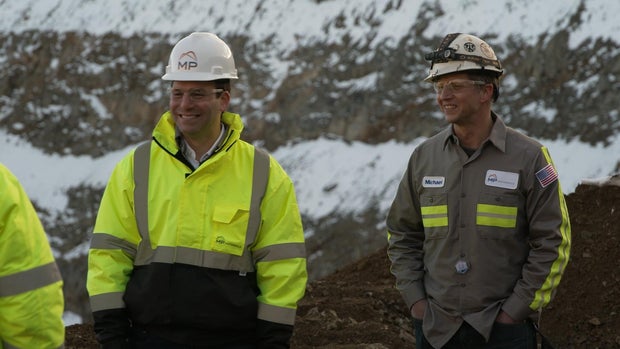
The mining is the easy part, Rosenthal said. The hard part is separating the rare earths from the rock, and then from each other.
In 2023, MP reached a milestone: After investing nearly a billion dollars more into the site, it was able to refine neodymium and praseodymium to 99.9% purity.
But MP Materials needed one last link to bypass China and secure the complete supply chain: the ability to manufacture their final product, those high-powered rare earth magnets so crucial to the modern world. So, in Fort Worth, Texas, they built a facility where pure rare earth oxide from Mountain Pass gets melted, cooled, compressed, diced and eventually turned into magnets. This meant MP was the only company, anywhere, to control the entire rare earth magnet supply chain, from mine to magnet, meaning independence from Beijing. They hope to soon be producing a million magnets a day as they scale up. Litinsky says their first customer, General Motors, will begin using rare earth magnets from MP Materials in vehicles later this year.
A call from Washington
But last spring things were not so rosy. After Mr. Trump announced tariffs in April 2025, major manufacturers and the U.S. government found themselves confronting China as it restricted the flow of rare earths and supermagnets. As the owners of America's only "one-stop" rare earth mine, refinery, and magnet-making company, Litinsky and Rosenthal were called to the Pentagon.
"The Pentagon wanted a Manhattan-style project to accelerate the entire supply chain of rare earth magnetics in the country," Litinsky said.
Litinsky and Rosenthal were asked to scale up everything as quickly as possible, and an unusual deal was brokered. The Pentagon agreed to inject $400 million into MP Materials (plus another $150 million to develop a refinery to process so-called "heavy" rare earths) and the U.S. government took a 15% ownership stake. Critically, the deal came with a guaranteed 10-year price floor for MP's rare earth oxide, $110,000 a ton, and promised to make up the difference to the company if prices drop below that. So, even if China tries to flood the market again, MP is covered. If rare earth oxide prices rise above that floor, the U.S. government shares the profits.
The government also asked MP Materials to ramp up rare earth magnet production, tenfold. To do it, Litinsky is building an even bigger rare earth magnet factory in Northlake, Texas. The company says it could produce enough to fulfill the country's most essential rare earth magnet needs. That plant, also in Texas and called "10X," is expected to be complete by 2028.
Burgum, who's been a vocal supporter of public-private partnerships and reviving U.S. industrial policy, defends the MP deal, even if it strays from strict principles of market capitalism.
"I'd certainly call it pragmatism," Burgum said, "because free markets work, but they don't work if you have an adversary that controls a monopoly that control[s] the prices."
Editor's Note: 60 Minutes updated this article to correct a typographical error in the price of rare earth oxide and in the location of MP's magnet factory.