LIRR strike has many worrying about Monday's commute. Here's the latest.

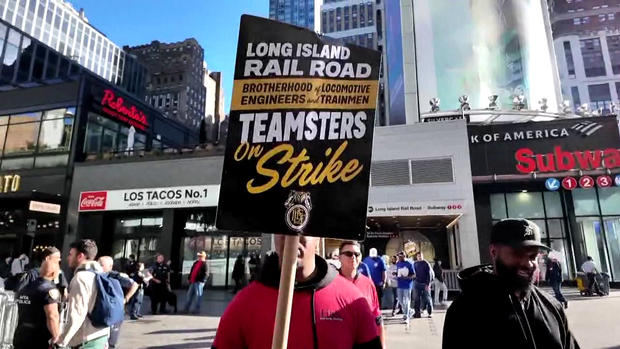
Long Island Rail Road workers were back on the picket lines at various spots in New York City and on Long Island on Sunday, voicing their concerns and demands as the strike continues for a second day.
It comes as the National Mediation Board said Sunday evening it summoned LIRR union leaders and Metropolitan Transportation Authority management to a meeting to resume bargaining.
While the work stoppage has caused a mess for people heading to weekend events, including the Mets-Yankees Subway Series, the real concern is Monday morning's commute. The LIRR is the busiest commuter rail system in North America, with roughly 250,000 weekday riders. The strike is expected to force many to find alternative routes into the city from the Long Island suburbs.
The MTA said it has activated its contingency plan, which includes recommended subway stations as passenger drop-off points to get into the city. However, if you don't have a ride, there will be limited, free shuttle buses from several Long Island train stations to subway connections in Queens starting at 4:30 a.m. They are reserved for essential workers and those who cannot telecommute, the agency said.
Bay Shore, Hicksville, Mineola and Lakeview will go to Howard Beach-JFK Airport, while Ronkonkoma and Huntington will be bound for Jamaica-179th Street.
Commuter parking will also be available for $6 at Citi Field, which connects to the subway at Mets-Willets Point station.
The MTA says it intends to issue pro-rated refunds to May monthly ticket holders.
Union, MTA exchange barbs
For months, the railroad's unions and the MTA have been negotiating a new contract, but talks have repeatedly stalled over workers' salaries and healthcare premiums.
With no deal, workers went on strike just after midnight Saturday without any future negotiations scheduled.
"The MTA never really came to the table to negotiate until we had to call them out at their last board meeting," said Karl Bischoff, president of the Brotherhood of Locomotive Engineers and Trainmen. "There is no sense or urgency, as has been said before. It just seems like the MTA board is never held accountable. My members are always held accountable for their actions."
"The raises weren't really raises, when you factor in inflation," said Steve Ammirati, also with the union.
MTA President and CEO Janno Lieber issued a response on CBS News New York on Sunday morning.
"Just to be perfectly clear, we never broke off negotiations. The union elected to cut off negotiations and go on strike and inconvenience everybody. That was their choice," Lieber said. "We have been available every minute of every day, if they are serious about trying to bring this to a close. These are by far the best-paid workers in the entire national railroad system, and they want a better deal than every other MTA worker. That's not fair.
"These guys seem to think they are special, they are better than everybody else, and we're not going to blow the MTA's budget and put more burdens on taxpayers and riders because they think they are special," Lieber added.
Asked how long the MTA can sustain such a standoff financially, Lieber said, "Listen, the MTA is a big organization and if we don't have ridership, obviously, that hits the bottom line. It's not a secret that fares don't cover the entire amounts, so this is not a financial crisis right now for the MTA. It would be a financial crisis if we gave in and gave them, and then everybody else, a ton more money."
Gov. Hochul, Blakeman sound off on strike
Gov. Kathy Hochul and Nassau County Executive Bruce Blakeman, her opponent in the upcoming November election, each addressed the strike late Sunday morning.
Flanked by Lieber and other MTA officials, Hochul praised LIRR workers and said they deserve fair wages and benefits, but added, "The strike has put all that at risk. Just three days of a strike would erase every dollar of additional salary that workers would receive under a new contract.
"We don't need to be here. Workers deserve better, but also New Yorkers deserve better. That's why today, I am urging all parties once again to bargain at the table and get a deal done," Hochul said.
The governor also went into further detail on the MTA's contingency plan and urged all non-essential workers to work from home Monday if they can.
Speaking at the Long Beach train station, Blakeman again blamed Hochul for the strike, calling it "a failure of leadership."
He also lauded the unions and called for congestion pricing, the controversial Manhattan tolling program, to be suspended for at least the duration of the strike, if not completely after the work stoppage ends.
"We shouldn't have to finance our state government with a toll on a road that we already paid for in our tax dollars," Blakeman said.
Blakeman then took aim at Lieber, saying he's mismanaging the MTA and that a change of leadership is necessary.
Hochul said there is "no legal mechanism" to suspend congestion pricing, though Long Island Republican state lawmakers said they would introduce a bill to do so.
A commuting nightmare
According to Sam Schwartz, aka "Gridlock Sam," the former Department of Transportation commissioner, the ripple effects of what's shaping up to be a commuting nightmare will be far reaching.
So buckle up, he says.
"People on the A train will see bigger crowds. People on the F train will see bigger crowds as the MTA sends more buses over to stations," Schwartz said. "Those from the South Shore are going to see the Belt Parkway backed up like they haven't seen in a long time. The Gowanus will be impacted, buses will be impacted, and we'll have to grin and bear it."
Riders said they felt the Monday morning commute was looking bleak, even with the MTA's shuttle bus plan.
"People are gonna go from 40 minute rides to like two hours and 30 minutes," said Wale Olukayaled.
"I can't even think about it. On Tuesday, I may just take the day off," said a commuter named Simon D.
New York City said it was planning to deploy NYPD officers at a number of subway stations to keep commuters safe and that Emergency Management will be standing by at shuttle bus hubs where large crowds are expected.
"I hope they could figure this out"
Though Monday's expected chaos looms, many weekend travelers have been left feeling confused and frustrated.
At the Jamaica station, normally a main transit hub in the city for LIRR riders and expected to be a main picketing location for workers, many commuters arrived Sunday morning unaware that trains were not running.
While the MTA has those contingency plans, the shuttle bus service doesn't start until Monday.
So weekend events like the Subway Series between the Yankees and Mets at Citi Field, the Bruce Springsteen concert on Saturday night at Madison Square Garden, and the Brooklyn Half Marathon, not to mention graduations and other events across the city, have been a real struggle to get to for Long Islanders who normally would get around on the LIRR without an issue.
"It would've been a 15-minute train ride. Instead, it was like an hour and a half to get here," Alex Lupo said at Citi Field on Saturday night.
"It's pretty annoying. I hope they could figure this out. It's really poor timing for this to happen during the Subway Series," Ryan Mattel added.
And with another Yankees-Mets game on Sunday afternoon, the same travel scenario is likely to unfold. In other instances, some ticketholders for other concerts and Broadway shows had no choice but to give up their tickets because of the strike.


