More than a dozen immigration detention facilities have gone over a year without inspection under revised ICE policies
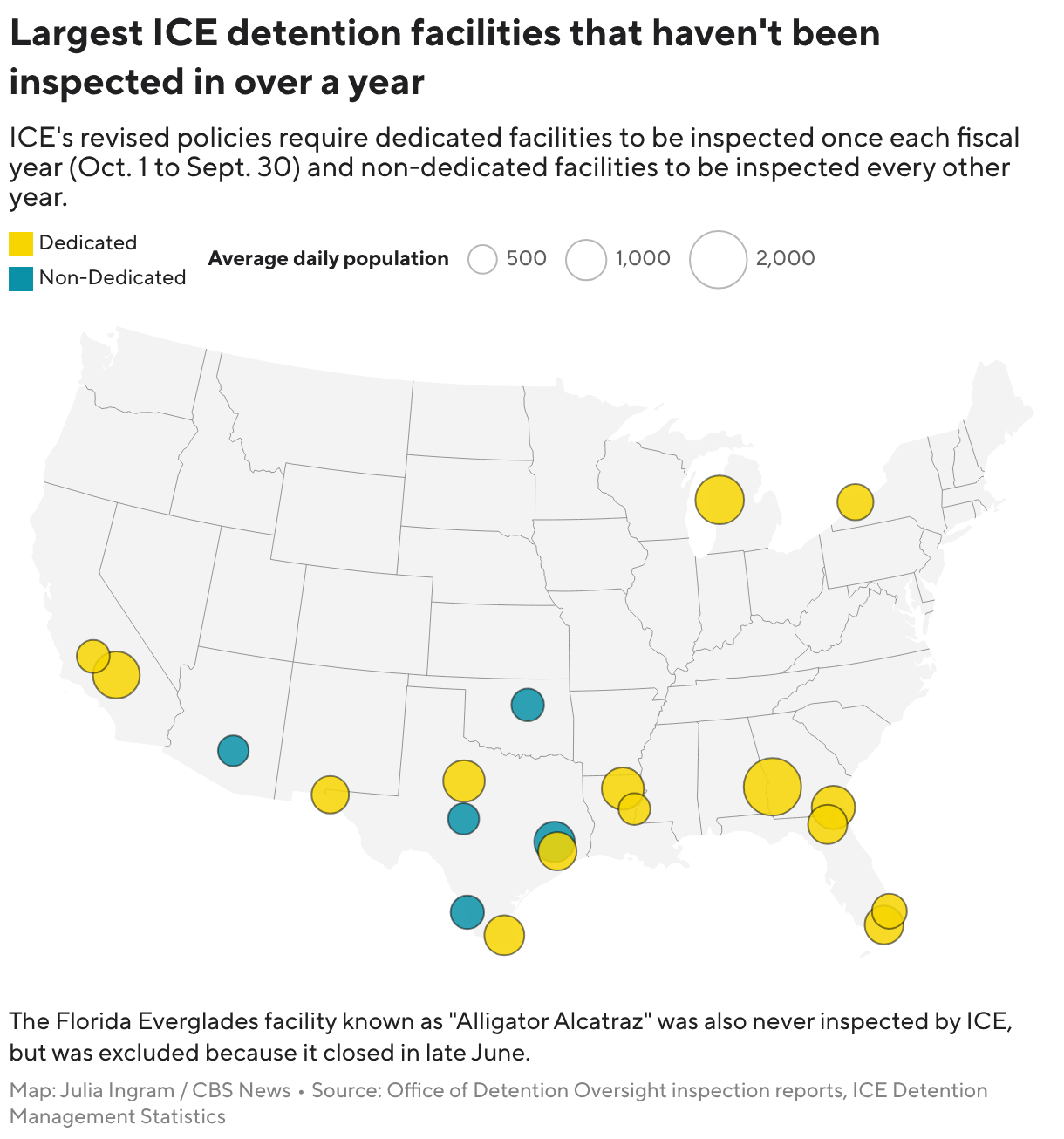
Fifteen of the 45 immigration detention facilities holding 500 or more people hadn't been inspected in over 12 months as of late June, while five had no inspection on record, a CBS News analysis of inspection reports found.
This follows a shift in Immigration and Customs Enforcement's policies from inspecting most of its facilities twice a year to once a year or once every two years. It's a move immigration custody experts said weakens an oversight mechanism that was already flawed.
"A lot of facilities have deficiencies and it takes frequent reassessments to ensure that those deficiencies are being addressed," said Dr. Annette Dekker, an assistant professor at UCLA's medical school who has studied health outcomes among immigration detainees and co-authored a 2024 paper calling for inspection reforms.
"It's concerning if now they're doing this less frequently, because that's a pretty big time gap between evaluations to just ensure that healthcare and other conditions are being met," Dekker told CBS News.
Concern about conditions in detention has mounted as the Trump administration's deportation crackdown has pushed the detention population to record heights. Deaths in ICE custody were at their highest rate since 2020 last year. In May, concerns about spoiled food and poor medical care sparked a hunger strike inside New Jersey's Delaney Hall and weeks of protests outside the facility. And last month, a government review found dangerous conditions at ICE's largest facility, Camp East Montana in El Paso.
Since 2019, ICE's inspections identified at least one deficiency in nearly 90% of inspections they carried out, ranging from staff failing to perform suicide checks often enough to not storing food at adequate temperatures or properly filing incident reports, CBS News' analysis found.
A Department of Homeland Security spokesperson defended the changes in inspection policy, telling CBS News that the "frequency of inspections is based on facility type, detention capacity, and operational function," and added that "ICE maintains a robust, multi-layered compliance program designed to promote compliance with ICE's contractually obligated detention standards."
Walking back reforms
After a DHS watchdog found in 2018 that ICE Office of Detention Oversight inspections were not frequent enough to ensure facilities remedied violations, Congress increased funding to require inspections twice a year by the end of fiscal year 2021.
That changed last year, when ICE moved to conduct annual inspections on dedicated facilities, or those that exclusively hold ICE detainees, and inspections every other year on non-dedicated facilities, such as county jails. It also added biennial "assisted self-inspections" for non-dedicated facilities holding fewer than 50 people, some of which were not previously regularly inspected.
Border czar Tom Homan told sheriffs in February 2025 that the administration was aiming to reduce the number of federal inspections in a move to encourage local law enforcement agencies to allow their jails to be used as detention facilities, Reuters reported. By April of this year, there were 203 facilities holding ICE detainees, up from 104 last February.
A DHS spokesperson told CBS News that the new framework allows ICE to "allocate oversight resources based on facility type and operational complexity."
The spokesperson emphasized that all dedicated ICE facilities, "regardless of population size," are scheduled for inspections this fiscal year, which ends Sept. 30. Under the new framework, they wrote, "smaller or non-dedicated facilities with limited detention populations and/or shorter-term detention functions receive biennial rated inspections," meaning every other year.
But some non-dedicated facilities hold just as many immigrants as dedicated facilities. Five of these facilities hold an average of more than 500 detainees, ICE data shows.
The budget measure passed in April that funded DHS outside of ICE and Customs and Border Patrol earmarked $20 million for immigration detention facility inspections by the agency's Inspector General, responsible for watchdog functions across DHS. The measure that funds those two agencies, passed this month, does not include requirements for ODO inspections.
'No question that more is better'
Even when ODO was inspecting facilities semiannually, a review by the Government Accountability Office found it lacked a way to determine whether its inspection program was effective at maintaining detainees' health and safety. Some say it wasn't.
"Often there are deficiencies noted at facilities without any repercussions," said Dekker, the UCLA physician and assistant professor. ODO refers to areas where facilities fall short of standards as deficiencies.
By law, ICE must terminate a facility's contract after two consecutive failures, but facilities have accumulated multiple significant deficiencies without failing an inspection, CBS News' analysis found.
Stewart Detention Center in Lumpkin, Georgia, for example, a dedicated contracted facility holding an average of about 2,000 people, received an "acceptable/adequate" rating at its most recent inspection in March 2025. Inspectors found 12 deficiencies, including two they labeled "priority components" pertaining to suicide prevention. Since then, two detainees have died by suicide, one last June and one in April, the county coroner told CBS News.
The DHS spokesperson pushed back on claims ICE does not hold facilities accountable, writing that "ICE works directly with the responsible field office and facility operator to correct identified deficiencies and bring the facility into compliance with ICE detention standards."
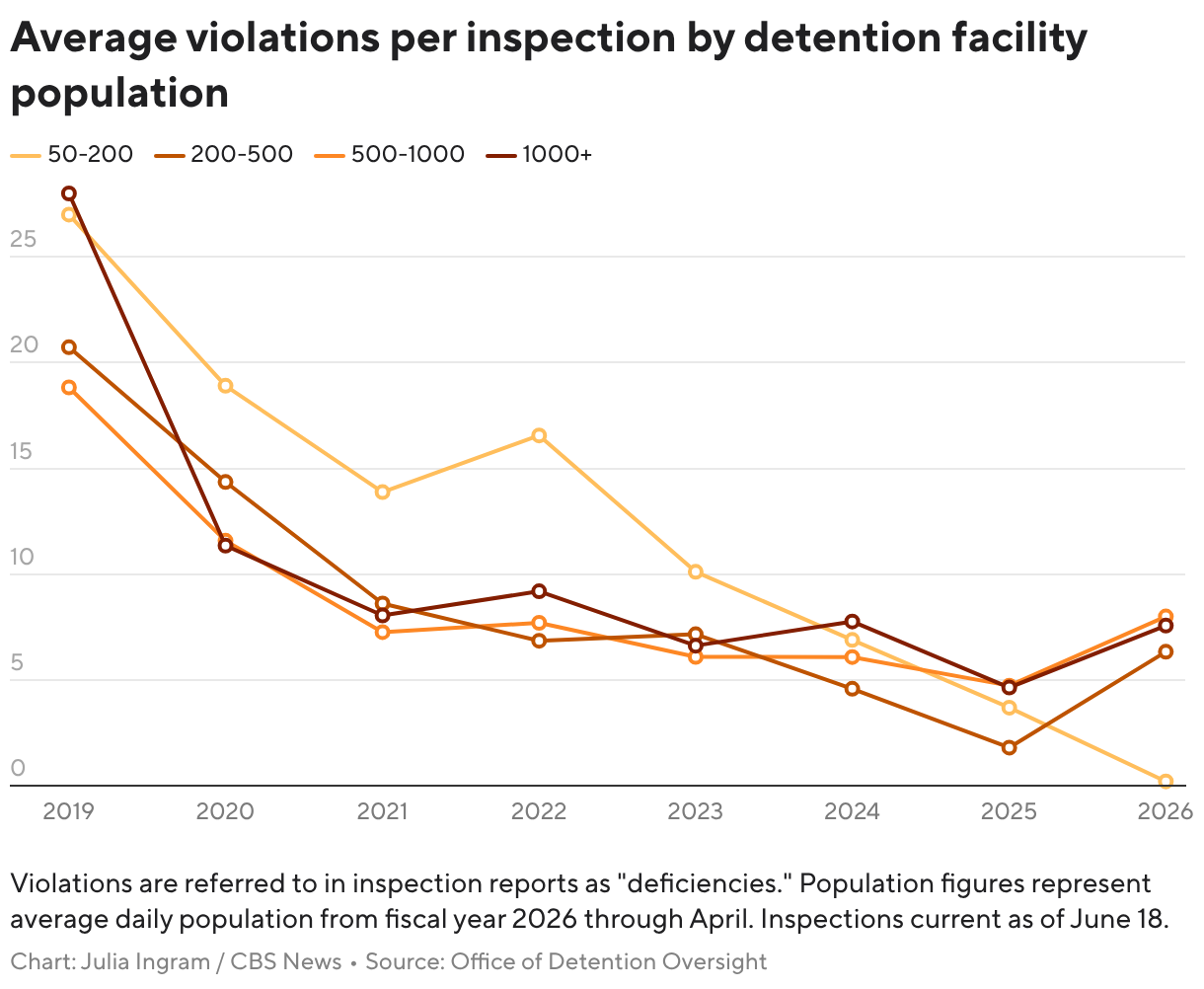
Inspectors have broadly found fewer deficiencies per inspection each year since 2019, when they started inspecting facilities twice a year, CBS News' analysis found. That trend continued in 2025, but so far this year, the number of deficiencies per inspection is trending upward for larger facilities.
Those included inspections that found more than 23 use-of-force violations at a facility in Natchez, Mississippi, and 22 at the El Paso detention center where inspectors outside DHS uncovered several health and safety issues. ODO's inspection of the family detention center in Dilley, Texas, also identified 16 deficiencies in the facility's education program for children.
Knowing an inspection is coming prompts facilities to "self-review," and sometimes rectify their own issues, said Margo Schlanger, who served as head of civil rights and civil liberties at DHS during the Obama administration.
"You want that to happen on a pretty regular cadence," she said. "Then the inspections themselves uncover things that are going wrong."
"There's just no question that more is better," she added. "And so when you make it less often, things can really go astray in between."
Dwindling oversight
The Department of Homeland Security also moved to cut other oversight mechanisms last year, including gutting the Office of the Immigration Detention Ombudsman and the Office for Civil Rights and Civil Liberties, which were responsible for investigating complaints of misconduct and abuse.
"People whose rights might previously have been protected are now vulnerable to serious medical neglect in detention, to abuse by guards in detention, to loss of their rights to fight fairly their immigration cases," said Anthony Enriquez, who is litigating a case against the government for dissolving the offices. "Where we might have seen those issues resolved at least individually for some people if a complaint was filed, we're no longer seeing that."
ICE also relaxed detention standards that apply to some facilities in June to "reduce the burden on our detention operators," including removing compensation requirements for detainee labor. Last year, ODO also allowed facilities operated by the U.S. Marshals (USMS) to operate under the USMS standards, a handbook one-third the length with fewer requirements in areas such as access to calls to legal counsel, accommodations for detainees with disabilities and how long detainees are allowed in disciplinary segregation.
"The guard rails are continuing to come off," said Dora Schriro, an expert in detention standards who served as a special adviser to former President Barack Obama's DHS secretary, Janet Napolitano. "I'm very concerned about what the ramifications are that we're not only capitulating to sheriffs but to U.S. Marshal as well."
ODO also allows USMS facilities to conduct "assisted self-inspections."
On average, USMS facilities reported many fewer deficiencies after switching to self-inspections or the new set of standards, CBS News found. Among the 26 facilities that have been inspected both before and after ICE began making these changes, ODO found an average of 12 deficiencies before the changes and an average of two after the changes.
Critics have also pointed to a lack of independence for ODO, which is housed within ICE, as hampering its ability to conduct adequate oversight.
"There's no reason to think that they're actually going to take a hard look at what the conditions are on the ground and make the required changes that would come from such an honest review," said Azadeh Erfani, director of policy at the National Immigrant Justice Center, a D.C.-based advocacy group that provides legal services to immigrants.
Some public officials have taken oversight into their own hands. A group of lawmakers sued ICE for access to conduct their own inspections, which sometimes surface more issues than ODO inspections do.
At the Adelanto ICE Processing Center, for example, California state inspectors found that medical and detention staffing levels were inadequate for the surge of detainees, and detainees reported they were unable to receive timely treatment, even in emergencies. At Adelanto's most recent ODO inspection in September 2025, officials recorded no medical deficiencies.
Four detainees in Adelanto have died since President Trump took office, three after the facility's most recent inspection. It's unclear when it will be inspected next.
"If [ICE is] looking to consolidate inspections or conduct fewer inspections without knowing what's working or how effective your current system is, it's hard to make those changes," said Heather MacLeod, director of Homeland Security and Justice Issues at the Government Accountability Office, which conducted the review of detention inspection practices in 2024. "While we haven't had a chance to review the effect of changing the inspections that ODO is conducting we would hope that they would have data to support such a decision to make that change."
About the data
To measure the frequency of inspections and number of deficiencies those inspections found, CBS News extracted and analyzed data from the Office of Detention Oversight inspection reports posted to ICE's webpage. As of July 8, the most recent posted inspection was completed on June 18, 2026. If an inspection occurred over multiple days, CBS News used the end date as the date of the inspection. To identify facilities holding 500 or more detainees each day, CBS News used ICE's most recent Detention Management Statistics, current as of early April, which include facilities' average daily population for the current fiscal year to date. The Florida Everglades facility known as "Alligator Alcatraz" was never inspected by ODO, but was excluded from the analysis due to its closure in June.