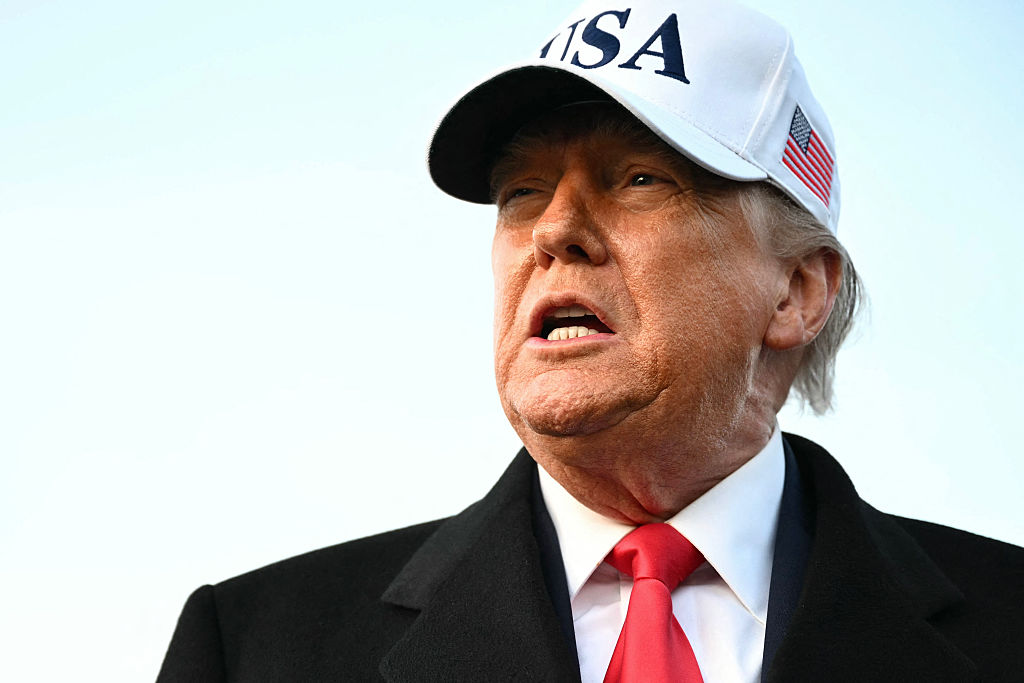
What is the "Golden Dome"? Here's what to know about Trump's missile defense plans
President Trump has said he wants to create a national missile system, which he's called the "Golden Dome for America," to protect the U.S. from foreign threats. But the plans are far from coming to fruition, and it would come with a steep price. Already though, China has criticized the plan as a threat that it says would increase the risks of militarizing space, and fuel a global arms race.
The president said his administration had "selected an architecture" for the "state-of-the-art system," which could cost hundreds of billions of dollars and put U.S. weapons in space for the first time in history.
In January 2026, Mr. Trump said a framework agreement he'd reached with America's NATO allies to defuse a standoff over his demands for the U.S. to take control of Greenland would include "a piece of" the Golden Dome being situated on the vast Arctic island.
Greenland is in a crucial location for U.S. defense, as any attack by America's biggest adversaries, be it with missiles, drones or ships, could be deployed across the Arctic, which is the shortest path from Asia to the U.S. East Coast.
What is the Golden Dome and how would it work?
The Golden Dome would be a multilayered defense system that the president has said will include "next-generation technologies" deployed on "land, sea and space, including space-based sensors and interceptors."
"The Golden Dome will be capable of intercepting missiles even if they are launched from other sides of the world and even if they are launched from space," the president said, adding that he wants it to be operational before his second term ends.
The concept includes capabilities that would defend against missiles by detecting and destroying them ahead of launch, intercepting them early in flight, halting them midcourse, and stopping them in the last few moments of approaching a target.
The initiative would have multiple layers that expand on what the U.S. already has and build new programs to counter the full range of aerial threats, according to Gen. Gregory Guillot, the head of U.S. Northern Command, who testified in front of Congress in April.
He described one layer of defenses that would track threats, and then two other layers: "The first being an ICBM (intercontinental ballistic missile) defeat layer, which largely exists today with the GBIs (ground-based interceptors) that can defeat a North Korean threat and then an air layer that would defeat cruise missiles and air threats."
"The time to intercept a missile is when it launches," retired Gen. Frank McKenzie, a CBS News contributor and former commander of the U.S. Central Command, told CBS News. He said that early in a missile's flight, it is on "a highly predictable" path, can't maneuver and can't deploy systems to spoof radars, making that the ideal time to disable it.
"And to do that, you really have to go into space. You have to have a space-based system to do that," McKenzie said. "That's very possible. We've looked at this at different times."
McKenzie said he hoped "that's where our thinking and our science is going to take us."
"This is not going to be off the cuff," Tom Karako, the director of the Missile Defense Project at the Center for Strategic and International Studies, told CBS News in an interview. "This is going to be well-rooted in the systems engineering and the understanding of the threat and in the overall architecture plans that have been in the works for a long time."
Sen. Dan Sullivan, a Republican from Alaska, told CBS News' Margaret Brennan in August 2025 that his state has long been home to key pieces of America's national missile defense infrastructure, and that he was working with the Pentagon on the development of plans for the Golden Dome.
"We have new threats. We have hypersonics, we have drones. We have, heck, even we've seen it here in Alaska, spy balloons. What we need to do is upgrade the system with what's called a layered defense, not just the ground based system here," Sullivan said. "You work it more with different systems, Aegis Ashore, THADD, and then including space-based systems — both for tracking and intercepting — and you do that with the open architecture in terms of software to integrate those systems."
How much will the Golden Dome cost?
The initiative, which will encompass many programs, will be built in states including Florida, Georgia, Indiana and Alaska, according to Mr. Trump, and involve multiple American defense and technology companies that have not yet been selected.
The Congressional Budget Office has estimated a cost of $542 billion for the space-based components alone.
"The cost is certainly a daunting thing," McKenzie said. "But on the other hand, the ability to defend the United States against a nuclear attack, not necessarily a massive Russian attack, but, you know, an attack from North Korea, an attack from Iran, a potential attack from a country like Pakistan, who's working to develop an ICBM. Those are all things that I think are feasible, and I think certainly are worth the cost that would be necessary to work the system."
Aerospace and defense company Lockheed Martin, which said on X that it was ready to support the dome mission, described it as a "revolutionary concept."
"This is a Manhattan Project-scale mission, one that is both urgent and crucial to America's security," the company said.
Lockheed Martin COO Frank St. John said it would protect against nuclear missiles as well as intermediate-range ballistic and cruise missiles, and other threats.
Mr. Trump said U.S. Space Force Gen. Michael Guetlein would be responsible for overseeing the dome's progress.
However, there is no funding yet to match the plan, which is "still in the conceptual stage," Air Force Secretary Troy Meink told senators at a hearing in May 2025. The Pentagon is also still developing the requirements that the dome will have to meet, The Associated Press reported.
Israel's Iron Dome
The Golden Dome idea first came to public light during Mr. Trump's joint address to Congress in March 2025, when he asked for funding for it.
"Israel has it, other places have it, and the United States should have it, too," he said.
The president was referring to Israel's Iron Dome defense system, which at least partially inspired the Golden Dome concept. Israel's system, installed in 2011 to defend against incoming projectiles, largely addresses shorter-range threats like rockets, while two other air defense systems work to defend against missiles.
The Iron Dome, developed with U.S. backing, has intercepted thousands of rockets and has a success rate topping 90%, according to Israel.
China responds
China's foreign ministry has called on the U.S. "to abandon the development and deployment of a global missile defense system as soon as possible."
"The United States, in pursuing a 'U.S.-first' policy, is obsessed with seeking absolute security for itself," a ministry spokesperson said last year. "This violates the principle that the security of all countries should not be compromised and undermines global strategic balance and stability. China is seriously concerned about this."
The spokesperson added that the Golden Dome plan, "heightens the risk of space becoming a battlefield" and "fuels an arms race."
"It's kind of humorous that the Chinese would talk about militarizing space, since I would guess they've done more work on militarizing space than any other nation in the world," McKenzie said. "I would argue this is an inherently defensive system, and it's designed to protect the United States from attack."
A U.S. Defense Intelligence Agency assessment shows that the U.S. military expects, over the coming decade, to contend with missile threats that are greater in "scale and sophistication." It also said that "China and Russia are developing an array of novel delivery systems to exploit gaps in the current U.S. ballistic missile defenses."
China has rapidly developed its missile and other military capabilities, while deepening ties with Russia. The two nations said in a joint statement in 2025 that the dome project was "deeply destabilizing in nature" and would turn space into "an arena for armed confrontation."
Karako said that the Golden Dome initiative was "a belated realignment of U.S. missile defense policy" to counter both China and Russia.
"Could [the Golden Dome] launch another spiral of offensive developments to try to break through?" McKenzie said. "Certainly that's possible. And I recognize that's a possibility. Having said that, I still think it's an objective worth pursuing."