Clinton steps in as Israel-Gaza truce deal put on hold
JERUSALEMA diplomatic push to end Israel's nearly weeklong offensive in the Gaza Strip gained momentum Tuesday, with Egypt's president predicting that airstrikes would soon end, the U.S. secretary of state racing to the region and Israel's prime minister saying his country would be a "willing partner" to a cease-fire with the Islamic militant group Hamas.
As international diplomats worked to cement a deal, a senior Hamas official said an agreement was close even as relentless airstrikes and rocket attacks between the two sides continued. The Israeli death toll rose to five with the deaths Tuesday of an Israeli soldier and a civilian contractor. More than 130 Palestinians have been killed.
CBS "Evening News" anchor Scott Pelley noted things looked frosty between U.S. Secretary of State Hillary Rodham Clinton and Israeli Prime Minister Benjamin Netanyahu. She had just flown ten hours, leaving behind President Obama behind on a tour of Cambodia to speak with the Israeli leader about the escalating conflict.
"The goal must be a durable outcome that promotes regional stability and advances the security and legitimate aspirations of Israelis and Palestinians alike," she said at a news conference with Netanyahu. Clinton spent over two hours speaking with the prime minister and other Israeli officials.
Netanyahu said Israel would welcome a diplomatic solution to the crisis but threatened further military activity, saying he was ready to take "whatever action" is necessary.
State officials said Clinton will head to Ramallah in the Palestinian-governed West Bank Wednesday morning and the head to Cairo midday.
The comments came after conflicting reports on whether a deal was imminent.
CBS News correspondent Clarissa Ward said an unnamed adviser to Egyptian President Mohammed Morsi had said Morsi would announce a cease-fire agreement Tuesday night in Cairo, where talks are being held. Nearly an hour after the expected time of the announcement, the adviser said it wasn't going to happen Tuesday night.
A spokesperson for Morsi's party, the political wing of the Muslim Brotherhood in Egypt, later said the delay was due to an Israeli request to postpone the announcement until Wednesday.
Earlier Tuesday, a source close to the Hamas delegation in Cairo told Ward that he believed some agreement would be reached "within a few hours."
- Timeline of recent Israel-Gaza violence
- Hamas kills suspected collaborators with Israel, witnesses say
- Children living near Gaza strip showing psychological toll
According to the source, Israel wants Hamas to stop rocket fire for an initial 24 hours, and then the Jewish state would theoretically meet some of the militant group's demands.
Ward notes, however, that previous remarks from diplomats suggesting a deal was near have proven premature, as Israel is reluctant to accept Hamas' key demand that a blockade on the Gaza Strip be lifted. Isreal fears that lifting the blockade would allow more weapons to flow into the Palestinian territory.
Israeli officials said only that "intensive efforts" were under way to end the fighting. Israeli media quoted Defense Minister Ehud Barak as telling a closed meeting that Israel wanted a 24-hour test period of no rocket fire to see if Hamas could enforce a truce.
The U.N. Security Council said it would hold an open debate on the crisis if a cease-fire was not called by Wednesday.
In what appeared to be a last-minute burst of heavy fire, Israeli tanks and gunboats shelled targets late Tuesday, and an airstrike killed two brothers riding on a motorcycle. The men weren't identified.
Egyptian President Mohammed Morsi, perhaps the most important interlocutor between Hamas, which rules the Palestinian territory, and the Israelis, said the negotiations between the two sides would yield "positive results" during the coming hours.
Israel demands an end to rocket fire from Gaza and a halt to weapons smuggling into Gaza through tunnels under the border with Egypt. It also wants international guarantees that Hamas will not rearm or use Egypt's Sinai region, which abuts both Gaza and southern Israel, to attack Israelis.
Hamas wants Israel to halt all attacks on Gaza and lift tight restrictions on trade and movement in and out of the territory that have been in place since Hamas seized Gaza by force in 2007. Israel has rejected such demands in the past.
In Brussels, a senior official of the European Union's foreign service said a cease-fire would include an end of Israeli airstrikes and targeted killings in Gaza, the opening of Gaza crossing points and an end to rocket attacks on Israel. The official spoke on condition of anonymity because he was not authorized to speak to the media.
Violence raged on as the talks continued. An airstrike late Tuesday killed two journalists who work for the Hamas TV station, Al-Aqsa, according to a statement from the channel. The men were in a car hit by an airstrike, Gaza health official Ashraf al-Kidra said. Israel claims that many Hamas journalists are involved in militant activities. Earlier this week it targeted the station's offices, saying it served as a Hamas communications post.
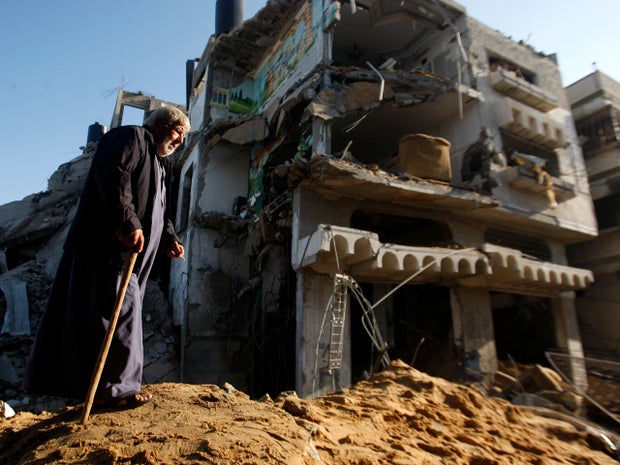
By Tuesday, 133 Palestinians, including at least 54 civilians, were killed since Israel began an air onslaught that has so far included nearly 1,500 strikes. Some 840 people have been wounded, including 225 children, Gaza health officials said.
Five Israelis, including an 18-year-old soldier and a civilian contractor who worked for the military struck by rocket fire Tuesday, have also been killed and dozens wounded since the fighting began last week, the numbers possibly kept down by a rocket-defense system that Israel developed with U.S. funding. More than 1,000 rockets have been fired at Israel this week, the military said.
CBS correspondent Charlie D'Agata reported that in the streets of Gaza, militants shot dead six Palestinians suspected of collaborating with Israel. One body was dragged through the street as people cheered.
Late Tuesday, a Palestinian rocket hit a house in the central Israeli city of Rishon Lezion, wounding two people and badly damaging the top two floors of the building, police spokesman Micky Rosenfeld said. In other violence, a 60-year-old Israeli woman was seriously wounded in a firebombing attack as she drove in the West Bank, police said.
With the death toll rising, the international community stepped up efforts to bring a halt to the fighting that began last Wednesday with an Israel's assassination of the Hamas military chief.
"If a long-term solution can be put in place through diplomatic means, then Israel would be a willing partner to such a solution. But if stronger military action proves necessary to stop the constant barrage of rockets, Israel wouldn't hesitate to do what is necessary to defend our people," Netanyahu said during a joint press conference in Jerusalem with visiting U.N. chief Ban Ki-moon.
Ban condemned Palestinian rocket attacks, but urged Israel to show "maximum restraint."
"Further escalation benefits no one," he said.
Minutes before Ban's arrival in Jerusalem from Egypt, Palestinian militants fired a rocket toward Jerusalem, just the second time it has targeted the city. The rocket fell in an open area southeast of the city.
Jerusalem had previously been considered beyond the range of Gaza rockets -- and an unlikely target because it is home to the Al-Aqsa Mosque compound, Islam's third-holiest shrine.
Earlier Tuesday, a man identified as Hamas' militant commander urged his fighters to keep up attacks on Israel. Speaking from hiding on Hamas-run TV and radio, Mohammed Deif said Hamas "must invest all resources to uproot this aggressor from our land," a reference to Israel.
Israeli warplanes dropped leaflets on several Gaza neighborhoods asking residents to evacuate and head toward the center of Gaza City along specific roads. The army "is not targeting any of you, and doesn't want to harm you or your families," the leaflets said. Palestinian militants urged residents to ignore the warnings, calling them "psychological warfare."
The Israeli military relies on a network of informants to identify its targets. Masked gunmen publicly shot dead six suspected collaborators with Israel in a large Gaza City intersection Tuesday, witnesses said. An Associated Press reporter saw a mob surrounding five of the bloodied corpses shortly after the killing.
Clinton was also scheduled to meet with Palestinian President Mahmoud Abbas in the West Bank and Egyptian leaders in Cairo on Wednesday. Turkey's foreign minister and a delegation of Arab League foreign ministers traveled to Gaza on a separate truce mission. Airstrikes continued to hit Gaza even as they entered the territory.
"Turkey is standing by you," Turkish Foreign Minister Ahmet Davutoglu told the Hamas prime minister in Gaza, Ismail Haniyeh. "Our demand is clear. Israel should end its aggression immediately and lift the inhumane blockade imposed on Gaza."
It was unclear how diplomatic efforts to achieve a cease-fire and stave off a threatened Israeli ground invasion into Gaza were hampered by the hard-to-bridge positions staked out by both sides -- and by the persistent attacks. Thousands of Israeli soldiers have been dispatched to the Gaza border in case of a decision to invade.
The U.S. considers Hamas, which has killed hundreds of Israelis in suicide and other attacks, to be a terror group and does not meet with its officials. The Obama administration blames Hamas for the latest eruption of violence and says Israel has the right to defend itself. At the same time, it has warned against a ground invasion, saying it could send casualties spiraling.
The conflict erupted last week, when a resurgence in rocket fire from Gaza set off the Israeli offensive, which included hundreds of airstrikes on militants' underground rocket launchers and weapons' stores.
The onslaught turned deadlier over the weekend, as airstrikes began targeting the homes of suspected Hamas activists, leading to a spike in civilian casualties. Hamas is deeply rooted in densely populated Gaza, and the movement's activists live in the midst of ordinary Gazans. Israel says militants are using civilians as human shields, both for their own safety and to launch rocket strikes from residential neighborhoods.
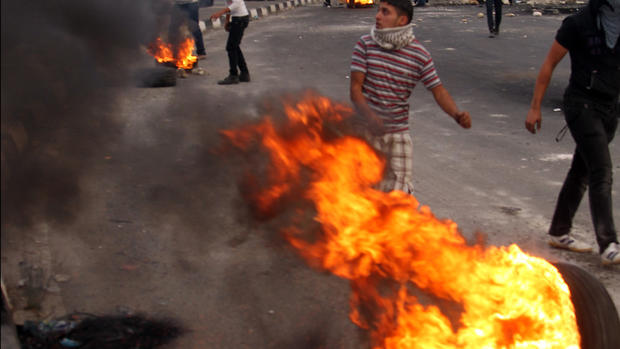
The conflict showed signs of spilling into the West Bank, as hundreds of Palestinian protesters in the town of Jenin clashed with Israeli forces during a demonstration against Israel's Gaza offensive.
Two Palestinian protesters were killed in anti-Israel demonstrations in the West Bank on Monday, according to Palestinian officials. Separate clashes occurred Tuesday in Ramallah, the seat of the Palestinian government, during the funeral for one of the dead.
Palestinian President Mahmoud Abbas, who lost control of Gaza to Hamas in 2007, now governs from the West Bank. Abbas claims to represent both areas, and there is widespread sympathy among West Bank Palestinians for their brethren in Gaza.