Cain, Perry tax plans could be gift to Obama
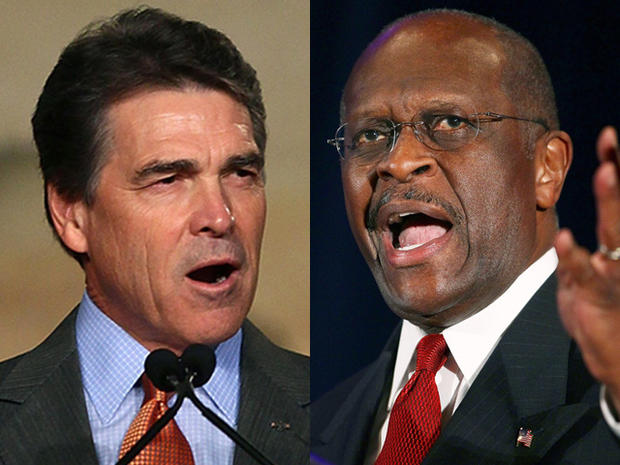
If President Obama loses his reelection bid next year, it will almost certainly be due to the state of the economy. In the CBS News/New York Times poll out this week, 86 percent of Americans said the economy is in bad shape - no surprise with unemployment at 9.1 percent and economic growth continuing to lag in the wake of the 2008 financial crisis. And while Americans are more likely to blame the Bush administration than the Obama administration for the state of the economy, the current occupant of the White House isn't exactly getting rave reviews.
In the new poll, just 39 percent said they approve of Mr. Obama's handling of the economy. When it comes to his handling of job creation, just 35 percent approve of his performance. It's no wonder that Republican presidential candidates like Rick Perry are focusing on their ability to revive the economyin making their case to the American people.
Yet Perry and many of his GOP rivals for the Republican nomination aren't exactly embracing the economic policies the American people say they want. On Tuesday, Perry unveiled an optional flat plan that would amount to an income tax cut for high earners. (Those who would not save money under a 20 percent flat tax - generally lower-income individuals - could stick with the old tax code.) Perry's plan also eliminates taxes on dividends and capital gains, investment taxes that generally affect the wealthiest Americans, and cuts the corporate tax rate to 20 percent.
It would be a boon to the wealthy that might have even been too much for former President Ronald Reagan, who argued that capital gains should be taxed at the same rate as regular income. It also goes against the wishes of most Americans. In the new CBS/NYT poll, 65 percent of Americans said households earning a million dollars per year or more should see their taxes raised - not lowered. And only 27 percent backed a corporate tax cut, while 67 percent opposed such a cut.
Perry is far from alone in promoting a tax policy that doesn't square with the preferences of most Americans. Herman Cain had to modify his "9-9-9" tax plan after being hammered over findings that it would mean a tax hike on more than three-quarters of Americans and a tax cut for the wealthiest. (Even under the modified plan, which exempts Americans under the poverty line from paying income tax, higher-income individuals will see a tax cut.) Cain's plan also includes a national sales tax, and while there is not much polling on that question, it sure doesn't seem very popular.
The top-tier candidate who has not proposed a dramatic tax cut for the top earners is also the one who seems to already be looking ahead to the general election. Like his rivals, Mitt Romney wants to eliminate taxes on dividends and capital gains - but only for those making under $200,000 for year. And Romney has not only rejected a full out flat tax, he once suggested Steve Forbes' flat tax proposal, which is similar to Perry's, is designed to help out "fat cats." Romney does want to "make the tax code more flat," but he doesn't go nearly as far as Perry or Cain in seeking to make the tax code less progressive.
The polls suggest that the more moderate position would put Romney in a better position in a head-to-head match-up with Mr. Obama. Sixty-six percent of Americans said in the new CBS/NYT poll that money and wealth should be distributed more evenly among income groups, including 67 percent of independents. These voters presumably do not look positively on efforts to lower taxes on the rich.
But Romney has to get through the Republican primary first, and the poll also found that a majority of Republicans both believe that income is distributed fairly and oppose a tax increase on millionaires. These are not the voters who get tripped up by questions of income inequality; they're largely more concerned with simplifying the tax code, and on that front, Cain and Perry would seem to have the advantage over Romney, whose economic plan comes with 59 points.
The potential pitfall for Perry and Cain is that their play to GOP primary voters could cost them dearly if they get to the general election -- on an issue that is both voters' chief concern and Mr. Obama's biggest weakness. Both Perry and Cain argue their plans would ultimately help the economy overall, not just the rich. But two in three Americans already say Republicans in Congress favor the rich over everyone else, and a tax plan that includes a tax cut for the top tier only furthers the notion that the GOP is working on behalf of the wealthy.
The Obama campaign, which does not want the election to be a referendum on the president, is already trying to define the GOP tax plans as putting the rich ahead of the middle class. Perry and Cain's plans play right into their hands. Romney, who already has something of a rich guy image problem, doesn't want to follow suit.
Which is why you can expect him to resist pressure to shift rightward on taxes unless his rivals gain enough traction to force his hand. Romney is well aware that while plans like Perry and Cain's win applause from debate audiences - and the endorsement of folks like Rush Limbaugh - they probably aren't going to help Republicans keep Mr. Obama from a second term.