CT scans helping researchers in fight against invasive species in Minnesota waterways

The University of Minnesota and the Bell Museum now have a new tool that could help battle invasive carp.
Researchers believe a giant Nikon CT scanner could be a gamechanger.
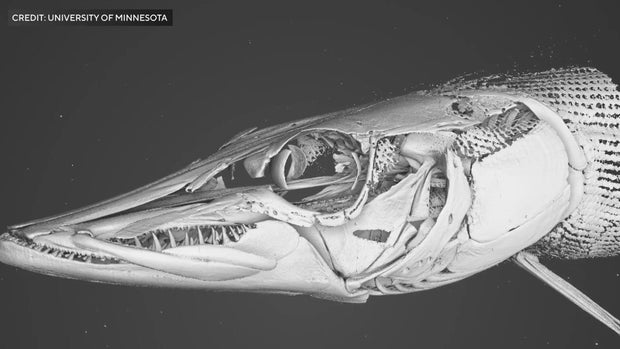
"It essentially takes a whole bunch of X-rays in a vertical view as the specimen rotates around," said Dr. Kassandra Ford.
For Ford, this changes everything. Rather than dissecting specimens, the scanner keeps them in one piece, while allowing Ford to look through the specimens in a way she never could before. The X-rays eventually lead to an image.
"Then, the computer does a whole bunch of complex math to turn that into a 3D object," Ford said.
She said the results are incredible. She's been able to look at animals that have been around for hundreds of millions of years to learn about their evolutionary history.
"The bat skull was a very, very cool thing to see up in 3D," she said.
Part of the idea behind this is to learn how the skulls of invasive species, like some carp, have evolved over time, and to see if there's a way to keep them from getting into Minnesota waterways.
"To figure out especially if there are certain acoustic sounds or noise frequencies that these fishes might be able to hear that are native fishes cannot hear," Ford said. "And then we can, essentially, produce that sound that makes the carp not want to be in that area."
She said that's just one of dozens of examples researchers are exploring.
"It's something that's really going to help me do my research and really help students do their research as well as we move forward," Ford said.
U researchers believe they will now be able to scan up to 3 million specimens at the Bell Museum in St. Paul, including insects, birds, reptiles and mammals.


