University of Minnesota scientists create first synthetic cell that can complete a life cycle
Scientists at the University of Minnesota say they've made the first synthetic cell that can complete a life cycle, a major breakthrough that could lead to innovation in the medicine and engineering fields.
Called SpudCell — a play on the first space satellite Sputnik — it is made entirely from chemical components but can grow, divide and replicate.
"We've replicated in chemistry what only used to be possible in biology: the complete set of behaviors of a cell. It proves that the most fundamental functions of life, like growth and replication, do not need a mysterious, magical spark," said Associate Professor Kate Adamala, who worked on the project with Aaron Engelhart.
Adamala said that it is "likely the most exciting project I've ever worked on."
While the human genome is roughly 3 million kilobase pairs in size, the SpudCell is a minuscule 90 kbp, Adamala said. Instead of dividing like a natural cell, it splits under mechanical stress when proteins come together at the surface. There is also evidence that the cell is capable of selection.
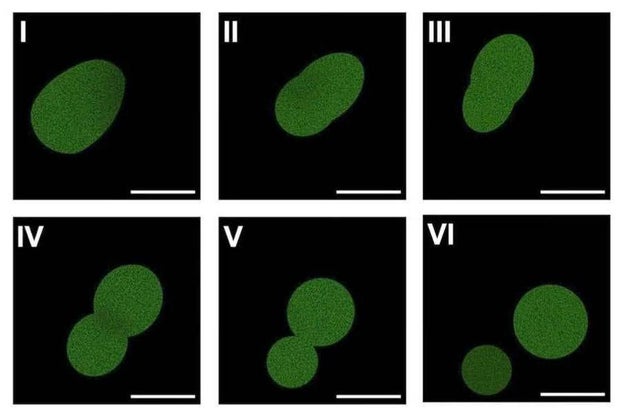
The results of the study, which are outlined in a 190-page paper, could revolutionize the way scientists develop medicines and industrial materials, the university says. Typically, molecular transformations require altering natural cells or using industrial chemistry, which comes with huge energy costs.
"The long term promise of this is to be able to do a lot of the same things that we can do with biotechnology right now in a lot more controlled way," said Engelhart.
In order to continue work on the project, Adamala and several external partners are launching a public-benefit research and engineering institution that can help share and scale the technology. They are hoping that the global scientific community participates in the project.


