How is wind chill calculated?

It might be hard to believe, but it's gotten warmer outside over the past few days. The temperature is creeping above zero during the day, but the wind chill remains dangerously low.
So, how is wind chill calculated?
Let's start with a real-life example. A cup of coffee, like a human, radiates heat. If you blow on the cup of coffee, it will cool down. That's similar to what the wind outside does to people. It draws heat away from the body while lowering the temperature on the skin and eventually in the body. That makes it feel colder than the actual air temperature.
An air temperature of 0 with a wind speed of 15 mph would create a wind chill value of -19. So, what's the equation to reach that number?
"The original equation was done in 1939 in Antarctica," said Pete Boulay, a climatologist with the Minnesota Department of Natural Resources. "They experimented with bottles of water and how quickly they froze and that was the calculation used for many, many years."
In 2001, the National Weather Service and Environment Canada created a more accurate equation for wind chill.
"They recalculated the formula using people on treadmills with sensors attached to their face. So, they were living experiments doing what they could for science, and they used the new formula based on that," said Boulay.
Here's the new formula for wind chill: 35.74 + .06215T - 35.75(V0.16) + 0.4275T(V0.16). The two most important variables are temperature (T) and wind speed (V).
Wind speed is first measured at 33 feet above the ground, like usual, but for wind chill, it's then recalculated to 5 feet above the ground because that's the typical height of an adult human's face. It also ignores any impact from the sun
The National Weather Service also made a chart that does the math for you.
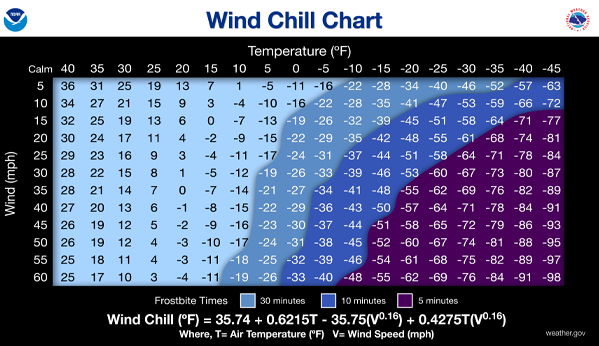
Take the air temperature on the top and the wind speed from the left, then see where the two numbers meet to know the wind chill value.
But which variable is most impactful, the wind speed or air temperature?
"What (the NWS) found is the colder it gets, the air temperature itself is a huge factor. So, -20 or -30 air temperature is big," said Boulay.
A windy day when it's 75 degrees outside isn't as impactful as a windy day when the temperature is below zero.