SpaceX's giant Super Heavy-Starship rocket blasts off on key test flight
SpaceX launched its 13th Super Heavy-Starship rocket Friday, with the giant booster chalking up an on-target but "hard" splashdown off the Texas Gulf Coast due to engine issues while the Starship upper stage carried out a successful suborbital hop to the Indian Ocean.
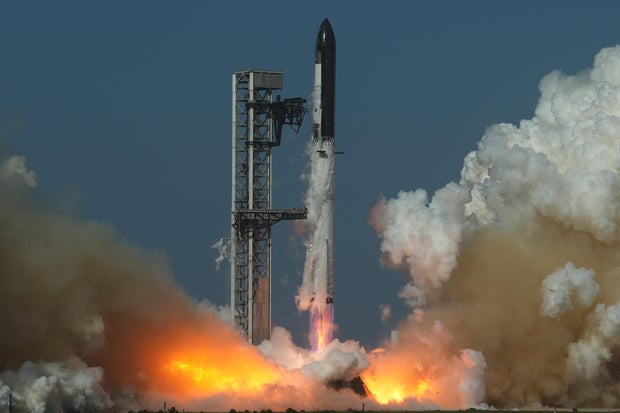
Powered by 33 methane-fueled Raptor engines, the 397-foot-tall two-stage rocket blasted off from SpaceX's Starbase, Texas, launch site at 5:51 p.m. ET, putting on a spectacular show for area residents and tourists as it climbed away atop some 16 million pounds of thrust.
A launch attempt July 16 ended with a last-second computer-commanded abort when four Raptors failed to start properly. After an analysis of telemetry, six engines were replaced and the launch was reset for Thursday, only to have low clouds prompt a 24-hour delay.
But the weather cooperated Friday, all 33 first-stage engines fired up normally, and the rocket thundered away through a mostly clear sky.
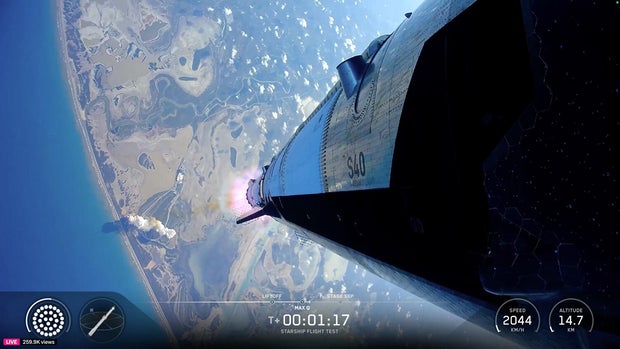
It was the second test flight of a third-generation Super Heavy-Starship, building on lessons learned during the initial flight of a "V3" rocket in May when the booster missed its landing target, and the Starship suffered an early engine shutdown on the way to space.
This time around, the booster performed as planned throughout its ascent and again during a flip to line up for a "boostback" burn to reverse course and head back toward the coast.
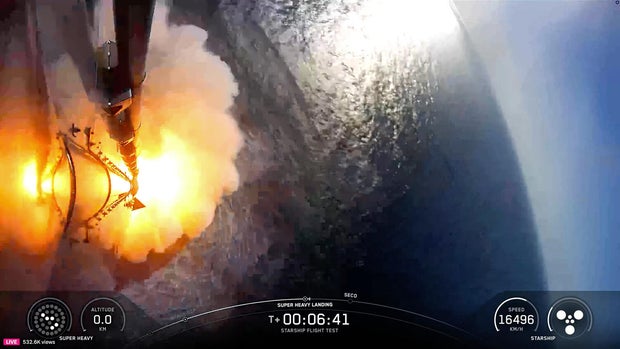
But the boostback burn ended early, SpaceX later said. Then, as the booster dropped toward the Gulf, only 10 of 13 engines restarted to slow the rocket down for splashdown. Only five engines appeared to be running when the booster hit the water at a higher speed than expected.
The booster is designed to fly itself back to its launch gantry where huge mechanical arms, known as "chopsticks," can pluck it out of midair. But that requires a relatively slow final descent. For good reason, it now appears, SpaceX opted for initial version-3 splashdowns in the Gulf as a safety precaution.
The Starship upper stage, meanwhile, continued its climb to space with all six of its Raptor engines operating smoothly.
Once coasting along its suborbital trajectory, the Starship deployed 20 third-generation Starlink internet satellites in a real-world test of the rocket's Pez-like payload dispenser, releasing the satellites one at a time from a slot near the nose of the vehicle.
Six of those satellites were equipped with cameras to inspect the Starship's heat shield tiles and general condition to help engineers assess the usefulness of such video for determining the health of future Starships before reentry.
In a final test, the Starship briefly reignited one of the Raptor engines to demonstrate its ability to restart in space, which will be required for future flights to the moon.
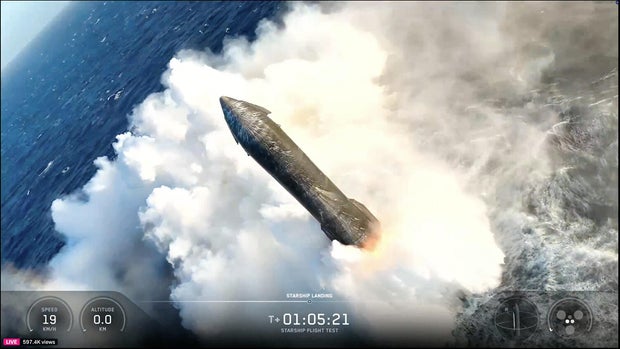
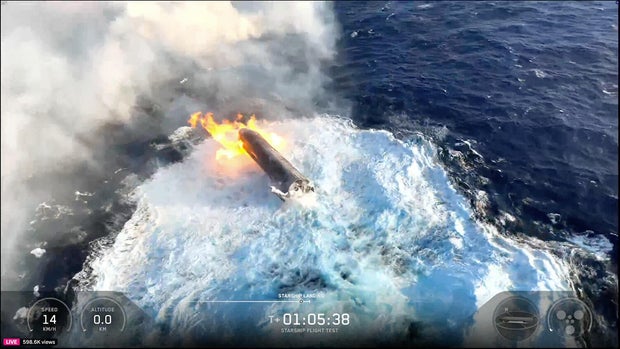
The spacecraft then faced the blazing heat of a belly-first reentry before flipping upright and settling to a dramatic rocket-powered splashdown northwest of Australia 1 hour and 5 minutes after launch.
The Starlinks, on the same suborbital trajectory as the Starship, were expected to fall back into the atmosphere and burn up — or as SpaceX puts it, "demise" — before reaching the sea.
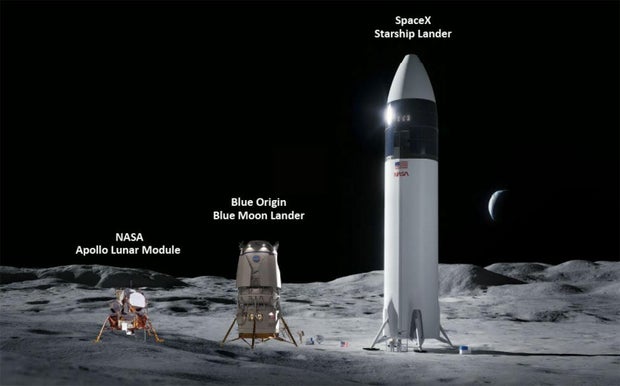
Engine issues aside, the Starship's performance was welcome news to NASA, which is counting on a variant of the upper stage to serve as a lunar lander for astronauts in the agency's Artemis program.
For moon missions, SpaceX will need to launch up to 15 or so Super Heavy-Starship tankers to refuel the lander before it can head for the moon to await the arrival of astronauts in a Lockheed Martin-built Orion capsule.
From there, the 165-foot-tall lander will carry two crew members down to the surface, landing vertically near the moon's south pole. The astronauts will then ride an external elevator down to the surface and back up again when their exploration is complete.
With the first such landing targeted for 2028, SpaceX must ramp up its Super Heavy-Starship test schedule to get the vehicle certified for human spaceflight and to demonstrate the reliability required to safely launch more than a dozen tankers within days of the lander's launch.
As of now, the moon lander variant has not yet flown, and no Starship of any kind has yet been put into Earth orbit. Many NASA veterans have criticized the complexity of the mission architecture and the number of flights that will be needed to get a single lander to the moon.
The Government Accountability Office said in a report released Thursday that SpaceX faces major challenges getting the Super Heavy-Starship ready for operational use.
"SpaceX's progress in developing its cryogenic fuel management technologies is a top risk for the program," the GAO said. "At present, SpaceX's plan for (moon missions) requires on-orbit propellant transfer between multiple Starship vehicles in low-Earth orbit before the HLS (Human Landing System) Starship can be sent to and dock with the Orion spacecraft in lunar orbit."
Another concern is completing development of the upgraded Raptor engines, the GAO said, "addressing issues identified through testing."
"Furthermore, SpaceX is more than a year behind its original schedule for key events," the GAO said. "These include the critical design review, the long duration and propellant transfer demonstrations and the uncrewed lunar landing flight test."
The agency said moon lander officials "also stated that they anticipate encountering technical challenges in the development of the third version of the Starship vehicle, which SpaceX plans to use for the first Starship orbital test flights."
NASA managers are hedging their bets.
Blue Origin, owned by Amazon founder Jeff Bezos, is also working on moon landers for NASA to carry both cargo and Artemis astronauts to the lunar surface. The spacecraft will be launched by the company's New Glenn rocket. That lander, too, will require refueling in space.
If the Starship lander isn't ready in time to meet NASA's landing target, the agency may be able to use Blue Origin's lander instead.
But during preparations to test-fire the main engines of the third New Glenn rocket, the launcher exploded in a spectacular fireball, virtually vaporizing the rocket and seriously damaging its pad. The company hopes to resume test flights by the year's end, but few details have been provided.
In the meantime, NASA is pressing ahead with preparations for an interim Artemis flight next year in low-Earth orbit. Four astronauts will be launched in an Orion capsule to test the rendezvous and docking procedures that will be needed in lunar orbit for a moon landing mission.
The crew will dock with a Blue Origin lander, open hatches and float inside as part of the test flight. They then will rendezvous and dock with a Starship. But in that case, a modified production model will be used instead of an actual moon lander. It will have no crew accommodations and the astronauts will not go inside.