Sargassum seaweed taking over South Florida beaches as scientists race to track blooms

South Florida beachgoers are already seeing and smelling an unusually heavy influx of sargassum washing ashore this season.
At Dania Beach, Joyanne Miller said a recent outing with friends quickly turned unpleasant after they encountered thick mats of seaweed covering the shoreline.
"All I could see was seaweed," Miller said. "I tried to go out a little bit, there were bugs everywhere. They're just jumping up out of the seaweed."
NOAA increasing satellite tracking of sargassum blooms
Experts estimate roughly 10 million metric tons of sargassum are already floating across parts of the Atlantic Ocean, with some of it now blanketing South Florida beaches.
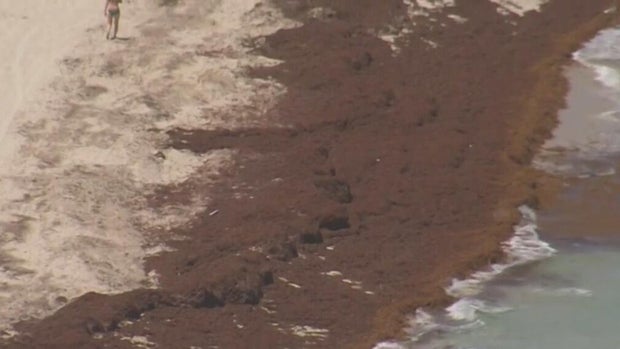
When the brown seaweed begins to dry, it can produce a strong odor and attract pests and bacteria, creating concerns for tourism and cleanup crews alike. Officials say coastal communities can spend millions of dollars removing the algae from beaches each year.
"It's so much worse than the last few years," Miller said. "I haven't seen this much seaweed ever."
The National Oceanic and Atmospheric Administration is now increasing how often it tracks sargassum blooms by satellite. Instead of weekly updates, the agency is now issuing daily estimates to help communities better prepare for incoming seaweed.
"We are able to have a better spatial resolution from 5km resolution to 1km resolution with better quality," NOAA research oceanographer Matthieu Le Henaff said. "We have a better way of telling whether it's actually sargassum that we see or it's something else."
FIU researchers exploring ways to turn sargassum into useful products
Meanwhile, researchers at Florida International University are looking at ways to repurpose the seaweed instead of simply throwing it away.
Scientists say sargassum contains alginate, a natural ingredient commonly used to stabilize and thicken foods such as ice cream, sauces and milk alternatives. Researchers are using high-pressure processing techniques to extract the compound while removing contaminants.
"If we can turn it into something useful, we shift the conversation from disposal to opportunity," said Dr. Imran Ahmad, a food science and technology research professor at FIU and co-author of the study.
Researchers said sargassum is not currently classified as a food source, and more research and funding will be needed before products using it can receive regulatory approval.
Miller said she supports the idea of finding new uses for the seaweed.
"I think that's a great way to reuse it and use what the Earth gives us," she said.