First officer warned that Amazon cargo plane was coming in too fast before deadly Miami crash, NTSB says

The first officer of an Amazon Cargo plane that overran a runway at Miami International Airport last month and struck two vehicles, killing five people on the ground, warned several times that the plane was coming in too fast during its approach, the National Transportation Safety Board stated in its preliminary report Thursday.
The report found that the plane's captain called for a go-around, or a second landing attempt, after the plane had landed and was moments away from crashing.
It also revealed it was the first day that the two pilots, the captain and first officer, had flown together, and there were strong winds during landing because of thunderstorms in the area.
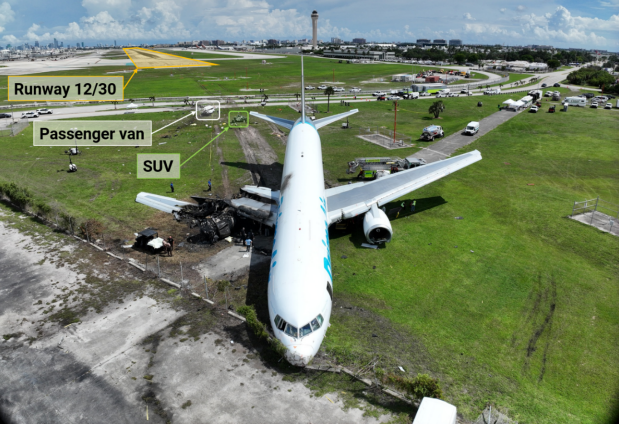
According to the report, 21 Air Flight 7598, a Boeing 767-33A freighter operating on behalf of Amazon, landed on Runway 30 from San Juan, Puerto Rico, at 1:53 p.m. local time on Sept. 6 and overran it. The plane hit an airport perimeter fence, crossed a street and came to rest about 1,200 feet from the end of the pavement, the report said.
The plane first hit a Ford Econoline passenger van on an airport perimeter road. Five of the seven people in the van were killed, and the other two were seriously injured. The plane then struck a Toyota Corolla Cross SUV on Northwest 67th Avenue, and its only occupant was seriously injured.
The captain and first officer, the only two people aboard, escaped with minor injuries.
The 12-page report did not state a conclusion as to why the crash occurred. The NTSB's final report will likely take between one and two years to release.
21 Air, a cargo airline headquartered in Greensboro, North Carolina, operates just under two dozen Boeing 757 and 767 airplanes. In a statement provided to CBS News Miami in response to the report, it said it would "continue to work closely with the NTSB as a party to the investigation and will do so until its investigation is complete."
"We are reviewing the information in the NTSB preliminary report closely, alongside our own internal safety and operational protocols, and we will take all appropriate action to improve our safety based on the facts as they are established," 21 Air said.
NTSB notes excess speed during the plane's landing
According to the flight recorders, as the plane was approaching to land, the first officer cautioned they were coming in too fast.
The first officer "made additional comments regarding the airplane's excessive speed throughout the remainder of the recording," the NTSB said. "There was not a consistent verbal response to the comments about speed."
More than 10 electronic warnings were captured on the flight recorder.
The report states that the plane crossed the runway's threshold, which is the start of the runway, going at about 204 miles per hour, and landed about 3,750 feet past the threshold at a speed of about 184 mph.
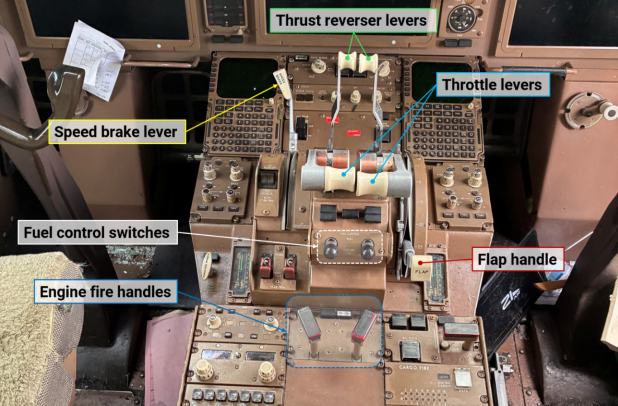
It also noted that neither the speed brakes nor the thrust reversers, which help the aircraft slow down after landing, were deployed by the pilots.
The plane's warning system, which alerts pilots to any issues in the aircraft, called out the "sink rate," the speed at which an aircraft loses altitude, and a "too low terrain" warning — which means it is coming in too fast — several times.
The captain was heard calling for a go-around about 15 seconds after the plane had already touched down, according to the report. But at that point, there was only about 415 feet of runway left, the NTSB said. A go-around is a standard procedure in which a pilot pulls up and tries the approach again.
No crushable-concrete overrun safety system was installed at the end of Runway 30.
Weather conditions during the day were windy and stormy
Thunderstorms were reported at the airport around the time of the crash, with wind gusting between 17 and 26 knots, or about 19 to 29 mph. The tower's south local controller cleared the flight to land about 1:49 p.m., when the plane was about 12 nautical miles from the runway, but did not give the pilots wind information.
A Federal Aviation Administration order governing air traffic control requires controllers to state both wind direction and speed when authorizing use of a runway where a tailwind component exists, the report says.
Crash marked the first day that the captain, first officer had flown together
The captain told investigators he had 7,267 total flight hours and had been with 21 Air since April, the NTSB said. The first officer reported about 2,800 total flight hours. He had been with 21 Air since February 2025.
The two had flown Flight 7521 from Miami to San Juan earlier that day, with the first officer flying. It was the first time they had flown together.
Plane sustained major damage
The plane was substantially damaged, with a post-crash fire on the right wing, the NTSB said. Part of the right wing and the right engine separated from the aircraft after impact, and the pilots shut the aircraft down before they evacuated.
The 767 was built in June 1994 as a passenger plane and converted to a freighter in June 2016. It had about 110,077 flight hours and 24,505 flight cycles.
The right engine was thermally damaged, partially separated from its wing pylon and resting on the ground. A large section of the right wing's upper skin was found in a parking lot about 158 feet northwest of the plane.
Attorney representing crash survivor reacts to the findings
Pablo Rojas, an attorney who is representing one of the survivors from the van, 27-year-old Sebastian Perdomo Torres, said in a statement that the report's information is valuable but not complete.
"I don't know for sure what the NTSB's conclusions are going to be, but I can tell you that this information does not answer all the questions we have about the broader airline operations. So we will be taking a thorough look at that independently of what the NTSB finds about the specific immediate causes of the crash," Rojas said.