South Florida officials say Nicaragua's ties to China, Russia, and Iran are a U.S. national security threat
South Florida elected officials and members of the Nicaraguan American community are condemning Nicaraguan leader Daniel Ortega, warning that his government's increasingly close relationships with China, Russia and Iran pose a national security concern for the United States.
The warnings came during a news conference in Miami-Dade County, weeks after Ortega declared that Nicaragua would no longer hold presidential elections.
"What you're seeing happening in Nicaragua is an aggression of the Chinese, the Russians, the Iranians," said Helen Aguirre Ferré, a Nicaraguan American journalist who spoke at the news conference.
Aguirre Ferré and others argued that the political situation in Nicaragua should be viewed not only as a struggle over democracy and human rights but also through the lens of U.S. national security.
"So the freedom of Nicaragua is not just to free the people of Nicaragua; it is a national security interest for the United States of America," Aguirre Ferré said.
Secretary of State Marco Rubio has repeatedly criticized Ortega's government and warned about Nicaragua's relationships with countries considered U.S. adversaries.
The concerns follow remarks Ortega made last month at the anniversary of the Sandinista Revolution in Managua.
"Aquí no volverán a ver elecciones," Ortega said in Spanish, declaring that there would be no more presidential elections.
The statement has alarmed Nicaraguans in South Florida, many of whom fled political repression in their homeland. Critics of Ortega say his growing ties with China and other U.S. adversaries have emboldened his government.
The news conference was convened by Miami-Dade Supervisor of Elections Alina García, days after South Florida's primary elections. Although turnout in Miami-Dade was below 20%, García emphasized that voters had the freedom to decide whether to participate — a choice she said Nicaraguans should also have.
"The people of Miami-Dade spoke," García said. "I would like the people of Nicaragua to have that same opportunity. They're going down a very bad path."
Ortega, 80, has ruled Nicaragua for more than three decades across two periods in power. In recent years, his government has tightened its grip on the country, while constitutional changes elevated his wife, Rosario Murillo, to the position of co-president.
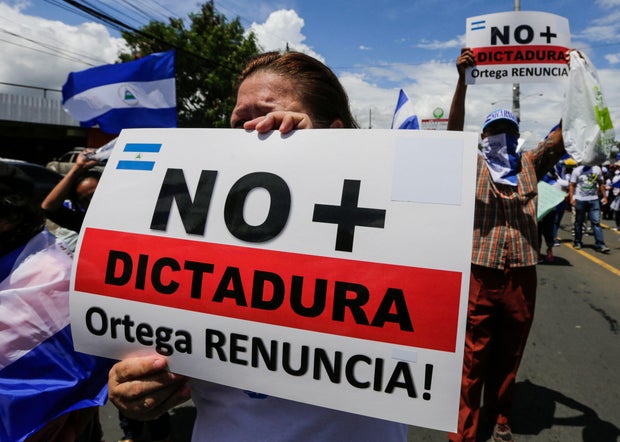
According to the U.S. State Department, Nicaragua maintains close relationships with Russia, China and Iran.
Norman Caldera, a former Nicaraguan government official now living in exile, also spoke at the news conference and called for the restoration of democratic elections.
"We need to have free elections," Caldera said.
Caldera said he believes Ortega is unwilling to hold a competitive presidential election because he fears losing power at the ballot box.
The developments are particularly significant in South Florida, home to one of the largest Nicaraguan communities outside the Central American nation.
According to U.S. Census Bureau figures cited at the news conference, about 138,000 Nicaraguans live in South Florida — roughly three-quarters of them in Miami-Dade County.
It remains unclear whether Ortega's declaration that Nicaragua will no longer hold presidential elections could lead to another wave of Nicaraguan migration to the United States. But speakers said the consequences of what happens in Nicaragua could extend far beyond its borders.