Grand jury finds DeSantis administration "misappropriated" $10 million in taxpayer money to Hope Florida

A state grand jury found the DeSantis administration "misappropriated" taxpayer money when it diverted $10 million from a Medicaid settlement into the Hope Florida Foundation, arguing the transfer was "part of a sophisticated scheme to fund political activities," according to a copy of the sealed grand jury report obtained by CBS News Miami.
The grand jury report said the money, which was supposed to be used to provide health insurance for poor children, was instead hastily passed through multiple organizations before eventually landing in the bank accounts of two political action committees and the Republican Party of Florida. Those funds were then used in 2024 to defeat Amendment 3, the citizen initiative to legalize marijuana in Florida.
"Despite our finding that the money was misappropriated, we find insufficient evidence to charge anyone criminally," the report concluded. "Nobody will take responsibility for deciding the $10 million of taxpayer money would go to Hope Florida… or had any memory of who made it."
"We recognize that this would be an impediment to criminal prosecution," the report noted. "While we can't prove who is responsible, we can plainly see that taxpayer money was misused for political purposes and we would like to see changes made to prevent this from happening again."
The grand jury identified the nexus for much of the activity surrounding the transfer as the state's current attorney general, James Uthmeier.
Read the full grand jury report. Click on the image below.
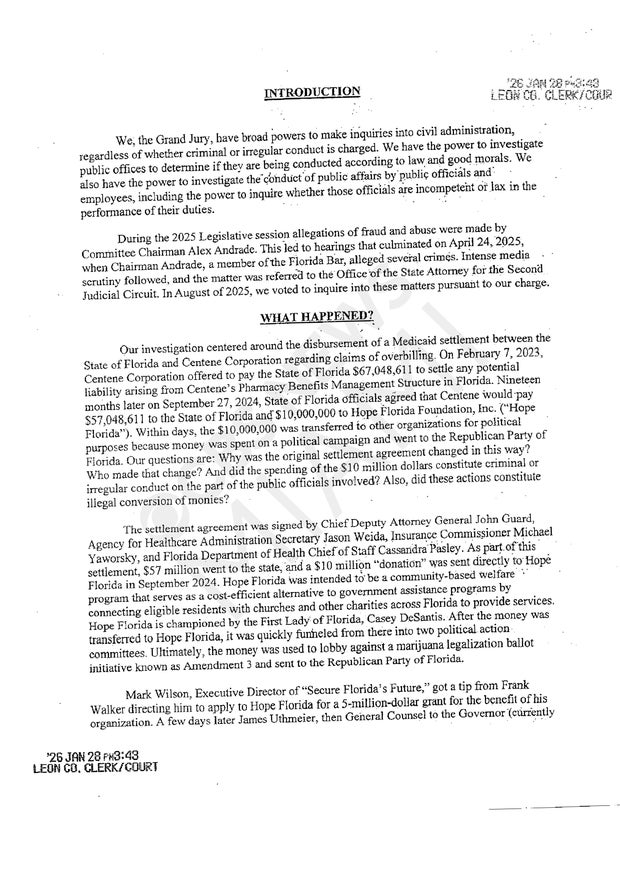
"We find that James Uthmeier, as the Governor's Chief of Staff at the time of settlement, was in a position of authority over those involved in settling …," the grand jury wrote. "Testimony identified him as having involvement in directing the money after it went to Hope Florida. Testimony also revealed that Mr. Uthmeier's Keep Florida Clean, a political action committee, was the prime recipient of the majority of the $10 million taxpayer funds."
The grand jury also concluded that Ashley Moody, who was the attorney general at the time, was aware of the plans to divert the $10 million to Hope Florida and "authorized" her former chief deputy, John Guard, to sign the settlement agreement. The grand jury noted that Guard signed the settlement "without conducting his due diligence to ensure the proper appropriation of taxpayer funds."
In response to questions from CBS News Miami about his role in the settlement, Guard wrote that "requests for the Department of Legal Affairs to join settlements weren't uncommon and this settlement was handled in the ordinary course by the Department."
Guard, whom Gov. Ron DeSantis appointed to the state appeals court in January, said he could not comment further on grand jury proceedings.
"As a sitting judge, it would be inappropriate for me to comment on past or ongoing court proceedings," he wrote to CBS News Miami. "Even if I weren't a sitting judge, to the extent that there was a grand jury, Florida law also makes it unlawful to disclose such proceedings."
Moody, who was appointed to the U.S. Senate in 2025 by DeSantis, has refused repeated requests for comment about Hope Florida. She is up for election in November.
DeSantis has also avoided publicly answering questions about what he knew of the diversion and who in his administration made the decision to send the $10 million to Hope Florida.
On Wednesday, DeSantis was asked about Hope Florida during a news conference and he said, "I wasn't involved in the settlement agreement, but I'm very happy with how everything was done."
He continued to call it a "hoax."
Neither Moody nor DeSantis nor Uthmeier was called before the Tallahassee grand jury to testify.
The grand jury report was filed under seal with the Leon County Clerk's Office on Jan. 28. The report's existence has been the subject of intense interest in recent months, with Democratic officials calling for its release and Republican leaders refusing to acknowledge there even was a report.
One source familiar with the investigation said that multiple individuals named in the report, including Uthmeier, have been blocking its release for the last seven months through closed court proceedings. It is not clear where those court proceedings currently stand. Earlier this year, the Florida Center for Government Accountability filed a brief with the circuit court in Tallahassee asking to intervene in the case so it could argue for the report's release. Its request is still pending.
Uthmeier, who is up for election in November, has refused to directly address the question of whether he was blocking the release of the report. Uthmeier's deputy chief of staff wrote to CBS News Miami: "Grand jury proceedings are confidential. Unauthorized disclosure of those proceedings is a crime."
Earlier this year, Uthmeier dismissed the entire affair surrounding Hope Florida as a "big nothingburger."
"I don't think anybody cares about this topic any more than the liberal media," he said in April. "Again, there was a grand jury proceeding. Under Florida law the contents thereof are confidential. That's not my choice. That is Florida law. What I can tell you is I have not been indicted. I've not been a suspect or a target. I have not been involved in any criminal activity. Nobody did anything wrong here."
Yet while DeSantis and Uthmeier maintain everything with the diversion of $10 million of taxpayer money was perfectly fine, a state grand jury argues it found significant wrongdoing.
The grand jury report describes a coordinated effort involving government officials across multiple state agencies and outside interest groups aligned with the governor. And the report suggests that administration officials took advantage of the chaos surrounding two deadly hurricanes — Hurricanes Helene and Milton — to help obscure their plans to siphon taxpayer money into the political campaign against the marijuana initiative.
In fact, the former chair of the Hope Florida Foundation, Joshua Hay, testified to the grand jury that he agreed to send the $10 million to a pair of political committees without asking many questions because "he assumed the money was needed to assist hurricane victims."
Hay then told the grand jury: "The road to hell is paved with good intentions."
History of the settlement
In 2021, Florida officials learned the health care giant Centene had been overbilling the state for prescription drugs under the Florida Healthy Kids program. Florida wasn't the only state affected. At least 20 other states were overbilled nearly a billion dollars.
Florida's share was calculated to be $67,048,611.
In 2021, Ohio and Mississippi both announced settlements of $88 million and $55 million, respectively. In 2023, Indiana was reimbursed $66.5 million, Massachusetts $14 million, and California received $215 million.
Yet, while other states settled their cases, Florida did nothing, even ignoring Centene's request to get the case resolved so it could put the overbilling affair behind it.
A draft of the settlement agreement was first sent to Florida officials on July 14, 2021, offering to fully repay the $67 million the state was owed.
It is not known why DeSantis allowed the settlement to languish for three years, but in early September 2024, state officials contacted Centene and said they wanted to immediately resolve the dispute.
Only this time, the state had a new condition.
On Sept. 12, 2024, the state altered the agreement and instead of returning the entire $67 million to state coffers, the DeSantis administration decided only $62 million should be returned to the state and $5 million to the Hope Florida Foundation, a nonprofit set up to help fund first lady Casey DeSantis' Hope Florida initiative. The idea behind Hope Florida was to move individuals away from government assistance and instead encourage them to receive help from religious-based organizations.
The next day, on Sept. 13, 2024, the state changed the settlement agreement again, this time lowering the amount returned to Florida taxpayers to $57 million and increasing the amount going to Hope Florida to $10 million. No reason was given as to why the amount doubled.
Centene's lawyers, however, were concerned about any diversion of money, especially since it was going to a charity aligned with the governor's wife.
Centene demanded the settlement include wording making it clear Centene was being directed by the Florida attorney general to send the $10 million to the Hope Florida Foundation.
Moody, however, did not want to be responsible.
According to the grand jury report, Moody's chief deputy, John Guard, said he had "reservations" about the deal and that "esoterically" he agreed the $10 million was taxpayer money and "belonged to the state of Florida."
During his testimony in front of the grand jury, Guard also explained that "Florida Statutes require the legislature to decide how money is spent," according to the grand jury report.
Guard, according to the report, was also concerned about the political consequences if the Legislature ever found out about the diversion.
"[Guard] did have political concerns about the dedication of $10,000,000 to Hope Florida, which he raised with AG Moody, because he knew the deal would be viewed by the legislature as a constraint on their spending authority," the grand jury noted.
As a result of Guard's objections, the settlement was rewritten so that instead of the attorney general directing Centene to send $10 million to the Hope Florida Foundation, it would now state that DeSantis' Agency for Health Care Administration (AHCA) was directing Centene to send $10 million to Hope Florida.
"His political concerns were resolved by the change to the agreement making the settlement AHCA's agreement rather than the AG's settlement agreement," the grand jury report states, "as the problem would now be AHCA's problem rather than the AG's problem."
In its review of Guard's testimony, the grand jury noted that "after consulting AG Moody, she authorized Mr. Guard to sign the settlement agreement in its final form."
Asked by CBS News Miami when he became aware that the $10 million sent to Hope Florida was moved into the political action committees campaigning against the marijuana amendment, Guard wrote: "I first learned that money had been transferred from Hope Florida months after the settlement either from watching a House Healthcare Appropriations committee hearing on the Florida Channel or from a phone call placed by [State] Representative [Alex] Andrade to me well after the election."
Andrade was the state representative who exposed the diversion of $10 million from the Centene settlement into the Hope Florida Foundation.
In 2025, President Donald Trump nominated Guard to the federal bench, but his appointment was held up by Florida Sen. Rick Scott, who had emerged as a vocal critic of the transfer of $10 million to the Hope Florida Foundation. In December, Scott posted on social media: "Millions in tax dollars for poor kids have no business funding political ads."
In January 2026, Guard withdrew his appointment to the federal judiciary and DeSantis appointed Guard to be a judge on the state's Second District Court of Appeal. Guard did not comment for this story.
Conflicting memories
The secretary of AHCA at the time of the settlement was Jason Weida. Not only did Weida ultimately sign the agreement, but emails reveal he was one of the key negotiators with Centene over the settlement in September 2024.
"Mr. Weida testified that he does not recall who suggested that Hope Florida should be the recipient of the" $10 million from the settlement. Weida testified that he thought it was OK for Centene to "donate" $10 million to Hope Florida, calling it a bonus, over and above what was owed to taxpayers, a view he said was affirmed when he consulted with the general counsel for AHCA. The general counsel also testified before the grand jury that he thought the diversion was permissible.
The grand jury, however, found otherwise.
"We find that the full Centene settlement was taxpayer reimbursement," the grand jury wrote. "We reject Agency for Healthcare Administration Secretary Jason Weida's explanation that $10 million was a `bonus.'"
The grand jury added: "This money was part of the damages Centene owed to Florida taxpayers."
Weida is currently serving as the governor's chief of staff. He did not respond to an email seeking his comment about Hope Florida.
Confusion amid the storms
On Sept. 26, 2024, Hurricane Helene struck the Florida Panhandle, killing at least 18 people and causing nearly $14 billion in damage. Cassandra Pasley, the chief of staff for the Florida Department of Health, told the grand jury that the next day, on Sept. 27, she was working in the state's Emergency Operations Center when she "was pulled aside by Katie Strickland, the Governor's Chief of Staff in charge of Health Agencies" and was asked to sign the settlement agreement.
She said she had never seen the agreement before and wasn't even aware a settlement was in the works. Nevertheless, she signed it that evening.
"At the time she signed the settlement agreement," according to the grand jury report, "Ms. Pasley testified that she was not aware that any of the settlement money would end up in a political action committee, nor would she have signed the settlement agreement had she known that fact."
Also signing the agreement the day after Hurricane Helene made landfall was Florida Insurance Commissioner Michael Yaworsky. He testified he found the provision to send $10 million to the Hope Florida Foundation "atypical," but was satisfied when he learned the attorney general's office had signed off on it.
The grand jury also found the repayment schedule outlined in the agreement suspicious, noting the state required Centene to wire transfer the $10 million to the Hope Florida Foundation within seven days, while it also allowed Centene to take more than a year to repay the remaining $57 million to Florida taxpayers.
"The Centene settlement itself seems rushed as it materialized rapidly after years of inactivity," the grand jury noted. "Then, once reached, it took a mere 7 days to fund. We believe the rush was due to the impending election which was just 45 days away."
The grand jury also found it questionable that unlike other states that issued press releases about their settlements, "there was no press release by AHCA or the Governor's Office to boast the recovery of millions in taxpayer funds."
The grand jury also found "there was no notification to the Legislature of the Centene settlement."
On Oct. 4, 2024, Centene transferred the $10 million into the Hope Florida Foundation bank account — and no one was more surprised than the chairman of the foundation at the time, Joshua Hay.
He testified before the grand jury that prior to the Centene wire transfer, the largest donation ever made to the foundation was $100,000.
He said he learned about the $10 million when the foundation's attorney, Jeff Aaron, a close confidant of DeSantis and Uthmeier, let him know the money was coming. Hay, however, testified he soon learned he wouldn't have the money for very long because he was about to receive two $5 million grant proposals.
The foundation's board approved the first grant unanimously, and Hay testified he approved the second $5 million grant on his own.
Within 25 days of Hope Florida receiving the $10 million in taxpayer money, it was gone.
Hay told the grand jury it was probably for the best that they didn't hold on to the $10 million because the Hope Florida Foundation "lacked the infrastructure to effectively and efficiently get the money to those in need."
The grand jury concluded that it never made sense for the Hope Florida Foundation to receive the money.
"We were told Hope Florida was chosen as the beneficiary of the initial donation because the Centene settlement was compensation for ripping off sick poor children and Hope Florida's mission and work was aligned with the purpose of serving needy children with health issues," the grand jury report notes.
"Hope Florida was touted by some witnesses as a high-profile project with a high success rate, but we were unable to get any evidence to substantiate these representations," the report continues. "On the contrary, other witnesses referred to Hope Florida as just a concept and did not have a clear understanding of what it did, where it existed, or how it operated. So, we fail to see the nexus between Hope Florida and the Centene settlement, and even if there was a nexus, it was rendered moot by the fact that the money only stayed in Hope Florida's account for a couple of days."
Following the money
On Oct. 9, 2024, Florida was hit with its second major hurricane in less than three weeks. Hurricane Milton killed 12 people after it made landfall near Siesta Key. It left 3 million Floridians without power and caused tens of billions of dollars in damage to the state.
Two days later, on Oct. 11, in the midst of this crisis, Uthmeier, the governor's chief of staff, was on the phone and texting Amy Ronshausen, executive director of Save Our Society from Drugs, telling her she should apply for a grant from the Hope Florida Foundation, according to the grand jury report.
He told her to contact the attorney for the foundation, Jeff Aaron.
"She does not recall if Mr. Uthmeier suggested an amount but does know that Mr. Aaron advised her to apply for $5 million," the grand jury report notes.
At approximately the same time, Mark Wilson, executive director of Secure Florida's Future and the president of Florida's Chamber of Commerce, testified he was told by the Chamber's lobbyist that Secure Florida's Future should apply for a $5 million grant from Hope Florida.
Wilson submitted the proposal on Oct. 13, 2024, outlining how Secure Florida's Future would use the $5 million to raise awareness about Hope Florida "through webinars, podcasts, in-person statewide summits and meetings, newsletters, surveys" that would help "accelerate the momentum Hope Florida has already created in Florida."
Less than a week later, Hope Florida approved the grant and sent Secure Florida's Future $5 million. Within days, nearly all the money — $3.75 million — was then transferred to Uthmeier's political action committee, Keep Florida Clean.
Ronshausen, from Save Our Society from Drugs, filed her grant application to the Hope Florida Foundation on Oct. 18, 2024, and within hours was informed she was approved. The $5 million was transferred to her account on Oct. 22, according to the grand jury report.
"Within a week, she distributed $4.75 million to Uthmeier's political committee, Keep Florida Clean," the grand jury found. "She stated she was not directed by anyone as to how to spend the money."
The grand jury said that both Mark Wilson and Amy Ronshausen "mischaracterized" the purpose of the funds in their grant applications to the Hope Florida Foundation. The grand jury noted that in both grant applications they stated the money would not be used for political purposes, and yet the money was almost immediately transferred into Uthmeier's political action committee.
According to a forensic accountant who analyzed bank records for the grand jury, Uthmeier's PAC received a total of $8.5 million from Secure Florida's Future and Save Our Society from Drugs. Uthmeier's PAC then sent $7 million to the Republican Party of Florida and an additional $1.23 million to another PAC he chaired, the Florida Freedom Fund.
Recommendations for change
The grand jury argued the public was ill-served throughout this process.
"Those negotiating the Centene settlement on behalf of the State of Florida failed to place any restrictions on the money's use," the grand jury states. "Therefore, there was no oversight to ensure proper usage of the taxpayer money."
The grand jury identified two recommendations that it believes the Florida Legislature should enact immediately.
"The Florida Legislature should enact a law to prevent this situation from occurring," the report noted. "For example, a law that says any monies received by the state from any source must be deposited into the General Fund, and there should be real consequences for anyone violating this law."
The grand jury also said the Legislature "should enact clear laws setting requirements how [groups like Hope Florida] can use taxpayer funds, ensuring usage of said funds are tracked and monitored, and providing consequences for violation of these mandates."
The grand jury ended its report reaffirming its belief the $10 million was taxpayer money that was misappropriated.
"As taxpayer money," the grand jury found, "it should have been treated as such instead of being allocated for partisan political purposes and without transparency."