Justice Department faces continued backlash over limited Epstein files release
Washington — The Justice Department is facing continued backlash over its partial releases of files related to late sex offender Jeffrey Epstein, with lawmakers and survivors denouncing the limited scope of the disclosures.
The Trump administration faced a Dec. 19 deadline to release most of the government's records under the Epstein Files Transparency Act, which Congress passed and President Trump signed into law last month. But Deputy Attorney General Todd Blanche said the files will be released on a rolling basis over the coming weeks due to the volume of the materials and the need to shield the personal information of survivors.
A first tranche of records was made public Friday, followed by a second batch Saturday. Many of the documents contained significant redactions, including whole pages of records that were blacked out.
Early Tuesday, the department released tens of thousands of additional documents from the files. It wasn't immediately clear what impact that release would have on the criticism of the earlier releases.
The Justice Department also removed more than a dozen of the earlier files without an initial explanation. The department said on X on Saturday that files would continue to be "reviewed and redacted consistent with the law in an abundance of caution as we receive additional information."
One of the removed files was an image of a group of framed photos, including two that appeared to show Mr. Trump. The department said on Sunday that the file was "temporarily removed" out of an abundance of caution after federal prosecutors in New York flagged it "for potential further action to protect victims." The department reposted the photo after it said a review determined that "there is no evidence that any Epstein victims are depicted in the photograph." Mr. Trump has not been accused of wrongdoing related to Epstein.
A group of survivors of abuse by Epstein and Ghislaine Maxwell, his longtime associate who was convicted of sex trafficking, called on Congress to hold hearings and take legal action to demand compliance with the law. Maxwell is serving a 20-year prison sentence.
"It is alarming that the United States Department of Justice, the very agency tasked with upholding the law, has violated the law, both by withholding massive quantities of documents, and by failing to redact survivor identities," they said in a statement Monday.
The survivors said the government released "a fraction of the files," and said the material that was disclosed was "riddled with abnormal and extreme redactions with no explanation."
Senate Minority Leader Chuck Schumer introduced a resolution Monday that would direct the upper chamber to "initiate legal actions" against the Justice Department to demand that it comply with the law. The New York Democrat is expected to force a vote on the measure when the Senate reconvenes in the new year.
Schumer called the Justice Department's rollout a "blatant cover-up," claiming Attorney General Pam Bondi and Blanche "are shielding Donald Trump from accountability, and the Senate has a duty to act."
"The law Congress passed is crystal clear: release the Epstein files in full so Americans can see the truth," Schumer said in a statement.
Bondi said in a post on X on Sunday that the Justice Department "will bring charges against anyone involved in the trafficking and exploitation of Jeffrey Epstein's victims," and urged any survivors with information to come forward.
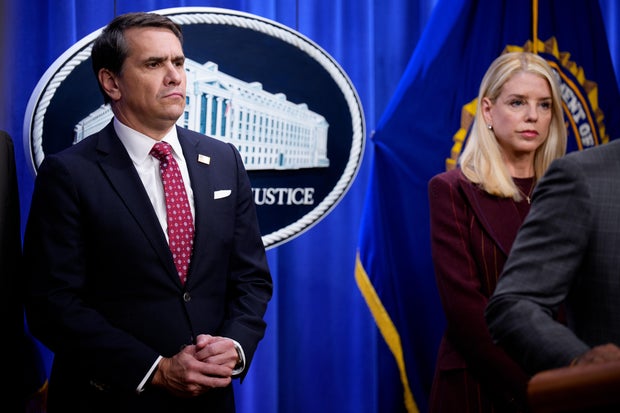
But in July, the Justice Department and FBI released a memo stating that a review of the government's files related to Epstein "did not uncover evidence that could predicate an investigation against uncharged third parties."
Meanwhile, Reps. Thomas Massie and Ro Khanna expressed dissatisfaction with the release on "Face the Nation with Margaret Brennan" on Sunday. Khanna, a California Democrat, and Massie, a Kentucky Republican, authored the Epstein legislation and worked together on the discharge petition to force a vote on the measure.
Massie said he and Khanna are "talking about and drafting" a resolution to hold Bondi in "inherent contempt" of Congress, which he called "the quickest way, and I think most expeditious way, to get justice for these victims."
Inherent contempt is a rarely used tool that Congress can use to enforce compliance with its directives. A 2017 report from the Congressional Research Service called it a "long dormant" power that allows lawmakers "to detain and imprison a contemnor until the individual complies with congressional demands." The report noted that while there "may be an argument for the imposition of monetary fines" as an alternative, there's no precedent for Congress imposing a fine for contempt.
Last year, a push by GOP Rep. Anna Paulina Luna of Florida to hold then-Attorney General Merrick Garland in inherent contempt fell short in the House. Though she had initially signaled that she was pursuing a resolution to hold Garland in custody, the final measure would have imposed a fine of $10,000 per day on Garland for defying a congressional subpoena.
Khanna said he and Massie are "building a bipartisan coalition, and it would fine Pam Bondi for every day that she's not releasing these documents." To force a vote on the House floor upon the chamber's return next month, the resolution would likely be offered as a privileged motion, which would require leadership to schedule a vote within two legislative days.
Under the Epstein Files Transparency Act, the attorney general had 30 days from its enactment to make public "all unclassified records, documents, communications, and investigative materials" in the Justice Department's possession that related to Epstein and Maxwell.
The law prohibited the government from withholding, delaying or redacting records "on the basis of embarrassment, reputational harm, or political sensitivity, including to any government official, public figure, or foreign dignitary." But it did allow the attorney general to redact certain portions of documents, including personally identifiable information of survivors or depictions of child sexual abuse.
The law also requires the Justice Department to provide written justification for any redactions to Congress.
The president, asked about the Epstein documents at an event at his Mar-a-Lago estate in Florida Monday, voiced frustration that there is still so much attention focused on them.
"I believe they gave over 100,000 pages of documents," he said. "And there is tremendous backlash, it's an interesting question, because a lot of people are very angry that pictures are being released of other people that really had nothing to do with Epstein. But they're in a picture with him because he was at a party. And you ruin a reputation of somebody. So a lot of people are very angry that this continues."
Epstein was under investigation in South Florida in the early 2000s, but ultimately reached a deal with federal prosecutors in Miami to escape federal charges. He agreed to instead plead guilty to state prostitution charges and serve 18 months in prison.
He was indicted on federal sex trafficking charges in New York in 2019 and died by suicide at a Manhattan correctional facility weeks later.