Remains of ancient king's temple dedicated to sun god discovered in Egypt
An Italian archaeological mission has discovered the remains of a sun temple belonging to an ancient Egyptian king near Cairo, the Egyptian antiquities ministry said.
The temple of King Nyuserre is believed to be from the Fifth Dynasty and the remains were found in the Abusir necropolis south of the Egyptian capital.
It is part of a monumental complex dedicated to the cult of the sun god Ra and is one of the few solar temples identified to date.
The site was identified as early as 1901 by the German archaeologist Ludwig Borchardt --known for his 1912 discovery of the famous bust of ancient Egyptian queen Nefertiti -- but a high water table prevented any excavation at the time.
According to the ministry, the mission has uncovered for the first time more than half of the temple, long buried under River Nile sediment.
The ministry described a colossal structure of over 1,000 square meters "with a unique architecture that ranks it among the largest and most remarkable valley temples in the Memphis necropolis", a stretch of ancient funerary complexes.
Architectural features including column bases, wall coverings, and granite thresholds have been identified, as well as a sloping ramp "likely connecting the temple to the Nile or one of its branches", the ministry said.
The team also found two wooden pieces of the ancient Egyptian "Sunnat" game, resembling modern chess, te ministry added.
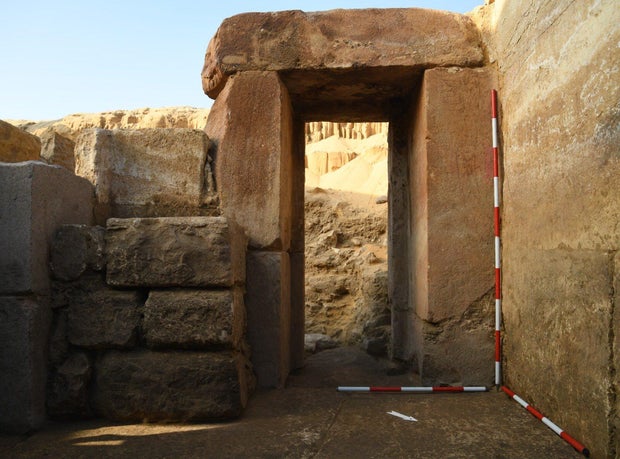
Abusir, about 12 miles south of Cairo, is an archaeological site that notably contains the pyramids of several pharaohs, though they are modest in size compared to the pyramids of Giza.
Six solar temples are believed to have been built during the reign of the pharaohs of the Fifth Dynasty, according to the University of Leicester.
Only the remains of two temples have been confirmed to date, including that of Nyuserre, according to the British university, which is famous for identifying the remains of Richard III, the English king who died more than five centuries ago.
Earlier this month, a treasure trove of 225 funerary figurines was discovered inside a tomb in the ancient Egyptian capital of Tanis in the Nile Delta. The royal symbol on the figurines solved a long-standing mystery by identifying who was buried in the sarcophagus: It was pharaoh Shoshenq III, who reigned from 830 to 791 BC.
Egypt reveals restored colossal statues of pharaoh in Luxor
Meanwhile, Egypt on Sunday revealed the revamp of two colossal statues of a prominent pharaoh in the southern city of Luxor, the Associated Press reported.
The giant alabaster statues, known as the Colossi of Memnon, were reassembled in a renovation project that lasted about two decades. They represent Amenhotep III, who ruled ancient Egypt about 3,400 years ago.
"Today we are celebrating, actually, the finishing and the erecting of these two colossal statues," Mohamed Ismail, secretary-general of the Supreme Council of Antiquities, told The Associated Press ahead of the ceremony.
Ismail said the colossi are of great significance to Luxor, a city known for its ancient temples and other antiquities. They're also an attempt to "revive how this funerary temple of king Amenhotep III looked like a long time ago," Ismail said.
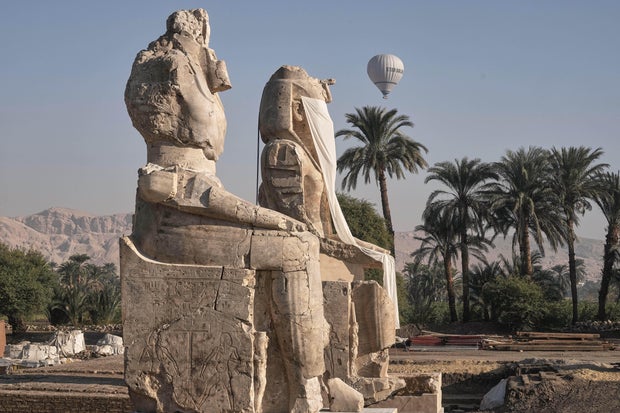
Amenhotep III, one of the most prominent pharaohs, ruled during the 500 years of the New Kingdom, which was the most prosperous time for ancient Egypt. The pharaoh, whose mummy is showcased at a Cairo museum, ruled between 1390–1353 BC, a peaceful period known for its prosperity and great construction, including his mortuary temple, where the Colossi of Memnon are located, and another temple, Soleb, in Nubia.
The colossi were toppled by a strong earthquake in about 1200 BC that also destroyed Amenhotep III's funerary temple, said Mohamed Ismail, secretary-general of the Supreme Council of Antiquities.
They were fragmented and partly quarried away, with their pedestals dispersed. Some of their blocks were reused in the Karnak temple, but archaeologists brought them back to rebuild the colossi, according to the Antiquities Ministry.
In late 1990s, an Egyptian German mission, chaired by German Egyptologist Hourig Sourouzian, began working in the temple area, including the assembly and renovation of the colossi.
"This project has in mind … to save the last remains of a once-prestigious temple," she said.
The statues show Amenhotep III seated with hands resting on his thighs, with their faces looking eastward toward the Nile and the rising sun. They wear the nemes headdress surmounted by the double crowns and the pleated royal kilt, which symbolizes the pharaoh's divine rule.
Two other small statues on the pharaoh's feet depict his wife, Tiye.
Sunday's unveiling in Luxor came just six weeks after the inauguration of the long-delayed Grand Egyptian Museum, the centerpiece of the government's bid to boost the country's tourism industry and bring cash into the troubled economy. The mega project is located near the famed Giza Pyramids and the Sphinx.