7.5 magnitude earthquake strikes off Japan, triggering tsunami on country's northern coast
A powerful earthquake struck off northern Japan late Monday local time, triggering a tsunami of up to 28 inches in Pacific coast communities, the Japanese Meteorological Agency said. The agency reported the quake's magnitude as 7.5, down from its earlier estimate of 7.6.
The quake struck at about 11:15 p.m. (9:15 a.m. ET) in the Pacific Ocean about 50 miles off the coast of Aomori, the northernmost prefecture of Japan's main Honshu island, the agency said.
A tsunami of 70 centimeters (about 28 inches) was measured in Kuji port in Iwate prefecture, just south of Aomori, and tsunami levels of up to 50 centimeters (about 20 inches) struck other coastal communities in the region, the agency said.
The agency had issued an alert for potential tsunami surges of up to 10 feet in some areas and later downgraded it to an advisory.
Chief Cabinet Secretary Minoru Kihara urged residents to go to higher ground or seek shelter until advisories were lifted.
The Japanese Meteorological Agency issued a caution about possible aftershocks in the coming days. It said there is a slight increase in risk of a magnitude 8-level quake and possible tsunami occurring along Japan's northeastern coast from Chiba, just east of Tokyo, to Hokkaido. The agency urged residents in 182 municipalities in the area to monitor their emergency preparedness in the coming week.
Monday's quake struck northeast of the Aomori town of Hachinohe, and about 30 miles below the sea surface, the agency said. Hachinohe residents fled their homes to seek shelter in city hall, public broadcaster NHK said.
A reporter for NHK in Hokkaido described a horizontal shaking of around 30 seconds that made him unable to keep standing as the earthquake struck. The quake was also felt in the northern hub of Sapporo, where alarms rang on smartphones to alert residents.
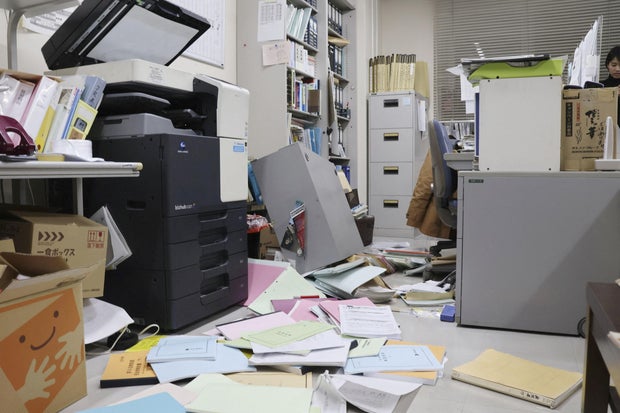
The Fire and Disaster Management Agency said 23 people were injured, including one seriously. Most of the victims were hit by falling objects, NHK reported, adding that several people were injured in a hotel in Hachinohe and a man in Tohoku was slightly hurt when his car fell into a hole.
Nuclear power plants in the region were conducting safety checks, Kihara said. The Nuclear Regulation Authority said about 118 gallons of water spilled from a spent fuel cooling area at the Rokkasho fuel reprocessing plant in Aomori, but that its water level remained within the normal range and there was no safety concern.
Kihara said about 800 homes were without electricity, and that the Shinkansen bullet trains and some local lines were suspended in parts of the region.
About 480 residents were taking shelter at the Hachinohe Air Base, and 18 defense helicopters were mobilized for damage assessment, Defense Minister Shinjirō Koizumi said.
About 200 passengers were stranded for the night at New Chitose Airport in Hokkaido, NHK reported.
"I've never experienced such a big shaking," convenience store owner Nobuo Yamada told NHK in Hachinohe, adding that "luckily" power lines were still operating in his area.
Satoshi Kato, a vice principal of a public high school in Hachinohe, told NHK that he was at home when the quake struck, and that glasses and bowls fell and smashed into shards on the floor.
Kato said he drove to the school because it was designated an evacuation center, and on the way he encountered traffic jams and car accidents as panicked people tried to flee. Nobody had yet come to the school to take shelter, he said.
The U.S. National Tsunami Warning Center said there was no tsunami danger for the U.S. West Coast, Canada's British Columbia or Alaska.
Japanese Prime Minister Sanae Takaichi, in brief comments to reporters, said the government set up an emergency task force to urgently assess the extent of damage. "We are putting people's lives first and doing everything we can," she said.
Later, she urged residents in the region to pay attention to the latest information from local municipalities: "Please be prepared so you can immediately evacuate as soon as you feel a tremor."
Japan sits on top of four major tectonic plates along the western edge of the Pacific "Ring of Fire" and is one of the world's most tectonically active countries.
The archipelago, home to around 125 million people, experiences around 1,500 jolts every year.
The vast majority are mild, although the damage they cause varies according to their location and depth below the Earth's surface.