Lucas Museum prepares to open in Los Angeles 10 years after plan for Chicago was called off

A decade after George Lucas gave up on trying to build a museum along the Chicago lakefront, the project is finally complete in Los Angeles.
The museum in Los Angeles' Exposition Park is set to welcome the public starting Sept. 22.
Lucas and his wife, Chicago businesswoman Mellody Hobson, founded the Lucas Museum of Narrative Art with what they characterized as a dedication to the universal tradition of visual storytelling.
The museum has 30 galleries, with "Star Wars"-related exhibitions only filling 7% of the space, museum officials told CBS Los Angeles.
One such exhibition is called "Star Wars in Motion." It includes the first original build of General Grievous' TSMEU-6 Wheel Bike, as well as Luke Skywalker's Landspeeder.
Lucas has said in the past that the museum will also feature comic art, photography and an in-depth look at the art of filmmaking through both rotating and permanent exhibitions. The Lucas Archives will also be a fixture of the venue, which will contain an array of models, props and concept art from Lucas' extensive and historic filmmaking career, which has now spanned over a dozen "Star Wars" movies and television shows.
"Stories are mythology, and when illustrated, they help humans understand the mysteries of life," said a past statement from Lucas.
The initial presentations at the Lucas Museum also include more than 1,200 works of art.
This all comes a dozen years after a two-year drama began surrounding plans to build the Lucas Museum in Chicago, which were ultimately called off.
In June 2014, then-Mayor Rahm Emanuel announced that the Lucas Museum would be constructed on the site of a parking lot between Soldier Field and McCormick Place, close to the Field Museum of Natural History, the Shedd Aquarium, and the Adler Planetarium.
Previously, Lucas had planned to build his museum in San Francisco. But that city rejected his four-year effort to build the museum on waterfront parkland overlooking the Presidio.
The Chicago Park District agreed to sign a 99-year lease for the 17-acre property for $10. A design by Ma Yansong of Beijing-based MAD Architects stood in contrast to the classical edifice of the Field Museum and the colonnades of Soldier Field, calling for a futuristic, undulating white structure with an observation deck resembling a floating disc on top.
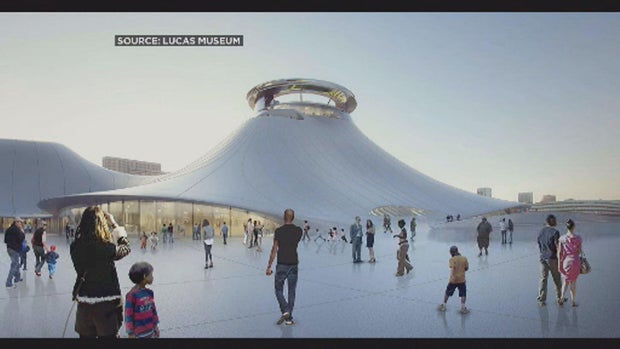
But from the beginning, Friends of the Parks warned that the Lucas Museum would violate use rules for lakefront land. The group said it supported the museum coming to Chicago, but was willing to sue to keep it off the lakefront.
Friends of the Parks went ahead with a federal lawsuit in November 2014 to block the lakefront plan for the museum. The lawsuit cited the "public trust doctrine," which requires lakefront land to be set aside as a natural resource and to be open to the public for recreation.
The group argued the city could not transfer the land to a private entity.
Some mocked Friends of the Parks' stance, calling the group "Friends of the Parking Lot." But some also questioned the purpose of the Lucas Museum as it was poised to claim lakefront land, calling it a vanity project.
In a June 2014 column, the Chicago Reader's Deanna Isaacs complained of vagueness surrounding what the museum, initially branded as a museum of "cultural art" and then changed to "narrative art," was supposed to be about. She wrote: "No inventory is available: beyond Darth Vader costumes, Norman Rockwell paintings, and movie posters, we don't really know what's in it or what it'll take to fill it out."
While the Mayor's office compared Lucas' philanthropy to that of museum namesakes Marshall Field, John G. Shedd, and Max Adler, Isaacs wrote that unlike Lucas, none of those three merchandising titans asked for "a lakefront site on which to showcase their achievements."
The Chicago City Council signed off on the plan for the Lucas Museum in October 2015, and museum officials hoped to begin work on the museum the following spring. But U.S. District Judge John Darrah issued an injunction preventing the start of construction while the Friends of the Parks lawsuit was pending.
In April 2016, Mayor Emanuel endorsed a plan that would move the Lucas Museum site to the south, calling for the demolition of the McCormick Place Lakeside Center and the construction of the museum there.
Friends of the Parks did not approve of that plan either. The group wanted Lucas and Hobson to investigate possible sites off the lakefront — such as the vacant Michael Reese Hospital property, a location west of DuSable Lake Shore Drive across from the original proposed Lucas Museum site, or a 28-acre truck marshalling yard just east of the Reese site.
But Mayor Emanuel emphasized that Lucas and Hobson were not interested in alternatives to a lakefront site.
In May 2016, Hobson warned that the museum could decide not to build in Chicago and took Friends of the Parks to task, saying in part in a statement, "If the museum is forced to leave, it will be because of the Friends of the Parks and that is no victory for anyone."
By June, the Chicago plan for the Lucas Museum was dead. The museum's board, citing "extensive delays" due to opposition by Friends of the Parks, said the museum would be built in California instead.
"No one benefits from continuing their seemingly unending litigation to protect a parking lot," Lucas said in a statement the time. "The actions initiated by Friends of Parks and their recent attempts to extract concessions from the city have effectively overridden approvals received from numerous democratically elected bodies of government."
Mayor Emanuel also lamented the loss of the museum and blamed Friends of the Parks. He said in a statement in part: "This missed opportunity has not only cost us what will be a world-class cultural institution, it has cost thousands of jobs for Chicago workers, millions of dollars in economic investment and countless educational opportunities for Chicago's youth."
But Chicago Tribune architecture critic Blair Kamin wrote that the problem was not Friends of the Parks and its defense of the lakefront, but Lucas and his "arrogance."
"George Lucas didn't court Chicagoans. He never made the equivalent of a visit to the front parlor to ask if he might build his narrative arts museum (whatever that was) in the city's front yard," Kamin wrote in a June 2016 column. "He seemed to consider city approval a matter of entitlement."
Kamin also wrote that if Judge Darrah had not allowed Friends of the Parks' lawsuit to proceed and Lucas had prevailed, "it would have allowed the powerful and wealthy to foist their vanity projects on the people's shoreline — and control those edifices for decades, even centuries, to come."
In January 2017, Lucas chose Los Angeles as the site for his museum. The project was initially set to be completed in 2021, but was delayed by the COVID-19 pandemic.


