GKN Aerospace shares statement after Orange County chemical leak in California: "Want to say how sorry we are"
Orange County officials say there's no risk to the public after several days of evacuation orders stemming from a chemical leak in a tank at a Garden Grove aerospace facility, but the risk of a contained fire or spill still exists in the immediate area.
During a news conference on Wednesday morning, Orange County Fire Authority Battalion Chief Mike Yeun said that although residents have returned home, crews are still working to contain a hazardous tank at GKN Aerospace.
"We still have a hazard," he said. "We still have a threat."
That threat, Yeun specified, is limited to a 300-foot zone within the immediate vicinity of the tank.
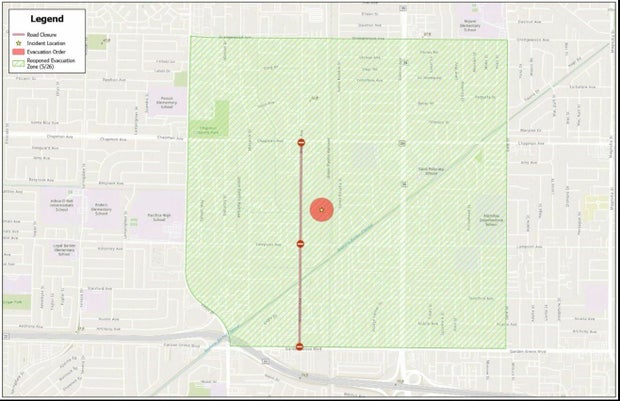
All evacuation orders were lifted by 7:30 p.m. Tuesday, the OCFA announced, after as many as 50,000 residents were mandated to leave their homes with orders starting Thursday night after the leak was spotted at GKN Aerospace. The decision to lift all evacuations came through an agreement between firefighters, Garden Grove police, the Environmental Protection Agency and the Orange County Health Care Agency.
"There should be zero alarm or concern [for residents]," Yeun said. He added that it could be "days," "weeks," or even "months" before the issue is fully resolved.
Testing conducted Tuesday nights led agencies to collectively agree that there was no chemical leak, no longer the risk of an explosion or fire and no risk to the public. They said that Western Avenue would remain closed between Chapman Avenue and Garden Grove Boulevard until further notice, and that a small radius around the aerospace facility would be closed to the public to allow for hazardous materials teams to continue working.
"Residents have started to return home," OCFA Interim Chief TJ McGovern said in a briefing posted to X at 11:22 p.m. Tuesday. "To the residents: We thank you again. We understand the inconvenience, the difficulties and the challenges that this has all brought to you."
On Wednesday evening, they finally reopened all roads, with just a 300-foot radius surrounding the tank being deemed a threat.
Late Wednesday night, a GKN Aerospace spokesperson shared a statement with CBS LA, which read, in part: "On behalf of the team at GKN Aerospace, I want to say how sorry we are for the uncertainty and disruption this situation has caused," said GKN Senior Vice President Steve Carlin. "I recognize how challenging this has been, particularly over the Memorial Day holiday. We are committed to understanding what occurred and identifying ways we can support those affected."
Carlin went on to thank OCFA crews, the first responder community and those who worked to contain the situation over the weekend.
"We recognize there is more work ahead," Carlin said. "Our focus remains on supporting the community, working closely with authorities, and continuing to ensure a safe and responsible path forward. I am personally committed to working with the Garden Grove, Stanton, and broader Orange County communities on these efforts."
Meanwhile, an emergency city council meeting in Garden Grove was held at about the same time the evacuations were lifted. Several dozens of residents gathered to express their frustrations at the situation, and to insist that local governments hold GKN accountable.
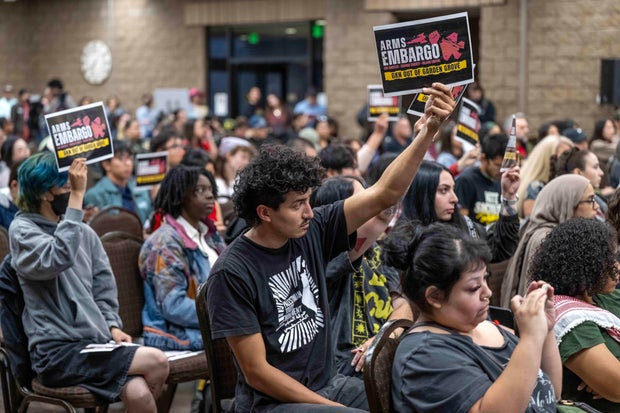
"We demand accountability from GKN Aerospace. And the city, our elected body, who are supposed to represent us, can make a real impact to change this long term," said one man who lives on the same square-mile block as the GKN facility. "We demand that they shut down the facility of GKN in our community."
Residents expressed confusion as to why a facility using methyl methacrylate, the toxic material inside the cracked tank at GKN, was allowed to operate in a densely populated neighborhood.
"It's shocking to me that a company using MMA for manufacturing was allowed into such a populated area," another resident said during the meeting.
More than 100 people have joined a mass tort case against GKN Aerospace, which is being filed by multiple law firms, including the Becker Law Group.
"Folks were, you know, out of their houses for four to six days and out of their businesses for four to six days, and you know, there still is a lot of losses that occurred because of that," said attorney Todd Becker. He expects the number of people joining the lawsuit to reach the thousands.
"We want people to be compensated for their losses, and that compensation will include their monetary losses and their emotional trauma that they've lost, that they've suffered," Becker said.
Still, officials urged on Tuesday night that danger to the public had been removed.
OCHA Dr. Regina Chinsio-Kwong assured those returning home that they "can feel safe."
"There was no contamination," she said. "You should feel comfortable going home, even if you're across the street from that new zone line."
Officials on Monday stressed that residents do not have to wash exteriors of their homes, outdoor furniture or walkways.
The fluid, often changing situation initially presented two options for crews dealing with the incident. According to OCFA Division Chief and Incident Commander Craig Covey, crews worked tirelessly until a third option presented itself.
"I was handed an incident that had two options: a spill or an explosion," Covey said. "As the chief said, it was unacceptable. … We found a plan and we [implemented] it. That took time."
The explosion, called a BLEVE, or Boiling Liquid Expanding Vapor Explosion, was viewed as the worst-case scenario — and a very real possibility — until it was ruled out Monday. Crews conducting an overnight operation discovered the crack on the tank, which was alleviating its pressure.
The possibility of a smaller explosion still remained, officials said, hence the 16,000 remaining evacuations. Potential for toxic fumes spilling out of the tank also existed until testing on Tuesday night confirmed that danger was gone.
Orange County officials said Monday that firefighters used a "deluge sprinkler system" to continuously douse a failing chemical tank at GKN Aerospace, helping to keep the temperature of the tank cool and preventing the potential of a fire.
When did the Garden Grove chemical leak start?
Crews arrived Thursday afternoon at the GKN Aerospace facility in the 12000 block of Western Avenue in Garden Grove after receiving a hazardous materials call just before 3:40 p.m. that day, according to OCFA.
The chemical in the industrial tank initially stayed at the same temperature, officials said. However, about four hours after firefighters arrived, the temperature rose, causing a relief valve and sprinkler system to activate near the tank. Firefighters said the sprinkler safety system is designed to cool off the tank if it starts leaking.
The OCFA said crews initially made progress toward removing the chemical product but determined Friday morning that the "tank that is in the biggest crisis is in fact unable to be secured and mitigated."
No injuries have been reported.
Orange County supervisors ratify Federal Emergency Declaration
During a meeting on Wednesday, the Orange County Board of Supervisors ratified the Federal Emergency Declaration approved by President Trump over the weekend. While it will help county officials reimburse costs like security, first responders and shelters, it can't be used to help businesses or residents who lost money.
"There is a possible responsible party, and that claims would be submitted through that responsible party," said Michelle Anderson, the county's director of emergency management. "At this point, we're not aware of a method that the company has set up for individuals to submit claims."
GKN Aerospace officials have not responded to CBS LA's request for comment on a possible reimbursement process for people impacted by the crisis.
Orange County officials urged businesses and residents to visit ocgov.com/gkn-aerospace-hazmat-incident for recovery resources.
The Orange County United Way launched a fundraiser to support residents and businesses impacted by the leak. Click here for more information.


