Live updates: U.S. conducts another round of strikes on Iran as Trump, supreme leader exchange threats
What to know about the Iran war today:
- U.S. forces on Saturday night conducted their third round of strikes this week on Iran, this time in retaliation for an Iranian attack on a Cyprus-flagged container ship in the Strait of Hormuz, the Pentagon said. Iran responded with counterattacks on the U.S.'s Gulf allies.
- An Iranian delegation traveled to Oman earlier Saturday to continue negotiations via mediators, despite a dramatic exchange of fire with the U.S. that derailed the truce agreed to under the mid-June memorandum of understanding signed by President Trump and his Iranian counterpart.
- President Trump on Friday threatened to "decimate and destroy" Iran if the regime made an attempt on his life, adding that "1000 Missiles are Locked and Loaded and aimed at the Islamic Republic of Iran" should it carry out an assassination attempt. In a statement Saturday, Iran's supreme leader vowed revenge for his father's death.
U.S. official says no major damage to base in Jordan
A U.S. official disputed earlier claims by Iranian officials that U.S. military bases in Jordan had been hit.
In a statement to CBS News, a U.S. officials said there were no injuries to American forces and that the "the overwhelming majority of Iranian missiles and drones launched were intercepted or shot down."
The official also added there were no reports of major damage to U.S. locations.
Earlier, the Iranian Revolutionary Guard Corps had said its attacks had demolished "the base's command and control center and the MQ9 drone hangars" on the Prince Hassan Air Base in Jordan.
1 Iranian soldier reportedly killed in U.S. strikes
Overnight US strikes on Iran killed one soldier, Iranian media reported Sunday.
"Lieutenant Hamidreza Dehghani, of the navy of the Islamic republic's armed forces, was martyred during the criminal, terrorist attack last night by the United States on the port of Jask" in southern Iran, the Mehr and Tasnim semi-official news agencies said, citing a local official.
Iranian negotiator warns he would not accept "one-sided" deals
Iran's parliament speaker and lead negotiator said on Sunday the country would not accept "one-sided" deals.
"The era of one-sided deals is OVER. We told you: keep your word or pay the price. Reality is knocking," Mohammad Bagher Ghalibaf said in a social media post.
The Iranian official also posted a screenshot of the memorandum of understanding, highlighting a section which read "the Islamic Republic of Iran will make arrangements" regarding the Strait of Hormuz.
Iran adviser reportedly says Hormuz 'more important' than nuclear bombs
An adviser to Iran's supreme leader said on Sunday that the Strait of Hormuz was more important than "dozens of atomic bombs", vowing to protect the vital waterway.
"This strategic passage is more important than dozens of atomic bombs, and the Islamic Republic of Iran will protect it," Mohsen Rezaee was quoted by Iran's semi-official ISNA news agency as saying. Western countries accuse Iran of seeking to create an atomic bomb, but Tehran has insisted its nuclear programme is for peaceful, civilian purposes.
Qatar calls Iran attacks a "dangerous escalation"
Qatar on Sunday condemned Iranian attacks against its territory and its neighbours, after the Islamic republic launched salvos against Arab countries.
"Qatar condemns in the strongest possible terms the renewed attacks carried out by the Islamic Republic of Iran," the foreign ministry said in a statement, also referring to the targeting of Jordan, the United Arab Emirates, Bahrain, Oman and Kuwait and calling the barrages a "dangerous escalation".
Iran says it continued talks with Oman on future of Strait of Hormuz
Iran said it held talks with Oman on Sunday as part of ongoing discussions about the future of the Strait of Hormuz.
Iran's Foreign Ministry spokesperson Esmaeil Baghaei said the talks were held "with the aim of coordinating between the two littoral states on arrangements for the administration of traffic and navigation through the Strait of Hormuz."
As part of the memorandum of understanding signed in June, the two countries will negotiate to define how the vital waterway will be managed in the future. But those negotiations have come under pressure recently as attacks on commercial vessels in the waterway have spark retaliating strikes between the U.S. and Iran.
One child among three injured in falling debris from missile interceptions in Qatar
Three people, including one child were injured as a result of falling debris from rocket interceptions in Qatar, the country's Ministry of Interior said Sunday morning.
Qatari authorities had announced earlier in the day the country's forces had intercepted missile attacks after Iran claimed it was targeting U.S. bases in the region.
1 missing and 10 rescued after vessel attacked off Oman, India says
India said on Sunday that 11 of its nationals were on a vessel that was struck in waters east of Oman, as Iran and United States traded fresh fire.
"Of the 11 Indian nationals on board, 10 have been rescued so far, while one Indian national is reportedly missing," New Delhi's foreign ministry said in a statement.
Crew rescued after container ship near Strait of Hormuz "sustains damage"
The crew on board a container ship near the Strait of Hormuz has been rescued, the British military said, after the vessel sustained damage which caused a fire late Saturday.
Early on Sunday the U.K. Maritime Trade Operations (UKMTO) center reported the crew which was on board the ship abandoned the vessel and embarked on a lifeboat before being rescued.
The ship sustained damage near the coast of Oman, the UKMTO reported, on a route which Iran has previously warned against using.
CBS News could not independently verify if this incident is related to Iran's claims that it had struck two vessels in the Strait of Hormuz overnight.
Iran says it hit U.S. command center and drones in Jordan
Iran's Revolutionary Guard Corps (IRGC) said it struck a command and control center and drone hangars at U.S. military base in Jordan, state media reported.
Iran's state-run IRNA news agency reported early Sunday the IRGC "struck key military infrastructure and facilities at Jordan's Prince Hassan Air Base, demolishing the base's command and control center and the MQ9 drone hangars with several ballistic missiles."
Iran says it struck second vessel in strait
The Iranian Revolutionary Guards announced they had hit a second vessel in the Strait of Hormuz on Sunday, state media reported, after claiming they had closed the key waterway and trading strikes with the United States.
"A second vessel accused of violating regulations in the Strait of Hormuz has been struck," the Guards said in a statement carried by state television IRIB, adding they had also attacked a US base in Qatar.
U.S. hits approximately 140 targets in third round of strikes on Iran, CENTCOM says
The U.S. military has concluded its latest round of strikes on Iran, U.S. Central Command announced late Saturday night. It marked the third round of strikes this week targeting Tehran's regime.
According to CENTCOM, 140 targets were struck Saturday, including missile and drone sites, naval capabilities, ammunition storage facilities, communication networks and coastal surveillance locations.
CENTCOM used naval vessels, fighter aircraft, drones and naval vessels to conduct the operation, it said.
In total, over the three sets of strikes, more than 300 sites were targeted, CENTCOM said.
UAE says it is responding to Iranian missile and drone attacks; Bahrain sounds air raid sirens
The United Arab Emirates' defense ministry reported early Sunday morning local time that it was responding to missile and drone attacks from Iran.
The defense ministry wrote on X "that the sounds heard in scattered areas of the country are the result of the UAE air defense systems intercepting ballistic missiles, cruise missiles, and drones."
Bahrain's interior ministry said on social media that air raid sirens had sounded, and residents were urged to "head to the nearest safe location."
This comes after the U.S. announced that it had launched retaliatory strikes on Iran for an Iranian attack on a commercial vessel in the Strait of Hormuz.
Since the war broke out in February, Iran has been consistent in responding to U.S. strikes by immediately launching counterattacks on the U.S.'s Gulf allies.
Hegseth after launch of new U.S. strikes: "Iran made a poor choice"
Just minutes after it was announced the U.S. began a new round of strikes on Iran Saturday night, Defense Secretary Pete Hegseth wrote on X, "Iran made a poor choice. Now they pay."
Hegseth's comment was in reference to a statement from the U.S. military's Central Command that the new strikes, the third round this week, were in retaliation for an Iranian strike on a container vessel earlier in the day.
U.S. launches third round of strikes on Iran in response to Iranian strike on commercial ship
U.S. forces launched their third round of strikes this week on Iran, this time in retaliation for an attack on a commercial ship in the Strait of Hormuz, the Pentagon said.
U.S. Central Command reported that the strikes, launched at 7:15 p.m. Eastern Time, were in response for an attack by Iran's Revolutionary Guard Corps on the M/V GFS Galaxy, a Cyprus-flagged container ship in the strait.
CENTCOM said Iran's strike sparked a fire aboard the GFS Galaxy. A civilian crew member of the ship was missing, and the vessel has been disabled. The ship sustained significant engine room damage as well.
"Iran was provided yet another opportunity to demonstrate adherence to the Memorandum of Understanding after being held accountable for earlier attacks on commercial vessels but has again failed," CENTCOM said in its statement.
Iran claims it launched warning shots at commercial ship in Strait of Hormuz, alleges strait is closed
Sepah News, the official media agency for Iran's Revolutionary Guards Corps, stated in a Telegram post that Iran launched warning shots at a "violating ship" in the Strait of Hormuz Saturday.
According to Sepah, Tehran's regime has said it will now close the strait "until further notice."
If the U.S. retaliates for this strike, Iran "will respond severely and new enemy bases in the region will be targeted," Sepah said in its statement.
CBS News has reached out to the White House for comment.
Iran and Oman discuss Strait of Hormuz, no agreement yet on administration
The talks on Saturday between Iran and Oman have wrapped, but a readout from Iran shows little was decided as the two sides meet over how to manage the Strait of Hormuz.
Iranian Foreign Minister Abbas Araghchi and Omani Foreign Minister Badr bin Hamad Al Busaidi met in Muscat, the capital of Oman, in the wake of Iran targeting commercial ships in the strait earlier this week. Those strikes garnered significant retribution from the U.S. and President Trump calling the memorandum of understanding dead.
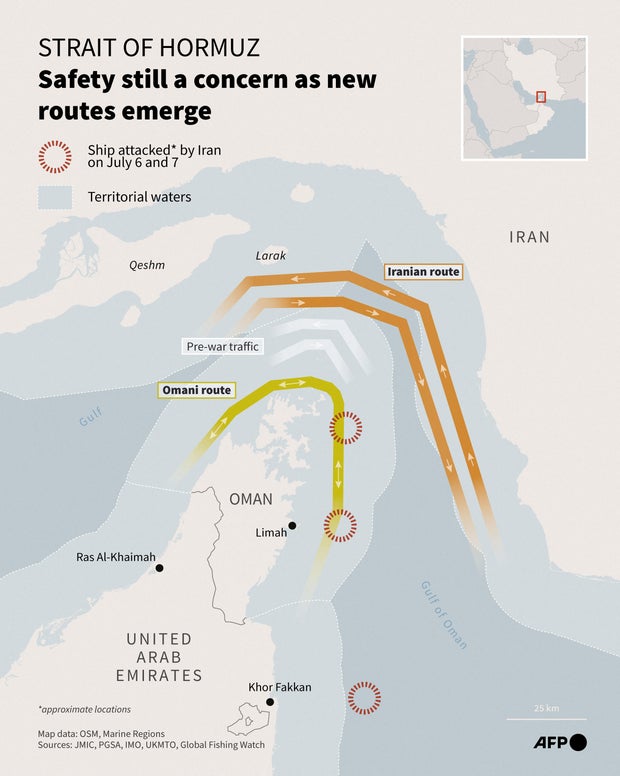
Both sides on Saturday expressed a desire to return to the conditions of that memorandum of understanding, but there appeared to be no clarity on U.S. and Iranian disagreements over the wording of Article 5 of the MOU.
"Araqchi and Al-Busaid also exchanged views on appropriate mechanisms for the safe passage of ships through the Strait of Hormuz, in accordance with Article 5 of the Islamabad Memorandum of Understanding," the readout said.
The U.S. and Iran have read that article differently, though. The wording of Article 5 states, "the Islamic Republic of Iran will make arrangements using its best efforts for the safe passage of commercial vessels, with no charge for 60 days only, from the Persian Gulf to the Sea of Oman, and vice versa."
Iran believes the wording of the article means ships should only follow its route hugging the Iranian coast, but the U.S. has offered a separate route through the strait along the Omani coast. That discrepancy has caused Iran to target ships on the southern route with missiles and drones.
Iran has also said it believes it should be able to charge a fee for transit of the strait after 60 days, which the U.S. has said it will not allow.
Several alleged Hezbollah members killed as Israeli strikes continue in Lebanon
Even as discussions between a U.S. delegation and Lebanon continue over Israel moving out of so-called "pilot zones" in southern Lebanon, the Israeli military killed several alleged Hezbollah members in a strike Saturday.
Israel said it observed "several Hezbollah terrorists transferring anti-tank missiles within the Security Zone in southern Lebanon" from a vehicle to a building. The Israel Defense Forces then said it saw additional Hezbollah members transferring more weapons into the building.
A strike on the location was conducted by air, the Israeli army said. It did not clarify how many people were killed.
As part of the trilateral deal signed at the U.S. State Department between Israel and Lebanon in late June, the Lebanese army would fill a security role in the "pilot zones" where the Israeli army withdraws. However, Israel has said it will only do so when it is sure Hezbollah forces have been eliminated from the areas.
U.S. delegation in Lebanon to discuss Israel "pilot zone" withdrawal: Official
A U.S. military delegation has met with Lebanon's army in Beirut to discuss the implementation of Israel's withdrawal from one of the "pilot zones" in occupied territory, a Lebanese military official told AFP on Saturday.
Under a framework agreement reached on June 26, Israel will gradually withdraw from areas of southern Lebanon where it has sent troops as part of its military campaign against Hezbollah, the Iranian-backed Shia movement that has long battled Israel.
As part of the agreement, the long-disempowered Lebanese military will take full control of two small areas dubbed pilot zones.
"The American military delegation arrived and began meetings with the Lebanese army command to discuss the mechanisms for implementing the first pilot zone from which the Israelis will withdraw, allowing the Lebanese army to deploy," the official said, requesting anonymity.
"This is the main objective the American military delegation is bringing to Lebanon. ... It is the translation and implementation of the framework agreement."
In Washington, a U.S. official had said that "we have moved to the implementation stage of the framework."
"The first pilot zone will launch in a matter of days, and further pilot zones are being mapped out and planned," the official said on condition of anonymity.
Pakistani mediators speak to Saudis, call for de-escalation
Ishaq Dar, deputy prime minister of Pakistan, spoke by phone Saturday with Saudi Prince Faisal bin Farhan Al Saud, the country's foreign minister, in an effort to de-escalate the situation in Iran.
"The two leaders exchanged views on the recent developments in the region and expressed deep concern over the escalations despite the signing of the Islamabad MoU between the United States and Iran in June 2026," Pakistan's Ministry of Foreign Affairs said in a readout of the call. "They agreed that the renewed conflict serves no one's interest and undermines efforts toward regional peace and stability."
Pakistan has played an integral role in negotiations, mediating between U.S. and Iranian representatives, including with the 14-point memorandum of understanding that President Trump said was dead earlier this week.
The two leaders "reaffirmed Pakistan's call on all parties to exercise maximum restraint and allow mediation efforts the necessary time and space to achieve a peaceful and meaningful outcome," according to the readout.
Iran's supreme leader vows to avenge his father's death
Iran's Supreme Leader Ayatollah Mojtaba Khamenei said in a statement published Saturday by Iran's state-run news agency that Tehran will avenge the death of his predecessor and father.
"We pledge to exact revenge for your pure blood and the blood of all the martyrs of these two wars from their criminal and disgraced killers," Khamenei said in the statement published by ISNA.
While the supreme leader didn't name any country or leader directly, the "two wars" likely refer to the past two open conflicts with the United States and Israel in 2025 and 2026.
"These criminals, whose names are fully documented from the top to the bottom of the ladder, will take their dream of a peaceful death in bed to their graves," Khamenei said.
17 people killed in U.S. airstrikes, Iran says
Iran's Ministry of Health said Saturday that 17 people were killed and 115 were injured in U.S. strikes on the country on Wednesday and Thursday.
The fragile ceasefire between the U.S. and Iran was broken on Tuesday when the U.S. and Iran exchange attacks after Tehran struck commercial ships on the Strait of Hormuz.
Iran's Ministry of Health says U.S. airstrikes across six of their cities on Tues killed 17 and injured 115 people. "14 surgeries have been performed, 102 patients have been discharged after receiving treatment," the ministry said in a statement.
Iran's foreign minister in Oman to continue negotiations
Iranian Foreign Minister Abbas Araghchi arrived in Oman on Saturday morning ahead of negotiations with the U.S. which are expected to continue via mediators.
According to Iran's IRNA news agency, Araghchi plans to discuss the Strait of Hormuz with his Omani counterpart today. The past week saw an intense exchange of attacks between the U.S. and Iran after Tehran attacked commercial tankers on the strait.
A Qatari official told CBS News that no Americans will attend the Omani talks.
Iran insists it had "kept its word" on agreement with U.S.
Iran insisted early Saturday it had "kept its word" with the U.S. and accused Washington of violating the memorandum of understanding (MoU) signed in June.
"Iran has so far kept its word, unlike the so-called U.S. Treasury Secretary who is violating [paragraph] 9 of the MoU," Iranian Foreign Minister Abbas Araghchi said in a social media post. "That violation follows other violations and missteps by the United States."
Paragraph 9 of the MoU calls for Iran to maintain its nuclear program as it was at the time and for the U.S. to not impose new sanctions or deploy additional forces to the region.
Araghchi's statement came after President Trump issued a threat in a Truth Social post late Friday to "decimate and destroy" Iran should there be an attempt on his life.
Trump issues threat to Iran if it tries to assassinate him: "Missiles are Locked and Loaded"
President Trump threatened Iran on Saturday after the funeral of former Supreme Leader Ayatollah Ali Khamenei saw open calls for his killing.
The comments by Mr. Trump, made on his Truth Social website, likely again will turn up tensions in the Middle East.
"1000 Missiles are Locked and Loaded and aimed at the Islamic Republic of Iran, with thousands of more to immediately follow, should the Iranian Government act on its threat," Mr. Trump wrote.
There had been multiple days of U.S. airstrikes targeting Iran following the Iranian strikes on three commercial tankers in the Strait of Hormuz, as well as Iranian retaliatory fire targeting nations across the Middle East.
The president went on: "Orders have already been given, and the U.S. Military is ready, willing, and able, for a one year period of time, subject to extension, to completely decimate and destroy all areas of Iran."
Earlier Friday, the New York Post quoted Mr. Trump as saying he had "left instructions" for the U.S. to bomb Iran "at levels that they've never seen before" if the Islamic Republic assassinates him, claiming he has "been No. 1" on their list of targets "for a long time."
CBS/AP
Iran privately told Trump advisers "they made a mistake" in shooting at ships in Strait of Hormuz
Iranian officials privately told Trump advisers that they made a mistake in shooting at commercial ships in the Strait of Hormuz, that the attacks stemmed from an "errant" sect of hardliners who are trying to undermine negotiations, and that they want to keep talking, senior U.S. officials said on Friday.
The White House wants the regime to publicly acknowledge its mistake, which the Trump administration views as a violation of the ceasefire.
President Trump has directed his team — led by Vice President JD Vance, the president's son-in-law
Jared Kushner, special envoy Steve Witkoff, and Secretary of State Marco Rubio — to continue negotiations.
The talks are to take place in Oman on Saturday.
The U.S. will respond, using military and economic leverage, if Iran continues to engage in hostile acts, the officials said.
"They came back to the table and said, 'We screwed up. We made a mistake. Let's keep talking,'" one official said.
Lebanese state media says Israeli strike kills 1 person
An Israeli strike on southern Lebanon killed one person on Friday, Lebanese state media reported, the latest attack despite a truce in the Israel-Hezbollah war.
"A young man from the city of Nabatieh was martyred in a raid by an enemy drone that targeted him this afternoon, when he was riding a motorcycle" in Kfar Rumman near the city of Nabatieh, Lebanon's state-run National News Agency said.
It also reported other strikes in the area, wounding at least one person.
The Israeli military said it targeted "a Hezbollah terrorist operating near an access shaft of the underground terror infrastructure at the Ali al-Taher Ridge, within the Security Zone where (Israeli) soldiers are operating," referring to a hill that overlooks the area of Nabatieh.
"In an additional strike, the (Israeli army) eliminated a suspect traveling in a vehicle who posed a threat to (Israeli) soldiers operating within the Security Zone," the Israeli military said.
Hezbollah drew Lebanon into the Middle East war by launching rockets at Israel in support of Iran. Israel responded with major airstrikes and a ground offensive, killing more than 4,300 people, according to Lebanese authorities.
Pakistan's prime minister urges Iran's president to preserve "hard-earned peace"
Pakistan's Prime Minister Shehbaz Sharif on Friday urged Iran's president to safeguard the "hard-earned peace" after Tehran and Washington exchanged strikes this week.
"We discussed the evolving regional situation and underscored the imperative of restraint, dialogue and diplomacy to safeguard the hard-earned peace gains of recent months," Sharif posted on social media of his conversation with Iranian President Masoud Pezeshkian.
Sharif added that Pakistan remained ready to continue "as an honest and sincere mediator for lasting regional peace."
U.S. sanctions Dubai-based Iranian financier
The Treasury Department has sanctioned Dubai-based Iranian financier Ali Ansari, his holding company and several Iranian currency exchange houses, officials announced Friday. The U.S. government is accusing them of diverting public wealth to benefit Iranian leader Mojtaba Khamenei and the Islamic Revolutionary Guard Corps.
The move, notably announced after Iran resumed attacks on international shipping in the Strait of Hormuz, freezes any U.S.-linked assets of those designated.
Qatari mediators in Iran worked to de-escalate situation, officials say
An Iranian official and a Qatari official confirmed to CBS News that Qatari mediators were in Mashad, Iran, to try to de-escalate the situation amid an intense flare-up in fighting between the U.S. and Iran.
The mediators are facilitating the indirect diplomacy to attempt to return to a truce and allow the Strait of Hormuz to reopen.
Two officials from the region told CBS News that Iranian officials will travel to Oman for talks on Saturday regarding the Strait of Hormuz and the dispute over the lanes for shipping traffic in their respective territorial waters.
Three sources familiar with the ongoing attempts to revive the truce, which lasted less than three weeks, told CBS News on Thursday that "active conversations" between the U.S. and Iran continued, although the diplomacy was indirect and mediated by Qatar.
Iran's Foreign Minister Abbas Aragchi has been speaking with Qatar's prime minister and his team for days, and a source familiar with the matter told CBS News he has been defending the actions of the Islamic Revolutionary Guard Corps, which fired on at least three commercial vessels Tuesday in Omani territorial waters. The IRGC has also sought to charge a fee for use of the lane, which the U.S. objects to.
Qatar has been going between the U.S. and Iran as they both seek to de-escalate the fighting that erupted after Iran attempted to exert control over the Strait of Hormuz, specifically the waterway lanes in Omani and Iranian territory. Article 5 of the U.S.-Iran memorandum of understanding was meant to reopen the trade route, but Iran has been attempting to divert traffic through the lane controlled by Iran and away from Omani waters. The agreement was meant to last until roughly Aug. 18.
Multiple officials told CBS News that Vice President JD Vance has been working the phones, along with Jared Kushner and envoy Steve Witkoff. Kushner, who is a private citizen, is in Sun Valley, Idaho, at a media conference.
On Thursday, the Saudi ambassador to the U.S. met with Secretary of State and national security adviser Marco Rubio to discuss the path forward.
No further details were shared through official channels about the discussions.
Gas prices start climbing again as U.S.-Iran tensions flare
Fuel prices are headed back up amid renewed clashes between the U.S. and Iran.
The national price of gasoline rose on Friday to $3.88 a gallon, up from $3.84 a week ago, according to AAA. In recent weeks, prices at the pump fell to as low as $3.80 on July 5, down from more than $4.50 in May, after Washington, D.C., and Tehran signed a temporary ceasefire last month.
Regular gas averaged $2.98 a gallon just before the Iran war started in late February. "Gas prices are going up again, as the future of the ceasefire between the U.S. and Iran remains uncertain," the auto group said in a report.
The latest spasm of violence is reviving concerns that a prolonged conflict could disrupt trade through the Strait of Hormuz. The number of ships traversing the strait on Thursday fell to 34, the lowest daily level since June 28, when Iran launched drone attacks in the region following U.S. airstrikes on the Islamic Republic, according to S&P Global MINT and S&P Global Commodities at Sea.
"Iran-linked and sanctioned traffic remained elevated, accounting for roughly one-third of total crossings," the financial research firm said of the ships navigating the strait on July 9.
Iran will respond against Israel if infrastructure is attacked, says security official
Iran will respond to any attack against its infrastructure, including by striking Israel, the head of the country's top security body said Friday.
"Any attack on infrastructure will be retaliated against, and the criminal Zionist regime responsible for these atrocities will not be safe from the response of our fighters," Mohammad Bagher Zolghadr said in a statement carried by state TV.
Fighting picked up again this week between the U.S. and Iran, with the U.S. military carrying out heavy strikes overnight between Wednesday and Thursday, saying it targeted 90 military sites.
The Islamic Republic accused Washington of also targeting civilian infrastructure in order to detract from the funeral of late supreme leader Ali Khamenei.
Bridges and railway links between the capital Tehran and Khamenei's hometown of Mashhad, where he was buried on Thursday, were hit, according to Iran.
On Thursday evening, Iranian state media reported a U.S.-Israeli attack on a military headquarters near Bushehr, where Iran's only civilian nuclear plant is located.
Israeli Defence Minister Israel Katz said Israel was prepared to resume its military campaign against Iran if needed, vowing to do so "with even greater force."
Trump says he "left instructions" to bomb Iran if the country assassinates him
The New York Post quoted President Trump Friday as saying he had "left instructions" for the U.S. to bomb Iran "at levels that they've never seen before" if the Islamic Republic assassinates him, claiming he has "been No. 1" on their list of targets "for a long time."
"I've been on their list for a long time. That's what we're dealing with," the Post quoted him as saying. "The only thing is, I've left instructions — if anything happens, to just literally bomb them at levels that they've never seen before."
Mr. Trump told the newspaper that reports suggesting Israel had provided intelligence indicating a specific threat to him this week were unfounded, saying, "No. Israel came up with nothing."
"I've been No. 1 [on Iran's kill list] for a long time, and it's the way life is, you know," he added.
Shipping giant Maersk returns to Red Sea with U.S.-flagged ships
Shipping giant Maersk announced Thursday that it would resume Middle East-US East Coast (MECL) services via the Suez Canal, years after threats by Iran-backed Houthi forces in Yemen forced the company to abandon the transit route in and out of the Red Sea.
U.S.-flagged container ships Maersk Denver and Maersk Chicago will be the first of the shipping giant's vessels to transit the Suez Canal as part of the restored service, the company said.
The company has been under pressure to restore the Suez route to boost maritime traffic as the U.S.-Iran war has severely restricted ship journeys in and out of the nearby Persian Gulf. The Suez route links the Red Sea and the Mediterranean, cutting voyage times to some ports, including along the U.S. East Coast, by up to two weeks compared to the southerly route through the Bab el-Mandeb strait.
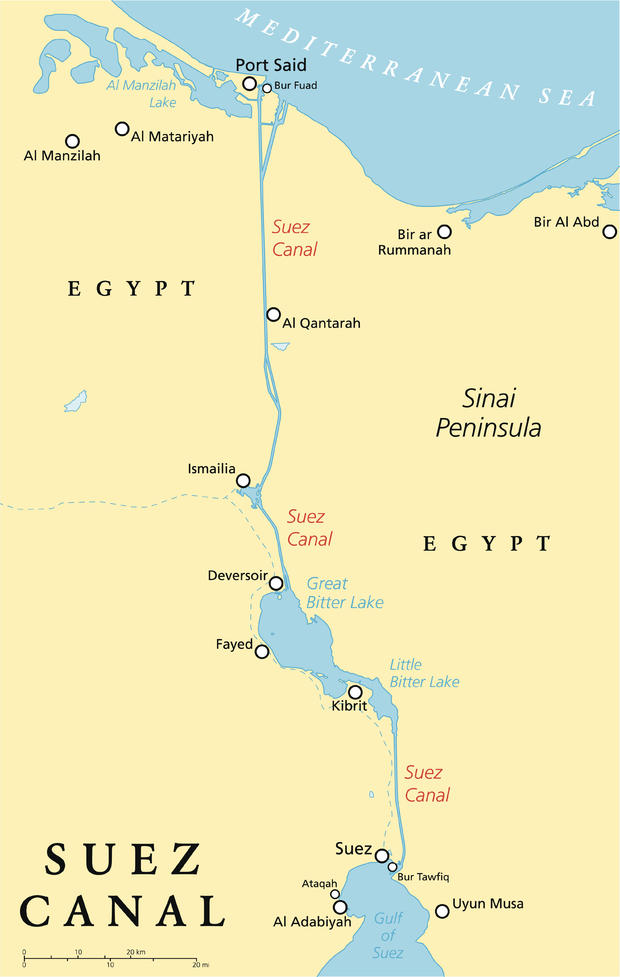
Some of Maersk's cargo vessels have been trapped in the Persian Gulf since the start of the Iran conflict in February, and the Suez route won't help them as the only way in or out of the Gulf is the Strait of Hormuz, where Iranian threats and attacks have kept shippers wary.
Although the Red Sea corridor is not a replacement for the strait, it is another critical connector for Middle Eastern energy producers to clients in parts of Asia and the Americas.
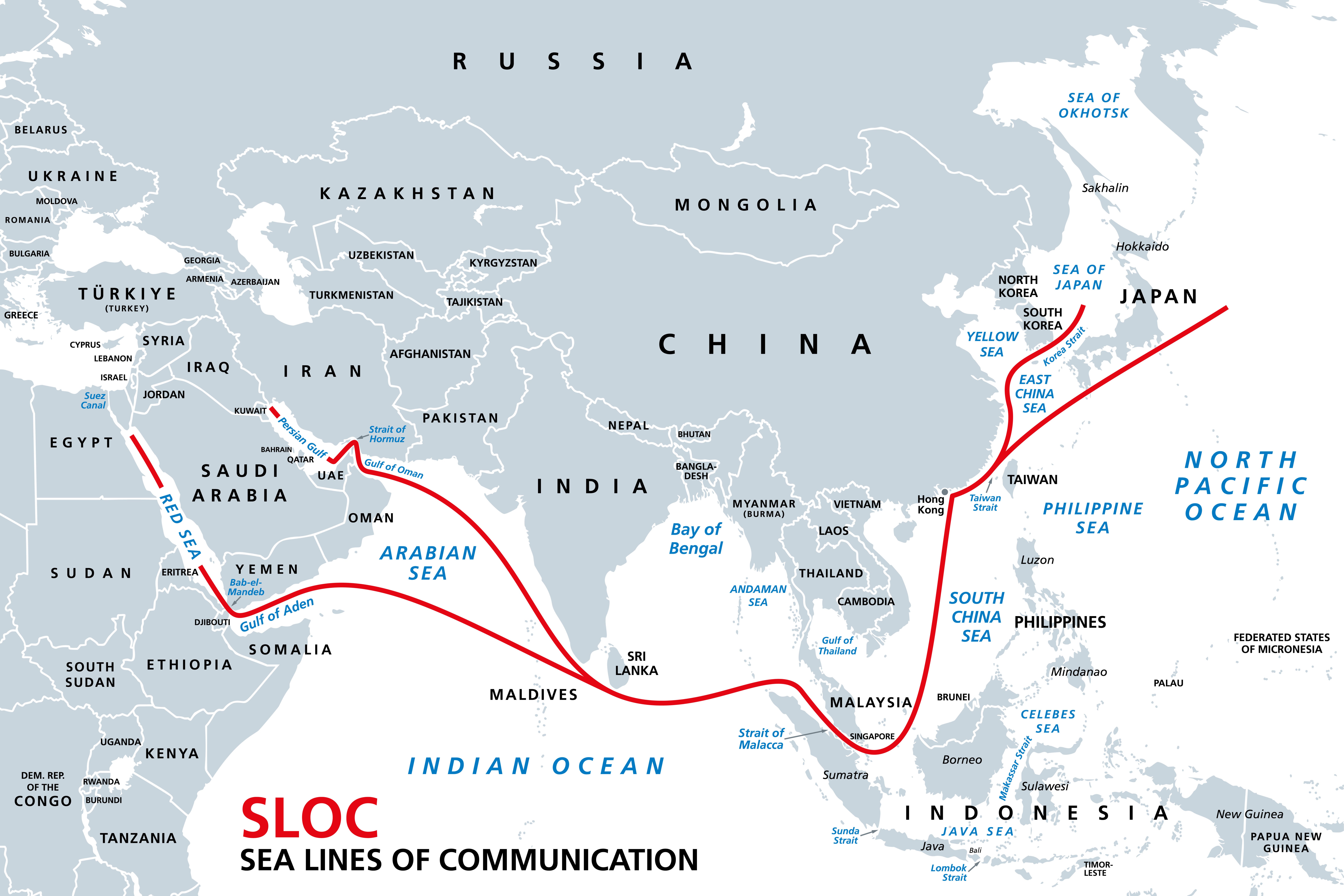
Maersk, one of the world's largest container shipping companies, suspended the MECL route in late 2023 after repeated attacks on civilian vessels around the Red Sea by the Houthis, forcing cargo vessels to take the much longer, and thus more expensive southern route around Africa's Cape of Good Hope.
Although Iran has threatened to target the Red Sea and Bab al-Mandab through its proxy Houthi force, the waterway has remained largely open during the war. The latest advisory from the Joint Maritime Information Center in Bahrain, of which the U.S. military is a member, said Thursday that, despite the Houthi rhetoric, it had observed no "operational indicators or targeting activity" in the region.
Someone else bombed Iran this week, but they haven't admitted to it
Mysterious, unclaimed airstrikes that hit Iran after the U.S. said it finished its attacks have again raised questions of who else may be targeting the Islamic Republic.
The strikes late Thursday, as Iran prepared to bury former Supreme Leader Ayatollah Ali Khamenei, hit areas across southern Iran. The country's theocracy hasn't directly blamed anyone, though one lawmaker warned the United Arab Emirates about allegedly providing support to the U.S. campaign against Iran.
Gulf Arab states, which Iran has targeted repeatedly since the war began Feb. 28, did not immediately respond to requests for comment Friday over the strikes.
Israel, which took part in the Iran war, also has not claimed any recent attacks on Iran.
The U.S. military's Central Command said Thursday around 6:30 a.m. local Iran time that it had concluded a round of strikes that hit 90 targets. Shortly after, Iranian state media reported a series of airstrikes and explosions targeting the country's Bushehr, Sistan and Baluchestan provinces.
CENTCOM did not respond to an Associated Press request for comment about the later strikes.
During the Iran war, officials said both Saudi Arabia and the UAE launched airstrikes targeting Iran, after Tehran struck energy sites in their countries.
On Friday, Iranian state media quoted Esmail Kousari, a member of the Iranian parliament's national security committee and a former commander in the paramilitary Revolutionary Guard, as warning the UAE would "pay the price for its cooperation with the United States."
He accused the Emirates of having a "behind-the-scenes" role in the recent U.S. attacks.
CBS/AP
U.S. still in "active conversations" with Iran via mediators, sources tell CBS News
The truce with Iran lasted less than three weeks, and the U.S. continues to try to revive it.
Three sources familiar with the ongoing attempts to revive a ceasefire with Iran told CBS News Thursday that "active conversations" between the U.S. and Iran continued, though the diplomacy was indirect, mediated by Qatar.
Iran's Foreign Minister Abbas Araghchi has been speaking with Qatar's Prime Minister and his team for days, and a source familiar told CBS that Araghchi has been defending the actions of Iran's Revolutionary Guard Corps, which fired on three commercial vessels Tuesday in Omani territorial waters.
The IRGC has also sought to charge ships fees for use of the lane, which the U.S. objects to.
Qatar has been going between the two countries, which both seek to deescalate the fighting that erupted after Iran attempted to exert control over the shipping lanes in Omani and Iranian territory in the Strait of Hormuz.
Article 5 of the 60-day long Memorandum of Understanding was meant to reopen the trade route, but Iran has been attempting to divert all traffic through the lane close to its territory, away from Omani waters.
The MoU was meant to last until roughly Aug. 18. Multiple officials told CBS that Vice President JD Vance has been working the phones, along with Jared Kushner and envoy Steve Witkoff.
CENTCOM conducted two days of intense strikes this week, and a U.S. official told CBS News that railways Iran was using to transport military supplies were among the targets.
There was no further detail shared through official channels about the ongoing discussions.
Trump says U.S. has agreed to continue talks with Iran, but ceasefire "over"
President Trump said Friday on Truth Social that the U.S. had agreed to a request from Iran to continue talks over a potential peace deal, but he reiterated his stance from earlier in the week that the ceasefire is "over."
"The Islamic Republic of Iran has asked us to continue 'talks.' We have agreed to do so, but the United States has stated to them, in no uncertain terms, that the Cease Fire is OVER!" Mr. Trump wrote.
During a NATO summit in Turkey earlier this week, the president said he believed the ceasefire with Iran had ended after the U.S. launched strikes in retaliation for Iranian attacks on commercial ships.
Qatari delegation in Iran to "stabilize" Gulf state's mediation role, Iranian news outlet says
Iran's semi-official Tasnim news agency said a Qatari delegation arrived Friday in the Iran to "stabilize" Qatar's position as a mediator following the events of recent days.
According to the report, the delegation is headed by an adviser to Qatar's foreign minister, and the visiting officials were likely to meet with Iranian Foreign Minister Abbas Araghchi in Mashhad, the northeastern city where memorial services for former supreme leader Ali Khamenei culminated Thursday in his burial.
Tasnim, which is closely linked with Iran's powerful Revolutionary Guard Corps, said the main purpose of the visit was to "stabilize Qatar's mediation position after the events on Tuesday or Thursday."
Qatar accused Iran this week of targeting a Qatari owned tanker in the Strait of Hormuz - one of three vessels struck by weapons in the vital waterway this week.
Iran has denied attacking a Qatari ship.
Vance, Witkoff and Kushner in contact with Qataris amid efforts to bolster diplomacy
A source familiar with the discussions tells CBS News that Vice President JD Vance, as well as U.S. envoys Steve Witkoff and Jared Kushner, have been in touch with Qatari officials this week after the dramatic escalation of attacks by the U.S. and Iran.
It wasn't clear how much progress had been made Friday as mediators from Qatar, Pakistan and other countries work to ease the tension sparked by Iranian attacks on ships in the Strait of Hormuz early this week. The U.S. responded with two days of intense strikes on at least 170 targets, drawing new Iranian attacks targeting U.S. allies in the Persian Gulf.
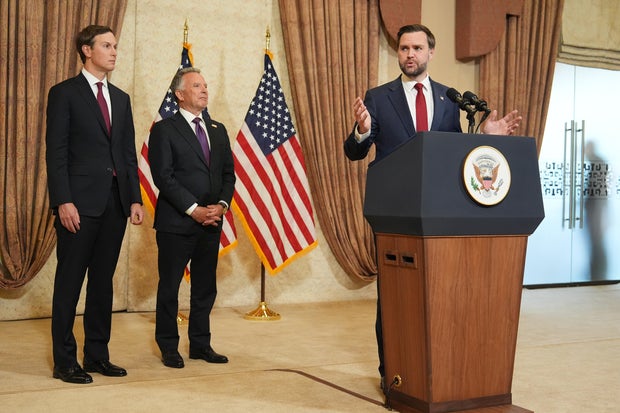
Iran has also confirmed ongoing discussions with mediators, but there's been no indication of any new direct contact between U.S. and Iranian officials.
This week's strikes represented the most serious challenge to date for the ceasefire agreed to by the U.S. and Iran as part of the memorandum of understanding signed in mid-June.
The MoU called for a ceasefire to enable 60-days of talks aimed at brokering a wider peace deal that would resolve contentious issues including the future of the Strait of Hormuz and Iran's nuclear program. So far, however, only two days of direct talks have taken place, though lower level "technical" negotiations had continued until this week's flare-up.
Qatar reaffirms role as mediator between U.S. and Iran, stresses "need to reactivate the diplomatic track"
Qatar will continue to serve as a mediator between the U.S. and Iran, the country's Foreign Ministry spokesman Majed Al Ansari said during a panel discussion at the Chatham House London Conference on Thursday.
Speaking at a session titled "The New Geopolitics of the Middle East," Al Ansari said Qatar remained committed to mediation "despite being directly affected" by the conflict. He stressed that the country's position was rooted in its belief that "military solutions will not achieve lasting stability, and the diplomatic path remains the only option capable of ending crises and achieving regional security and stability."
According to a statement released by Qatar's Foreign Ministry, Al Ansari said the region was facing "not a passing crisis, but rather an extension of accumulated cycles of escalation" causing unprecedented instability.
Al Ansari stressed "the need to reactivate the diplomatic track and create the conditions for sustainable political settlements" to strengthen economic integration and rebuild trust among regional states.
Lasting regional stability, he said, would require "respect for the sovereignty of states, strengthening collective action, and consolidating diplomacy as the best means of addressing crises and building a more stable future."
Israel says it has carried out more than 20 attacks in Lebanon this week
Israel's military said Friday that it had carried out more than 20 attacks in Lebanon over the course of the week, responding, it said, "Hezbollah ceasefire violations."
In a statement, the Israel Defense Forces said troops continued operating in the "security zone" they have occupied across southern Lebanon for weeks, "to remove threats to the State of Israel."
"As part of the activity, two underground routes were destroyed in the village of Majdal Zone. In addition, the Air Force and the forces carried out more than 20 attacks following Hezbollah ceasefire violations and killed a number of terrorists who were a threat to the forces," the IDF said.
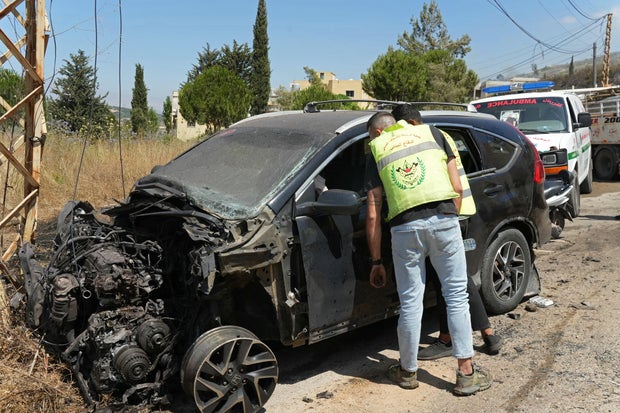
Israel's ongoing fight with Hezbollah, despite a U.S.-brokered ceasefire, has remained a major bone of contention in efforts to forge a peace agreement between the U.S. and Iran.
The memorandum of understanding signed in mid-June by President Trump and his Iranian counterpart calls for an immediate end of hostilities on all fronts, including in Lebanon, and Tehran has insisted that Israel keeping forces in the neighboring nation constitutes a violation of that agreement.
Israel and Hezbollah have continued attacks, albeit at a lower level, despite their ceasefire agreement, consistently justifying their actions as a response to the other side's violations.
30 boats destroyed in U.S. strike on Iranian port, fishermen's cooperative says
At least 30 fishing boats were destroyed by two U.S. projectiles that hit the Panj-Pelleh fishing pier in Bandar Abbas during attacks on Iran's coastline in the southern Hormozgan Province on July 8 and 9, according to a board member of a local fishermen's cooperative.
The official with the Posht-e Shahr Fishermen's Cooperative was quoted by state media as saying each boat was worth around $11,000, with the attacks causing significant financial losses for the local fishing industry.
Iran's IRNA state news agency quoted a deputy governor of the neighboring Bushehr Province, also on Iran's southwest coast near the Strait of Hormuz, as saying Thursday that U.S. strikes had hit the Benoud fishing pier in Asaluyeh, resulting in fishing boats belonging to local residents catching fire.
President Trump has said the U.S. would target small boats used by Iranian forces to lay sea mines in the Strait of Hormuz and surrounding waters.
The U.S. military's Central Command said the strikes earlier this week had been aimed at about 170 Iranian targets, including air defenses, drone and missile storage, naval targets and logistics infrastructure on Iran's coast.
U.S. encourages commercial vessels to use southern Strait of Hormuz route despite attacks
The U.S. Navy continues to encourage commercial ships to use the so-called southern route through the Strait of Hormuz, despite attacks by Iran this week targeting vessels trying to use that route and repeated warnings from Tehran for ships to only use a northern passage close to its coast.
An advisory released Friday by the international Joint Maritime Information Center (JMIC) in Bahrain, of which the U.S. Navy is a core member, reminded mariners in the region that the security threat level in the strait and surrounding waters remained severe, but it added "further information" specifically from U.S. Naval Forces Central Command.
"Notwithstanding recent unprovoked attacks on merchant vessels, mariners are reminded that the southern route of the [Strait of Hormuz] has been expanded and remains available for all traffic," the update, highlighted in red to differentiate it from the previous guidance, says.
JMIC urges mariners to coordinate any passage through the narrow waterway with the joint naval forces, but says it is not mandatory.
"Ships may transit the southern route without coordination," the advisory says.
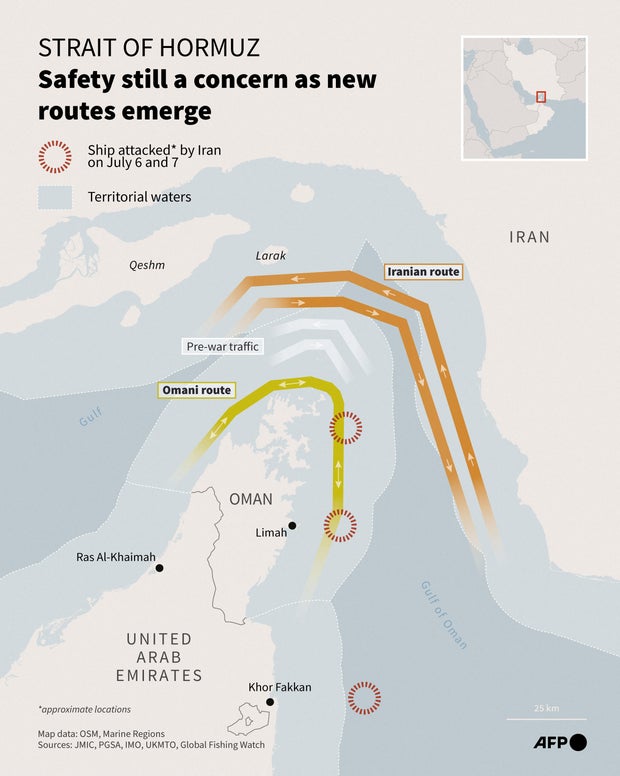
The new guidance added that additional routes are available, but are not "protected." The only other route known to exist, without a risk of potential sea mines laid by Iran, is the northern route designated by Tehran, which Iranian authorities say requires direct coordination with its military.
The Lloyd's List maritime intelligence group said Thursday that no large vessels had transited the southern route, which hugs the coast of Oman, with their location transponders switched on since July 7, though it could not rule out ships using the path with their locators switched off.
A CBS News review of open-source maritime tracking data on Friday found no commercial vessels publicly broadcasting locations that would indicate an intention to transit the southern shipping lane through the Strait of Hormuz.
Iran steps up regional diplomacy after flare-up, holds talks with Oman, Turkey, Pakistan and Saudi Arabia
Iranian Foreign Minister Abbas Araghchi held a series of telephone calls Thursday with senior regional officials, including the foreign ministers of Oman, Turkey and Saudi Arabia, as well as Pakistan's army chief, to discuss regional developments following an intense exchange of attacks with the U.S. this week.
The flare-up, sparked by Iranian strikes on several commercial vessels in the Strait of Hormuz, appeared to ease by Thursday evening after the most intense rounds of U.S. strikes since the ceasefire was agreed in mid-June.
In separate calls with Omani Foreign Minister Sayyid Badr Al-Busaidi and Turkish Foreign Minister Hakan Fidan, Araghchi discussed the latest regional developments, particularly in the Strait of Hormuz.
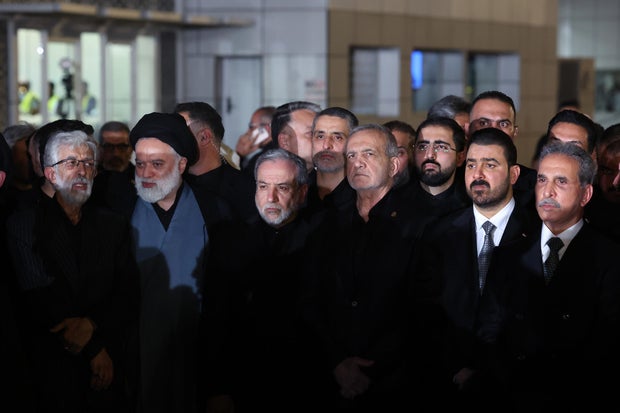
All diplomats on the calls stressed the importance of using diplomatic channels, maintaining contacts and coordination, and working to prevent further escalation, according to the Iranian government's description of the calls.
Araghchi also spoke with Pakistan's Army chief Field Marshal Asim Munir, during which the Iranian minister strongly condemned "aggressive attacks by the U.S. military on various areas of Iran," calling them violations of the ceasefire terms laid out in the memorandum of understanding.
Later Thursday, Araghchi held a phone call with Saudi Foreign Minister Faisal bin Farhan to discuss regional developments following what Tehran described as U.S. aggressive actions, as Iran continued diplomatic engagement with neighboring countries amid heightened regional tensions.
Mediators push to get U.S.-Iran diplomacy back on track
Countries that have mediated between the U.S. and Iran for weeks have been working for the past couple days to ease flaring tension between the two nations and to revive talks aimed at brokering a peace deal that addresses Iranian nuclear ambitions and other sensitive matters.
The diplomacy was set back by a dramatic flare-up early this week, as the U.S. responded to Iranian attacks on commercial vessels in the Strait of Hormuz with the most punishing series of airstrikes since the memorandum of understanding was signed in mid-June. Iran said at least 14 people were killed, and it lashed out with missiles targeting U.S. Gulf allies.
Qatar, Pakistan and other nations in the region have been working to bring Iran and the U.S. back to the negotiating table, sources with knowledge of the discussions told CBS News on Thursday.
While there has been little to indicate serious diplomatic progress over the last day or so, neither Iran nor the U.S. launched more strikes Thursday night into Friday morning.
This week's clash was most intense since U.S.-Iran ceasefire agreed, by significant margin
This week's exchange of strikes by the U.S. and Iran represented a sharp escalation between the countries. The U.S. military said Navy and Air Force weapons had hit a total of at least 170 targets in Iran on Tuesday and Wednesday - 17-times the number struck during the last salvo on June 26.
It was the most intense U.S. assault on Iran since President Trump and his Iranian counterpart signed the memorandum of understanding declaring a ceasefire in mid-June.
This week U.S. Central Command said it specifically targeted military sites, including Iranian air defenses and missile and drone storage and launch sites, along the country's coastline at the mouth of the Strait of Hormuz, suggesting a possible strategic motive to reduce Iran's ability to target ships in the region.
Iran retaliated on a larger scale, too, launching missiles and drones at Kuwait, Bahrain, Qatar, and Jordan. U.S. officials reported no significant damage to U.S. facilities in the allied nations, and U.S. casualties, and most of the weapons were intercepted.
While it was a significant escalation, it did not appear to be a return to full combat operations, however. During the height of the war, Iran was firing hundreds of missiles and drones every day at U.S. allies, and the U.S. was launching hundreds of airstrikes.
Notably, Israel has appeared to stay out of the latest eruption of fighting, and Iran has not targeted Israel this week.
Trump holds call with Netanyahu on latest developments in Middle East
President Trump spoke with Israeli Prime Minister Benjamin Netanyahu on Thursday, according to Netanyahu's office and a White House official.
Netanyahu's office said that Mr. Trump updated Netanyahu about "American moves in the Gulf," and also addressed "continued coordination between the countries in various sectors."
A White House official confirmed the call took place, but did not provide details.
Trump sees Iran's attacks on commercial tankers as terrorism, U.S. official says
A U.S. official told CBS News on Thursday that President Trump views the Iranian strikes earlier this week on three commercial tankers in the Strait of Hormuz as acts of terrorism.
The U.S. official said the 60-day ceasefire signed last month between the U.S. and Iran is performance-based, and Iran's actions in those strikes "failed performance at an unacceptable level."
According to the U.S. official, however, "technical talks" between the two sides are continuing. When asked about the ceasefire on Wednesday, Mr. Trump had said that "as far as I'm concerned, it's over." The president also said peace negotiations would continue, claiming that Iran "wants to make a deal so badly."
The U.S. official also reaffirmed Thursday the U.S. position that Iran cannot have a nuclear weapon.
U.S. insists Iran does not control Strait of Hormuz, despite dramatic slowing of traffic after ships attacked
The U.S. military reiterated its insistence on Thursday that Iran does not control the Strait of Hormuz.
In a social media post, U.S. Central Command said that, since early May, U.S. forces had helped more than 800 commercial vessels and 380 million barrels of crude oil transit the strait.
The statement came after the U.S. said Iran struck three commercial tankers in the strait earlier this week, reigniting fighting between the two sides amid what has been a shaky ceasefire.
The maritime journal Lloyd's List reported Thursday that strait traffic had "fallen sharply" since the two sides began exchanging strikes Tuesday.
The MarineTraffic.com tracking website showed early Thursday that there were just three fuel tankers in the strategic waterway openly broadcasting their positions — two of which are subject to U.S. sanctions for transporting Iranian oil.
"We're certainly better than we were in March and April, but until we have some sort of substantial agreement ... it's just going to remain very, very volatile," Andrew Wilson, head of research at BRS shipbrokers, said of shipping through the strait during a webinar held Thursday by Lloyd's List.
"We're not going back to February 27, and I think everybody understands that," Lloyd's List editor-in-chief Richard Meade said at the briefing. "A tentative 60-day agreement with few guarantees was never really going to change the dial much in terms of shipping decisions."
Iran says Khamenei's eldest son oversaw his final funeral ceremony
The Iranian government said the eldest son of former Supreme Leader Ayatollah Ali Khamenei, who was killed in a strike at the start of the Iran war, oversaw his father's funeral services Thursday as he was laid to rest.
Mostafa Hosseini Khamenei led the funeral prayer, the Iranian government said in an X post.
Khamenei's second son, Mojtaba Hosseini Khamenei, was named the new supreme leader of Iran in March, but he has not been seen in public since before the war and U.S. officials have said he was severely injured in the strike that killed his father, possibly disfigured.
Week-long memorial services for the senior Khamenei, who ruled over Iran for almost four decades before he was killed on the first day of U.S.-Israeli strikes, ended Thursday evening with his state funeral and burial in the city of Mashhad, in northeast Iran.
Tens of thousands of people came out to pay their respects to the late ayatollah at events in Iran and neighboring Iraq over the last week, often holding signs and burning effigies calling for the killing of President Trump.


