Government shutdown looms as leaders make little progress at White House meeting with Trump
Follow Tuesday's live updates on the shutdown here. See earlier developments below.
What to know about a possible government shutdown:
- Republicans and Democrats in Washington remain at odds over how to fund the government and avoid a shutdown by Oct. 1, 2025, with congressional leaders emerging from a meeting at the White House on Monday having made little progress.
- Vice President JD Vance said after the meeting: "I think we're headed to a shutdown."
- Senate Minority Leader Chuck Schumer, a New York Democrat, said there are "very large differences" between the two sides. Democrats are pushing for the extension of health care subsidies while Republicans want to extend current funding levels for seven weeks.
- House Speaker Mike Johnson said Schumer and Minority Leader Hakeem Jeffries "refuse to acknowledge the simple facts." Senate Majority Leader John Thune accused Democrats of "hostage-taking" and "hijacking" the appropriations process. The GOP leaders said Democratic senators should support a House-passed bill to extend funding.
- The apparent lack of progress leaves few options for avoiding a shutdown beginning at 12 a.m. on Wednesday. The Senate plans to bring up the House bill for another vote on Tuesday.
Trump posts fake video of Jeffries and Schumer outside White House; Jeffries calls it "disgusting"
Hours after meeting at the White House with the top two congressional Democrats, President Trump posted a fake video to Truth Social mocking the lawmakers.
The video, which appeared to be generated by AI, shows Schumer and Jeffries standing outside the White House, but splices in fake audio of Schumer claiming Democrats' plan is to "give all these illegal aliens free health care." Jeffries, meanwhile, is shown with a moustache and a sombrero, and the Mexican hat dance plays in the background.
In an interview later Monday with MSNBC's Lawrence O'Donnell, Jeffries called the video "disgusting," adding: "Bigotry will get you nowhere."
Schumer responded to the video by writing on X: "If you think your shutdown is a joke, it just proves what we all know: You can't negotiate. You can only throw tantrums."
Mr. Trump has posted fake images on Truth Social in the past. Over the weekend, he posted a cartoon of him firing his foe, Federal Reserve Chair Jerome Powell. The president hasn't attempted to fire Powell.
CBS News has reached out to the White House for comment.
Airline groups urge "immediate action" to prevent a shutdown
A coalition of U.S. airlines, industry groups and labor unions for airline workers pushed lawmakers to "take immediate action" to prevent a government shutdown, which they warned could hurt efforts to modernize the nation's aging aviation safety system.
Typically during government shutdowns, air traffic controllers and other essential workers are expected to keep reporting to work without pay, but many other staff at agencies like the Federal Aviation Administration are sent home.
A letter from the coalition — called Airlines for America — warned that a shutdown could halt efforts to hire and train new air traffic controllers, as the FAA struggles with staff shortages and invests billions in modernizing the air traffic control system.
"A government shutdown at this stage would jeopardize the important progress that we all have made on these efforts thus far," the letter says.
Jeffries rules out short-term bill to keep government open, says deal must address Obamacare credits
Jeffries said on CNN that Democrats' demand to extend Affordable Care Act tax credits in exchange for keeping the government open is "not simply a negotiating tactic."
The New York Democrat also ruled out the idea of passing a short-term bill to avert a government shutdown for seven to 10 days, giving lawmakers more time to negotiate.
"We are a no when it comes to kicking the can down the road," he said. "This issue needs to be dealt with immediately."
AOC: "My hope is that we do not see a replay of what happened in March"
Democratic Rep. Alexandria Ocasio-Cortez said she hopes Senate Democrats can remain united against the GOP's plan to avert a government shutdown and there's not a repeat of the March showdown, when several Democrats, including Schumer, delivered the remaining votes at the last minute to pass a short-term funding patch.
"My hope is that we do not see a replay of what happened in March and that we are moving forward together and concerted," she said.
The New York Democrat said legislating is a "team sport" and "as a team, we have responsibility to be on the same page and to enforce those expectations and agreements that we have with one another."
Here's how a government shutdown could impact the military
If the government shuts down this week, military personnel will continue to serve without pay until Congress strikes a deal.
During a shutdown, all active-duty service members, as well as National Guard who are currently deployed, must carry out their assigned duties with their pay delayed until the shutdown is over. Civilian personnel whose work the Defense Department considers essential, or "excepted," will also continue to work, while other civilians are furloughed for the duration of the shutdown.
"After the government shutdown, all government employees will automatically receive back pay, based on the terms of the Government Employee Fair Treatment Act of 2019," said Seamus Daniels, a fellow for Defense Budget Analysis at the Center for Strategic and International Studies.
Active-duty service members won't get paid on time unless Congress passes a separate piece of legislation to ensure military pay and allowances continue, as it did in 2013. One House Republican introduced a bill to keep members of the military paid earlier this month, drawing bipartisan support, but it's unlikely to pass in time because the House is out of session until next week.
Thune on White House meeting with Democrats: "It was lively"
Senate Majority Leader John Thune called Monday's meeting between President Trump and congressional leaders from both parties "lively."
"It was lively. It was spirited," the South Dakota Republican told Fox News' Bret Baier when asked whether the White House meeting was heated.
Thune criticized Democrats' proposal to avert a shutdown, which would extend government funding in exchange for concessions that mostly focus on health care.
"There isn't a world in which they're being realistic. This is a totally unserious proposal," he said.
Once again, Thune said it's up to Democrats to prevent a shutdown.
"It's up to them, the ball is in their court, and this is politics for them," Thune added.
Fetterman says he still supports GOP bill to prevent shutdown
Sen. John Fetterman of Pennsylvania said his mind has not changed in supporting the Republican measure that passed the House earlier this month, which would avert a shutdown by extending government funding until Nov. 21.
"I refuse to vote to shut our government down, and that's not going to change," he said.
Fetterman was the lone Democrat who joined Senate Republicans in voting for it. GOP Sens. Lisa Murkowski of Alaska and Rand Paul of Kentucky joined Democrats in voting no.
If the two GOP defections hold, Senate Republicans need at least eight more Democrats to vote in favor to reach the 60-vote threshold for passage.
"I think it's always wrong to shut the government down," Fetterman said, adding that "of course" he wants to extend the enhanced tax credits under the Affordable Care Act that expire at the end of the year, but he's not willing to shut down the government to force negotiations.
"What's our leverage here? What's our leverage?" Fetterman asked.
Schumer says he wouldn't support a bill to avert shutdown for 10 days
Amid reports that Democrats might propose a shorter continuing resolution to avert a shutdown for less than two weeks, Schumer threw cold water on the idea.
When a reporter asked Schumer if he would support a 7- to 10-day funding bill, Schumer responded, "No, no, we have to do it now. The time is a wasting. We have to do it now. We've delayed and delayed and delayed."
The main reason Schumer said time is running out is because many Americans will receive notices on Oct. 1 about health care premiums increasing, potentially by hundreds of dollars a month, and need to make a decision about whether to change their health care coverage within weeks.
Trump "appeared to have an open mind"
After leaving his news conference with Schumer, Jeffries told reporters that Mr. Trump "appeared to have an open mind as it relates to how to find a bipartisan path forward."
Schumer says there was a "possible division" between GOP leaders and Trump in their conversation
Speaking to reporters on Capitol Hill, Schumer said it appeared to him there was a "possible division" between where the Republican congressional leaders stand and where Mr. Trump stands.
Schumer said he and Jeffries particularly raised the need to extend the Affordable Care Act's enhanced health insurance tax credits and the concern that the threat of rescissions and impoundments — two controversial strategies for the Trump administration to avoid spending money appropriated by Congress — make negotiations impossible.
"When we made these arguments, it was clear there was a division, or possible division, between the president and the two Republican leaders," Schumer said. "The Republican leaders were adamant that they do nothing on rescission, and they just wanted to kick the health care problem down the road. Well, they've been kicking it down the road since March. And in fact, I made the point clear to the president and to the legislative leaders, as did Leader Jeffries, that this meeting should have occurred much earlier, but it didn't."
Schumer said he relayed to the president the story of a woman who told Schumer her daughter has cancer and is losing her health insurance, and the president wasn't aware millions of Americans would pay huge increases in their health care bills because of the ACA tax credits expiring this year.
"So it seemed from his body language and some of the things he said that he was not aware of the ramifications of … the bad, bad implications on health care for Americans, nor the argument about rescissions," Schumer said.
Schumer said he urged the president to have Republicans use Democratic provisions on the ACA and on rescissions to avoid a shutdown.
"It's in the president's hands whether we avoid a shutdown or not," Schumer said. "He has to convince the Republican leaders. Now we know why they didn't want him to meet with us."
Top House Democratic appropriator on if Democrats will take shutdown blame: "Get over it!"
Rep. Rosa DeLauro of Connecticut, the top Democrat on the House Appropriations Committee, gave a fiery response when asked by a reporter if she worried that Democrats would take the blame for a shutdown.
"Get over it! Get over it!" she said. "We have been trying to sit down."
She said there had been a consensus between the top Democratic and Republican appropriators in Congress to move forward with a bipartisan short-term funding bill that considered Democratic priorities, but that Thune, Johnson and Mr. Trump torpedoed the plan.
"You want to have a good-faith effort? Come and talk to us about what priorities we have," she said. "Sit down with us. Let's hammer it out."
Vance said Democrats had some "reasonable" ideas, but "we're not going to let you take the people's government hostage"
Vance acknowledged that both he and the president thought Schumer and Jeffries had some "reasonable" ideas, but faulted them for using their proposals as leverage in the fight over funding the government.
"They had some ideas that I actually thought were reasonable," Vance said. "And they had some ideas that the president thought was reasonable."
He continued: "What's not reasonable is to hold those ideas as leverage and to shut down the government unless we give you everything that you want. There were multiple times where Leader Jeffries or Leader Schumer would say, 'You know what, we should be doing this,' and the president of the United States would say, 'Yeah, absolutely, let's have that conversation.' But we're going to do it in the context of the people's government being open. We're not going to let you take the people's government hostage and then give you everything you want. And that's really the state of negotiations."
Thune accuses Democrats of "hostage-taking" and "hijacking the American people"
Thune held up the 24-page continuing resolution to reporters.
"I don't know where they're saying this is some huge partisan thing," Thune said. "This is something we do fairly routinely."
"This is purely and simply hostage-taking on behalf of the Democrats," Thune added. "The Republicans are united."
Thune also said declining to vote for the continuing resolution "is a hijacking of the American people."
Johnson says Democrats will be responsible for shutdown consequences
Johnson insisted Republicans are being straightforward in putting forth a clean funding proposal, saying there's "nothing partisan in here."
Johnson said Democrats are trying to bring in "extraneous issues," like health care, and if the government shuts down, "the consequences are on them."
He told reporters that Mr. Trump invited congressional leaders to the White House because he is "operating in good faith" and "he demonstrated that very well."
"The problem is that Chuck Schumer and Hakeem Jeffries refuse to acknowledge the simple facts," he said.
Vance: "I think we're headed to a shutdown" because of Democrats
Vance, speaking on behalf of the White House, said they had "a very frank conversation with the Senate and the House Democratic leadership."
Vance accused Democrats of, metaphorically, putting a "gun to the American people's head" by threatening to shut down the government.
"We know that American health care policy is broken," Vance said. "We've been trying to fix it for the eight months that we've been in office."
He said negotiations over health care policy should take place outside the context of government funding.
"I think we're headed to a shutdown because the Democrats won't do the right thing," he said. I hope they change their mind, but we're going to see."
Jeffries: "Significant and meaningful differences remain"
Jeffries told reporters that congressional leaders and Mr. Trump had a "frank and direct discussion" but "significant and meaningful differences remain."
"Democrats are fighting to protect the health care of the American people," he said, calling it a "deadly serious issue for the American people."
Jeffries and Schumer did not take any questions.
Schumer after meeting with Trump: "Still large differences between us"
Schumer said he and Jeffries concluded their meeting with the president. Speaking outside the West Wing, Schumer said there are "still large differences between us."
Schumer said Democrats and the White House have "very large differences" on health care and concerns that Republicans and the White House would undo approved government funding through rescissions.
"For the first time, the president heard our objections, and heard why we needed a bipartisan bill. Their bill has not one iota of Democratic input," Schumer said. "That is never how we've done this before."
Schumer said he and Jeffries "made to the president some proposals," and that "ultimately, he's the decisionmaker."
Schumer said he hopes the president tells Republicans they need to work on the key issues with Democrats, including health care.
Trump meeting with lawmakers is underway
A White House official says the president's meeting with congressional leaders — Speaker Mike Johnson, Senate Majority Leader John Thune, Senate Minority Leader Chuck Schumer and House Minority Leader Hakeem Jeffries — began shortly after the president's appearance with Netanyahu wrapped up. The meeting is taking place behind closed doors.
Why Congress still gets paid during a shutdown
Hundreds of thousands of federal employees could soon go without pay or face potential layoffs if there's a shutdown, but lawmakers will continue to get paid even if they haven't reached a deal to fund the government.
The reason is because of how their pay is treated under the Constitution and federal law. Article I, Section 6 of the Constitution states: "The Senators and Representatives shall receive a Compensation for their Services, to be ascertained by Law, and paid out of the Treasury of the United States." This means they must get paid whether or not other parts of the government are funded.
Lawmakers' pay has been funded by a permanent appropriation since 1983, according to a recent Congressional Research Service report, meaning funding for their pay doesn't need to be renewed annually.
Read more here.
Trump on meeting with Democrats: "We'll see how that works out"

Wrapping up his appearance with Israeli Prime Minister Benjamin Netanyahu at the White House, the president said he's meeting with Democratic leadership soon about keeping the country open. Mr. Trump said they're going to "have to do some things" differently.
"I'm meeting with, as you know, a couple of Democrats in a little while about the country, about keeping our country open," he said. "They're going to have to do some things because their ideas are not very good ones, they're very bad for our country. So we'll see how that works out."
Congressional leaders head to the White House for meeting
Senate Minority Leader Chuck Schumer, Majority Leader John Thune and House Minority Leader Hakeem Jeffries left the Capitol around 3 p.m. to head to the White House for their meeting with the president, who is currently holding a news conference with Israeli Prime Minister Benjamin Netanyahu. House Speaker Mike Johnson is also expected to attend.
Alan He, Cristina Corujo and Jaala Brown
How a shutdown would affect the Justice Department
A government shutdown would affect only a small number of Justice Department operations and legal activities, according to the department's contingency plans. No FBI agents would be furloughed, and criminal cases — including that of former FBI Director James Comey — would not be delayed or impacted. Only approximately 10% of Justice Department workers would potentially be sent home.
According to the memo, the department would scale back some of its civil litigation, including suits against organizations, local government and business. "Civil litigation will be curtailed or postponed to the extent that this can be done without compromising to a significant degree the safety of human life or the protection of property," the plan said.
There will be pauses on the transfer and relocation of employees and agents if Congress doesn't pass new funding by Oct. 1. The pause would impact FBI Director Kash Patel's initiative to reduce the number of employees who work in FBI headquarters in Washington and redeploy them to the bureau's more than 50 field offices.
"Employees may not be reassigned or given new duties, and offices may not be restructured, in order to move individuals from a non-excepted function into an excepted function," the memo said, referring to work that isn't allowed to continue during a shutdown and work that is.
The department's National Security Division, the DEA and the ATF would be largely untouched. The memo noted that there are alternative sources of revenue, including "multiple-year appropriations" and fees, to help support many of its missions.
The memo emphasized that there will be no scale-back in criminal operations or U.S. Marshals services. Extraditions are also "necessary to protect life and property and therefore excepted," the plan said.
The department cited the president's emphasis on immigration enforcement to justify keeping employees in the Executive Office of Immigration Review on the job: "A national emergency was declared by President Trump citing the threat to the national security and economy of the United States caused by illegal migration."
Labor Dept. to delay economic data if government shuts down, putting Friday's jobs report in doubt
The U.S. Department of Labor said it would delay releases of economic data if the federal government shuts down this week, which could postpone Friday's highly anticipated monthly jobs report.
On Friday, the Labor Department posted a 73-page "contingency plan" detailing operations if government funding lapses at midnight on Sept. 30. If that occurs, the Bureau of Labor Statistics (BLS) would suspend all operations, including data collection activities for BLS surveys, website updates and economic reports, the plan states.
The BLS is scheduled to release its report on September employment gains on Oct. 3. In a shutdown, government agencies must stop all non-essential functions until funding is approved by Congress and signed into law, except for programs that are funded from other sources, such as fees, or under other legislation.
The BLS' closely watched monthly jobs report drew scrutiny last month when President Trump fired its commissioner of labor statistics after disappointing employment numbers. At the same time, the Federal Reserve has signaled it is closely watching the labor market for signs of weakness amid a hiring slowdown.
Read more here.
Thune says it's "up to Democrats" whether Congress averts a shutdown
Thune reiterated his message to reporters at the Capitol ahead of the White House meeting. When asked how hopeful he is about averting a shutdown, he said it's "up to Democrats."
"We have a clean, short-term bipartisan CR sitting at the desk," he said. "It's up to them."
The majority leader said he plans to bring up the House-passed continuing resolution for a vote on Tuesday. The measure fell short of the support needed earlier this month.
Soldiers likely won't get paid during shutdown despite "big, beautiful bill" funds
Active-duty service members are considered essential personnel and will continue to report for duty during a shutdown but likely won't get paid until Congress authorizes new funding for the armed services, despite tens of billions of dollars allocated to the Pentagon in Republicans' One Big, Beautiful Bill Act.
Chris Towner, policy director at the Committee for a Responsible Federal Budget, a Washington think tank, told CBS News that the $150 billion approved for the Pentagon over the summer was meant largely for other purposes.
"It depends a little bit, but for the most part, no, they can't pay soldiers with that. The way that we pay soldiers is through a military compensation for each of the armed services, and none of those accounts got plus-ups in the One Big, Beautiful Bill," Towner said.
Towner said there are a handful of "fungible accounts" that the Pentagon could use to pay some soldiers, but doing so would be "really inequitable." He said the department could theoretically use about $1 billion under the OBBBA that was designated for the Pentagon to help with immigration enforcement.
"That would be the only money that I would think that maybe they'll spend, but I don't even think they'll spend that, because it's only a billion dollars," Towner said. He noted that Congress could pass a separate bill ensuring soldiers get paid, which lawmakers did during a previous shutdown in 2013.
In its guidance for a possible shutdown, the Pentagon said there are about 2 million active-duty service members who would continue to work during a lapse in funding.
Kaine: "I want an assurance that if we make an agreement, it will be honored"
Sen. Tim Kaine, a Virginia Democrat who represents thousands of federal workers, outlined to reporters ahead of the White House meeting on Monday what he said is a "very solid proposal" from Democrats to "ameliorate the effect of drastic cuts to our state and our country's health care network," while noting that "we're willing to negotiate."
Kaine said there has been GOP interest in Democrats' push to extend health care subsidies. But he added that "I definitely want to believe and be firm" that "a deal's got to be a deal."
"And I want to see a commitment," Kaine said. "I don't think every 'i' has to be dotted to satisfy me … but I want to see a commitment to doing what's right by the health of my constituents."
Kaine said he would wait to see what came out of the White House meeting.
The Virginia Democrat said "the main thing I'm worried about is a president who would agree to a deal and then immediately start firing people and tearing everything up, because that's what he's done."
"So I want an assurance that a deal is a deal," Kaine said. "I want an assurance that if we make an agreement, it will be honored."
When asked whether Democrats were risking a painful shutdown for their constituents by drawing a red line on health care, Kaine responded, "Is there a problem with asking?"
"I mean, isn't this the way this is done?" he said.
How would a government shutdown affect Social Security recipients?
Even if a U.S. government shutdown begins on Oct. 1, the 74 million Americans who collect Social Security will continue receiving their monthly checks, although some services could be disrupted due to a potential halt in federal activities, according to experts.
Social Security benefits are covered by mandatory spending, which means that the funding for the program has already been approved by Congress without an expiration date. As a result, Social Security recipients including retirees, disabled Americans and the dependents of deceased workers wouldn't see an interruption in their monthly payments if the government shuts down.
However, other Social Security services could be impacted by a shutdown, according to the National Committee to Preserve Social Security & Medicare. The Social Security Administration's working budget requires approval from Congress, with lawmakers currently at loggerheads over funding the federal government past Sept. 30.
If an agreement isn't reached before then, some Social Security services could be temporarily halted until the issue is resolved, according to both the Social Security Administration and experts on the retirement program.
"The system hasn't missed a payment in its entire 90-year history and won't start now," Max Richtman, CEO of the National Committee to Preserve Social Security & Medicare said in an email. "But customer service at the Social Security Administration (SSA) may be disrupted, including benefit verifications, earnings record corrections and updates, overpayments processing, and replacing Medicare cards."
Read more here.
What happens when government funding runs out?
In a shutdown, the federal government must stop all non-essential functions until funding is approved by Congress and signed into law, except for programs that are funded by other means, like fees or other legislation. Each agency determines what work is essential and what is not. Members of Congress make that determination for their own staff, as well.
The Constitution says the Treasury Department cannot spend money without a law authorizing it. Under a statute known as the Antideficiency Act, agencies are required to cease operations — with certain exceptions — in the absence of funding authorized by Congress.
"No money can come out of Treasury whether you're essential or not essential. But who can keep working and incur obligations, even when there are no appropriations — there are three exceptions," said Matt Glassman, a senior fellow at the Government Affairs Institute at Georgetown University.
The exceptions under the Antideficiency Act allow the government to fund operations to protect life and property, and keep officials involved in the constitutional process on the job, like the president, his staff and members of Congress.
Essential employees continue to work during the shutdown, but don't get paid until funding is restored to their agency. Employees in nonessential positions are typically furloughed until the government is funded again, although that could look different this time if there are widespread layoffs. Under a 2019 law, furloughed employees are guaranteed to receive back pay once the shutdown is over.
Read more on what happens during a shutdown here.
Lessons of March funding fight color Democrats' shutdown approach
The last funding fight has seemed to color the Democrats' approach this time around. In March, Democrats pledged to push back on a GOP funding plan, but Schumer changed course at the eleventh hour, delivering one of the Democratic votes necessary to propel the measure to passage and prevent a shutdown.
At the time, Schumer argued that a shutdown risked doing more damage to the federal government, despite intense criticism from some within his own party. Since then, he's faced heated opposition from Democrats, including calls for new leadership, and plummeting poll numbers. Now, faced with the latest funding fight, he's changed his tune.
When asked whether the key difference between the last spending fight and this one is the pressure from the Democratic base to stand up to Mr. Trump, the minority leader told NBC on Sunday "absolutely not."
"We're hearing from the American people that they need help on health care," he said.
Since March, Republicans in Congress passed the signature legislation of Mr. Trump's second term, which included restrictions to Medicaid that Democrats disavowed. And the GOP also approved a rescissions package that clawed back congressionally approved funding for foreign aid and public broadcasting, which Democrats say has increased distrust that funding agreements will be honored.
But in March, Schumer also argued that a shutdown would have given wide latitude to the executive branch and the Department of Government Efficiency to make deeper cuts to the federal workforce, and he noted that there wouldn't be an offramp to reopen the government.
Schumer addressed the change of tune Sunday: "As for these massive layoffs, guess what — they're doing it anyway."
"The heat is on them when they do this," Schumer added. "And the American people won't like it at all."
Leavitt says Trump is "giving Democrats one last chance to be reasonable today"
White House press secretary Karoline Leavitt told reporters ahead of the meeting on Monday that "our message and what we want out of this is very simple: The president wants to keep the government open, he wants to keep the government funded."
"There is zero good reason for Democrats to vote against this clean, continuing resolution," she said, adding that "the president is giving Democrats one last chance to be reasonable today."
Asked whether the president is prepared to negotiate with Democrats in the meeting, Leavitt said "there's nothing to negotiate when you have a clean CR."
"There are of course important policy discussions that can be had, but we are nearing a government shutdown and we are nearing a funding deadline," Leavitt said. "The president wants to make this deadline, he wants to keep the government open."
Jeffries says Dems are looking to "have a good-faith negotiation" about averting shutdown at White House
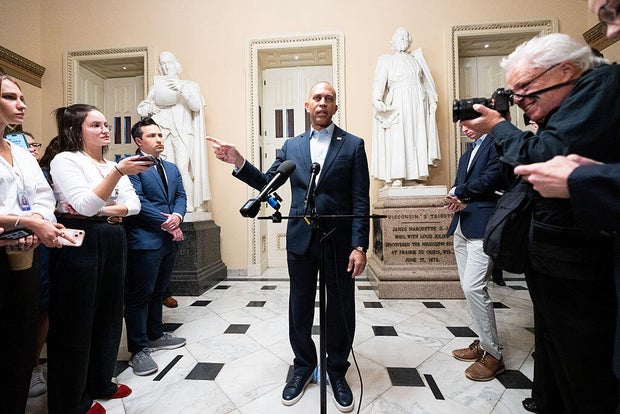
Jeffries, speaking to reporters at the Capitol, reiterated Democrats' position ahead of the meeting at the White House on Monday, saying "we've made clear that we are willing to find a bipartisan path forward on a spending bill negotiated by Democrats and Republicans, but it has to meet the needs of the American people."
"What we will not do is support a partisan, Republican spending bill that continues to gut the health care of the American people," Jeffries said.
The House minority leader said he and Schumer are in "lockstep," adding that "we're heading into the meeting to have a good-faith negotiation about landing the plane in a way that avoids a government shutdown, but does not continue the Republican assault on the health care of the American people."
Jeffries argued that over the last few months, Republicans "have created a health care crisis in the United States of America," with their restrictions to Medicaid in the One Big, Beautiful Bill Act. He said Republicans "have refused to extend the Affordable Care Act tax credits, and as a result of that, millions of working-class Americans are going to experience skyrocketing premiums, copays and deductibles at a time when America is already too expensive."
"This is a five-alarm fire, in terms of the Republican-caused health care crisis, and that's why Democrats are determined to turn things around," he said.
Asked whether Democrats would back a clean continuing resolution if they get assurances that Republicans are willing to negotiate on extending the health care subsidies going forward, Jeffries said the Democrats' position is "a permanent extension of the Affordable Care Act tax credits."
"No one can trust their word on health care, are you kidding me?" Jeffries said. "These people have been trying to repeal and displace people off the Affordable Care Act since 2010. That's 15 years. And on behalf of the American people, we're supposed to simply take their word that they're willing to negotiate?"
Pentagon shutdown plan calls for 334,904 civilian workers to be furloughed
The Defense Department, which the Trump administration has rebranded the Department of War, released its contingency plans for a shutdown over the weekend. The document says 334,904 of the department's 741,477 civilian workers would be furloughed in the event of a funding lapse. The department would retain 182,684 civilian workers whose pay comes from sources other than annual appropriations, as well as 223,889 who are "necessary to protect life and property."
The 16-page guidance document notes that the roughly 2 million service members who are "on active duty, including reserve component personnel on Federal active duty, will continue to report for duty and carry out assigned duties."
It lists activities that are excepted under the Antideficiency Act, the law that bars agencies from spending without approval from Congress, and says employees whose work is not excepted will be furloughed. Employees who continue to work through a shutdown are not paid until Congress approves more funding.
"Civilian personnel, including military technicians, who are not necessary to carry out or support excepted activities, are to be furloughed using lapse in appropriations (often referred to as 'shutdown') procedures and guidance provided by the Office of Personnel Management," the document says. "Only the minimum number of civilian employees necessary to carry out excepted activities will be excepted from furlough."
A history of government shutdowns: The 14 times funding has lapsed since 1980
A government shutdown occurs when Congress fails to approve funding for federal agencies. Before 1980, agencies largely continued operating during a lapse in funding with the assumption that Congress would act quickly. But in 1980 and 1981, then-Attorney General Benjamin Civiletti authored a series of legal opinions that found government agencies didn't have the authority to continue running during a gap in funding.
President Ronald Reagan oversaw eight shutdowns during his time in office, the longest of which lasted three days. There were three funding gaps between 1990 and 1995, then none until 2013.
The threat of a government shutdown has become more frequent over the past decade, as Congress has found itself engaged in funding fights that are ultimately resolved with massive, year-long spending packages. The most recent lapse in government funding, in late 2018, caused $3 billion in permanent losses, according to the Congressional Budget Office. Hundreds of thousands of federal workers are expected to feel the impacts of a shutdown if a deal isn't reached this time around.
Read about the 14 times the government has shut down since 1980 here.
The state of play in the Senate ahead of the shutdown deadline
Earlier this month, the GOP-controlled House passed a bill known as a continuing resolution that would extend current funding levels for seven weeks and thus avoid a shutdown. But the bill fell short in the Senate, where 60 votes were needed. Republicans control 53 seats in the upper chamber, meaning they need Democratic votes to get the bill over the finish line.
But Senate Democrats appear mostly united in opposing the bill, arguing Republicans should have negotiated with them to find an outcome they could support. Senators are returning to the Capitol on Monday afternoon, where they are set to convene at 3 p.m. to search for a path forward.
Thune told NBC that whether the government shuts down is "totally up to the Democrats," outlining that "there is a bill sitting at the desk in the Senate right now" that the House passed that would keep the government open. He said the continuing resolution could get another vote this week.
"This decision, in my judgment at this point in time, is up to a handful of Democrats," Thune said. "We need eight Democrats to pass it through the Senate."
Congressional leaders set to meet with Trump at White House at 3 p.m.
The top four congressional leaders — Senate Majority Leader John Thune, Senate Minority Leader Chuck Schumer, House Speaker Mike Johnson and House Minority Leader Hakeem Jeffries — are set to meet with the president at the White House around 3 p.m.
The meeting comes as Democrats have for weeks sought to get Republicans to the negotiating table. Schumer told NBC on Sunday that after Mr. Trump canceled a meeting with the leaders last week, he called Thune on Friday and urged him to get the leaders together for a meeting. The New York Democrat called the meeting a "first step," saying "we need a serious negotiation."
Sen. Amy Klobuchar says "Republicans have created a health care crisis"
Sen. Amy Klobuchar, a Minnesota Democrat, told "Face the Nation with Margaret Brennan" on Sunday that "Democrats are united in pushing" for an extension of expiring health insurance subsidies, accusing Republicans of creating a "health care crisis."
"My constituents, Americans, are standing on a cliff right now with these insurance premium increases that are upon them," Klobuchar said. "So, Democrats are united in pushing on this and saying, 'look, let us do something about this crisis before it is too late."
Klobuchar, a member of Senate Democratic leadership, outlined that without the extension of the health insurance subsidies, premiums could increase by an estimated 75%. And she stressed that addressing the subsidies is a "now thing."
"It's not a December thing. It's not a January thing. It's not an offramp," Klobuchar said. "It is something we have to get done now."
Trump: "I just don't know how we are going to solve this issue"
Mr. Trump told CBS News on Sunday that "I just don't know how we are going to solve this issue." He indicated that a shutdown is likely unless Democrats back down from their negotiating position.
The president cast the Democrats' current demands, which have centered on extending Affordable Care Act insurance subsidies, as ill-advised. He said if the Democrats want to discuss health care, they should work with him to prevent undocumented migrants from accessing public benefits.
"The Democrats, incredibly, want to keep their old policies of open borders and we're not going to have it. We're not going to allow it," Mr. Trump said. He added that any possible health care negotiations must address immigration and border-related matters, otherwise, "It's just not acceptable for us."
Read more here.