Government shutdown drags on as Senate GOP eyes key Friday vote

Follow live updates on the shutdown for Friday, Nov. 7, here. See earlier developments below.
What to know about Day 37 of the government shutdown:
- Senate Republicans are planning a different approach to try to end the government shutdown on Friday, sources familiar with the matter tell CBS News, with the hopes of peeling off enough moderate Democrats to end the stalemate.
- The GOP plan involves a vote on advancing the House-passed continuing resolution with the goal of amending it to include long-term appropriations bills and an extension of government funding beyond Nov. 21. Senate Republicans are hoping that moderate Democrats who have been involved in negotiations all week will be enticed by the appropriations bills and a promise to hold a vote on extending health care subsidies. Friday's vote would need 60 votes to succeed, a bar that the Senate has failed to clear for the last 37 days.
- "My hopes and expectations are always that we're going to have enough Democrats to actually proceed, but I don't know, we'll see," Senate Majority Leader John Thune told reporters at the Capitol.
- House Speaker Mike Johnson reiterated his position that he would not commit to a vote on the subsidies in the lower chamber, underlining concerns from some Democrats that a future Senate vote on health care would go nowhere, even if it's successful. Democrats emerged from a meeting on Thursday without divulging what was discussed.
Republicans discuss narrow filibuster change to end shutdown but unlikely to adopt it, sources say
On Thursday, Republican senators discussed the idea of adopting a limited change to the Senate's filibuster rules to make it easier to reopen the government without Democratic votes, Republican sources told CBS News.
They discussed lowering the threshold to fund the government during a shutdown from 60 votes to a simple majority of 51, but only if the vehicle is a "clean" continuing resolution without any strings attached. The change would not terminate the 60-vote threshold writ large as there is not widespread Republican support for eliminating it despite the president's recent entreaties to do so.
Republican sources suspected even the limited change under consideration might not even make it to a vote.
The 60-vote filibuster rule has been watered down in the past. Former Senate Democratic leader Harry Reid amended it in 2013 to allow executive and most judicial branch nominees to be confirmed by a simple majority, and four years later, former GOP leader Mitch McConnell did the same for Supreme Court nominees. Recently the current Republican leader John Thune has defended the Senate rule requiring 60 votes to pass most legislative matters.
During Democratic control of the Senate under the Biden administration, Democrats discussed the nuclear option of eliminating the filibuster but faced opposition from within their own caucus due to two holdouts, Sens. Joe Manchin and Kyrsten Sinema. Those two became independents and no longer are in the Senate.
Vance calls judge's order requiring full SNAP payments "absurd"
Vice President JD Vance called an order by a federal judge requiring the government to fully fund nutrition aid for this month — which the Trump administration swiftly appealed — an "absurd ruling."
"In the midst of a shutdown, we can't have a federal court telling the president how he has to triage the situation," Vance said during an unrelated event at the White House.
U.S. District Judge John McConnell on Thursday ordered the administration to provide full Supplemental Nutrition Assistance Program benefits within one day, accusing the government of defying an earlier ruling that required it to fund SNAP despite the government shutdown.
SNAP benefits — which help more than 40 million people pay for groceries — were halted last week after the Trump administration said it didn't have legal authority to keep distributing benefits during the shutdown. Following rulings from McConnell and one other judge, the administration said recipients would receive 65% of their benefits for this month after the government tapped into a contingency fund.
Here's how the FAA's flight cancellations will work tomorrow, according to a new federal order
The Federal Aviation Administration has formally released its emergency order that will require airlines to slash domestic operations at 40 airports by 10% from 6 a.m. to 10 p.m. due to the government shutdown, which has left air traffic controllers without pay.
The capacity cuts will be phased in over the next week, with a 4% reduction by Friday morning and reductions of 6% by next Tuesday, 8% by next Thursday and 10% by Friday, Nov. 14.
Airlines are required to issue full refunds to affected passengers, but aren't required to cover secondary costs like hotels, according to the Department of Transportation.
The full list of impacted airports is available here.
Air Traffic Controller union chief Nick Daniels on reducing flights during shutdown, financial pressures for air traffic controllers
Nick Daniels, who heads the Air Traffic Controller union, said reducing the number of flights will ensure the safety of the air traffic control system, as ATC operators are distracted by personal financial strains over the government shutdown.
"Every day that this drags on, risk is going to increase," Daniels told "The Takeout" tonight. Air traffic controllers "have to be 100%, 100% of the time. But now, they're worried about putting gas in their car. They're worried about putting food on the table. They can't even pay for childcare in some instances. So, as that risk increases, you have to begin reducing the capacity of the of the system and take down the number of flights in order to ensure the safety of it."
He also told "The Takeout" that he knew of one air traffic controller who had been "evicted out of their apartment."
Air traffic controllers have now had two consecutive pay periods with paychecks for $0.00, and their last paycheck with income was a partial paycheck, Daniels pointed out, since the pay period ended after the shutdown had begun.
Daniels said he's hearing from union members, "It's manifesting in, anger … they don't know where to focus it, but it's also frustration, stress, fatigue, their mental well-being."
"They have to be ready to ensure the safety of the flying public," he added. "So, every day that this drags on, it's introducing new problems because these are real people with real lives and every American can empathize with — If you don't pay anybody, there's going to be issues ahead."
Thune on expectations for Friday vote: "We'll see"
At the Capitol, Thune commented on his expectations for Friday.
"My hopes and expectations are always that we're going to have enough Democrats to actually proceed, but I don't know, we'll see," the South Dakota Republican said. "They seem to be walking back or slow-walking this, and it's what they asked for."
Senate expected to hold key vote Friday aimed at ending shutdown
The Senate is expected to vote Friday on advancing the House-passed continuing resolution with the goal of amending it to extend funding for several more weeks while passing three separate appropriations bills, two Republican sources familiar with the plan tell CBS News.
The plan would require Democratic support to reach the 60 votes needed to proceed to the debate and amendment process, a hurdle that has so far defied GOP leaders. But Republicans hope the moderate Democrats who have been in the negotiations all week will vote to at least advance the bill, with the expectation that it will be amended and include some longer-term funding.
The approach would not address the expiring health care subsidies under the Affordable Care Act, an omission that has prompted disagreements within the Democratic caucus. Most Democrats want a tangible policy, not just the promise of a vote. But there may be a few who decide the promise of the vote is enough and the need to end the shutdown is greater.
Two Senate Republicans, coming out of a lunch meeting with their conference, hinted at the plan to vote Friday on the funding approach. Sen. John Kennedy of Louisiana said the Senate will likely vote to move onto the appropriations bills, saying, "we'll find out how serious the Democrats are or not." Sen. Thom Tillis of North Carolina also said leaders are trying to come up with an updated continuing resolution, alongside three consensus appropriations bills.
Caitlin Huey-Burns and Alan He
Democrats remain tight-lipped after meeting
Senate Democrats emerged from a two-hour meeting, remaining tight-lipped about where the caucus stands.
Senate Minority Leader Chuck Schumer called it a "very good, productive meeting." Sen. Lisa Blunt Rochester of Delaware said "there's real momentum being made." And Sen. Sheldon Whitehouse of Rhode Island simply said, "working on unity, working on health care."
Sen. John Fetterman of Pennsylvania said he wasn't sure "how productive it was or not."
Collins says federal workers fired during shutdown "should be recalled"
Sen. Susan Collins of Maine, one of the Republicans involved in talks with Democrats, said she believes that federal workers who were fired during the shutdown should be brought back to work.
"I believe that federal employees who have been furloughed should be paid back pay for that period. I also believe that those who are RIFed during the shutdown should be recalled," she said.
Asked whether recalling those employees would be part of the deal to end the shutdown, Collins replied, "We're still negotiating that language."
Senate Democrats huddle for lunch meeting
Senate Democrats are huddling for a lunch meeting near the chamber as they consider their approach to Republicans' proposal to reopen the government.
Enthusiasm among moderate Democrats who have been part of bipartisan discussions appears to have waned. Sen. Gary Peters, a Michigan Democrat who has been part of the talks, said he's feeling less positive about the conversations.
Kaine says reversing some Trump layoffs is "being discussed"
Democratic Sen. Tim Kaine of Virginia, who represents thousands of federal workers, said there have been discussions over reinstating some federal employees who have been laid off during the Trump administration as part of the deal to end the shutdown
"That has been my principal issue, which is to reverse the RIFs, and no more RIFs going forward," Kaine said, referring to reductions in force, the government's term for layoffs. "That is something that's being discussed. I don't have any commitments."
Politico reported Thursday morning that Republicans offered to reserve some of the firings that have occurred during the shutdown in their latest offer to Democrats.
Asked whether Republican leadership is engaging on the RIF issue, Kaine said yes.
"The discussion was a health care discussion, and in the last few days, it's also become a discussion about what I've been calling the moratorium on mischief," Kaine said. "I've been saying that we need that, I need that ... And that is now a significant part of the discussion."
Johnson says he's "less optimistic" about shutdown ending

After his press conference, Johnson told reporters that the House could return to Washington quickly if the Senate reaches a deal that would extend government funding. But he added that he is "less optimistic" about the shutdown ending.
"We can get everybody back quick. If they can pass something today, we can have that vote before the end of the weekend, for sure," Johnson said.
While the House has already passed the Nov. 21 continuing resolution, the deal being discussed in the Senate would change the date to which funding is extended. The change would require the House's approval before it can go to the president's desk for his signature.
"I'm less optimistic this morning than I was yesterday, because we were hearing that there were some common-sense, centrist Democrats who were talking to Republicans, but what I understand is that Chuck Schumer has pulled them back from that, and that they're being instructed and told they can't go there," the speaker said. "So that's a great disappointment. And every American who's going to miss a flight and is going without a paycheck and is not able to make a car note because of it, they need to know that Senate Democrats are personally responsible for that."
He added: "We are ready to reopen the government. We are begging them to do it."
Johnson won't commit to House vote on health care subsidies
House Speaker Mike Johnson said he would not commit to holding a vote in the lower chamber on extending health care tax credits, saying at this daily press conference that House lawmakers "did our job."
A reporter asked Johnson: "Will you assure the House members will get a vote, House Democrats, they'll get a vote on ACA subsidies by a date certain?"
"No. Because we did our job, and I'm not part of the negotiation," Johnson said. "The House did its job on Sept. 19. I'm not promising anybody anything. I'm going to let this process play out."
Some Senate Democrats have said the promise of a Senate vote on extending health care tax credits is meaningless without a commitment from the House to bring up the bill. Sen. Bernie Sanders on Wednesday said "there has to be a commitment that the speaker of the House is on board."
Johnson said he would not be involved in "taking four leaders in a back room and making a deal and hoisting it upon the people."
"I'm not going to be a part of that. Chuck Schumer is part of the old way this is done, and that's part of the reason that people have such a lack of trust in Congress," he said. "We need to be transparent, open, we need to do it through the process. We need to involve and engage all of our caucuses and all of our members in this discussion."
Thune says Senate could stay through the weekend "if there's a path forward"
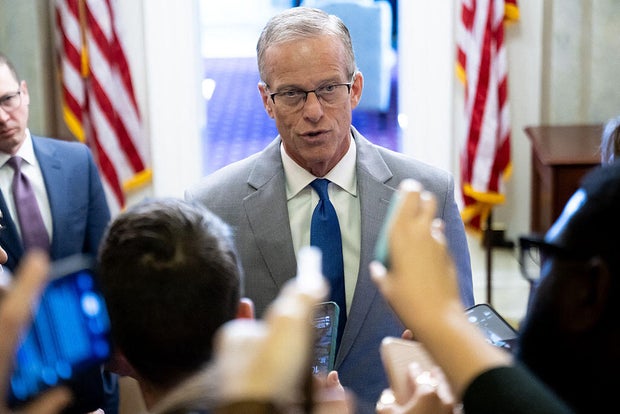
Walking off the floor, Thune said the Senate could stay in session through the weekend if there are signs of progress on a deal.
"I think that depends a little bit on what happens. If there's a path forward to vote, whether that's today, tomorrow, Saturday, we'll stay and do that," Thune said. "I think all options are on the table."
The outlines of the current proposal would tie a vote on reopening the government to a package of three appropriations bills, with a promise to vote on extending health care tax credits in the future. Republicans hope enough Democrats are willing to take that offer and end the stalemate.
Thune reiterated that he "can't guarantee" Democrats "an outcome" on extending health care tax credits, but he can "guarantee them a process."
"I think the clear path forward here with regard to the ACA issue is, they get a vote and we open up the government and we head down to the White House and sit down with the president and talk about it," he added. "Right now, this hostage-taking has got to stop."
Asked if there are enough Democrats who are willing to join Republicans to open the government, Thune said "I think there are Democrats who are inclined to do the right thing. They're under an enormous amount of pressure from the left."
He added: "There is a group, I believe, who really wants to, in my view, do the right thing and get this over with. So we'll see if they hold sway today, and hopefully we'll know more about that as the day rolls on."
Thune says GOP waiting to hear from Democrats on shutdown offer
Walking to the Senate floor, Senate Majority Leader John Thune said Republicans are waiting to hear from Democrats to determine whether the Senate will work through the weekend.
"First off, we've got to get the Dems' response to the offer they have in front of them, and then we'll see where they go with that," he said. "I think it's all going to be subject to whether there's a path to wind this down this weekend. It's in their court. It's up to them."
Asked about the Senate's planned recess for next week, Thune said, "I'm not ruling anything out at this point."
In his speech on the floor, Thune reiterated that Republicans are willing to hold a vote on Democrats' plan to extend health care tax credits. "We're just waiting for Democrats to take yes for an answer," he said.
What the Senate is voting on today
The Senate is not currently scheduled to vote on the House-passed measure to reopen the government today.
The Senate convenes at 10 a.m., with a vote on a Democrat-led war powers resolution aimed at blocking strikes on Venezuela, according to Majority Whip John Barrasso's office.
The notice says further votes are possible on Thursday.
SNAP recipients will now get up to 65% of November food stamp benefits, USDA says
Recipients of federal food benefits under the Supplemental Nutrition Assistance Program will receive a higher portion of their monthly payments for November than initially expected, an official with the U.S. Department of Agriculture said late Wednesday.
Patrick Penn, who oversees food and nutrition services at the USDA, including SNAP, said in a court declaration that maximum allotments for food-stamp beneficiaries will be reduced by 35% for this month, instead of halved.
As a result, eligible Americans will receive up to 65% of their benefits, more than the initial 50% that states had been directed to implement earlier this week.
Read more here.
Pelosi announces she will not run for reelection
Former House Speaker Nancy Pelosi, who has wielded enormous power in Congress and in the Democratic Party for decades, announced on Thursday that she will not seek reelection and will retire from Congress after her term ends in early 2027.
Pelosi, 85, made her decision public in a video released Thursday morning that begins as a letter to the people of the San Francisco area, whom she has represented in the House since she was first elected in 1987.
"I will not be seeking reelection to Congress," Pelosi says in the nearly six-minute video. "With a grateful heart, I look forward to my final year of service as your proud representative."
"As we go forward, my message to the city I love is this: San Francisco, know your power," Pelosi says. "We have made history. We have made progress. We have always led the way. And now we must continue to do so by remaining full participants in our democracy, and fighting for the American ideals we hold dear."
Read more here.
Robert Costa and Nikole Killion
Senate Democrats split on shutdown posture after elections wins
Senate Democrats appeared emboldened in their shutdown posture Wednesday after a sweep in key races in Tuesday's elections. But the caucus appears split on how to proceed, with some progressives urging Democrats not to cave now on their health care demands, while some moderates engage in talks on a way out.
The dynamic came into play after the contours of a deal to end the stalemate began emerging earlier this week, with a possible agreement that would fund the government alongside long-term appropriations bills in exchange for a vote on extending health insurance tax credits that Democrats have demanded.
Sen. Bernie Sanders, a Vermont independent who caucuses with Democrats, told reporters Wednesday that a vote on the tax credits must come with a commitment from GOP leaders that they would support the extension, saying if Democrats "cave now and go forward with a meaningless vote, I think it will be a horrible policy decision, and I think politically, it will be devastating to the Democrats."
Bipartisan talks on the possible off-ramp to end the shutdown continued Wednesday. Democrats involved in the talks told reporters only that the talks were continuing, without weighing in on the details or how the election was impacting their posture.
But Sen. Mike Rounds, a South Dakota Republican involved in the talks, told reporters he's hopeful an end to the shutdown remains in sight, saying he had more conversations Wednesday, while suggesting that Democrats need to "run a victory lap" before ultimately helping them reopen the government.
Here's a list of the 40 airports that could be hit by FAA flight cancellations
The FAA's plan to slash airline capacity due to the government shutdown could hit some of the nation's busiest airports, including in Atlanta, Dallas, New York City and Los Angeles, according to a proposed list provided to CBS News by a source familiar with the discussions.
It includes scores of busy passenger airports in major cities and airline hubs, as well as cargo airports in Louisville, Kentucky; Memphis, Tennessee; Anchorage, Alaska; Ontario, California, and an airport in Teterboro, New York, that is frequented by private jets and other general aviation traffic.
The list is not final, and it still could change, as the FAA has not issued a final order requiring airlines to cut their capacity. The FAA has not formally announced which airports will have their capacity cut.
Read the full list here.
FAA's airline capacity cuts will likely be phased in over several days, sources say
Airlines are scrambling to make plans after the Federal Aviation Administration announced it will throttle air travel capacity by 10% in 40 high-volume markets due to the government shutdown.
The capacity cuts are expected to be phased in starting Friday, according to two sources familiar with a call between airlines, the FAA and the Department of Transportation. The airlines have not yet received an official order from the FAA, but are operating under the understanding that they'll need to reduce their schedules by at least 4% on Friday and at least 5% on Saturday, and hit the 10% mark by next week. Those plans could change, though, when the final order is issued.
Transportation Secretary Sean Duffy announced the capacity cuts on Wednesday, calling them necessary to reduce stress on air traffic controllers who have worked without pay since the shutdown began last month. Airports have faced on-and-off delays for weeks as some air traffic controllers call out of work.
Several airline sources describe confusion about how the policy will be applied and whether or not it will be tied to actual air traffic controller staffing levels.
Airlines were expecting increased travel volumes this weekend as Veterans Day is next week. There is also the potential for weather disruptions in the upper Midwest this weekend.
The Department of Transportation has not responded to a request for comment.