U.N. panel cites possible U.S. war crimes as Trump again says Iran wants a deal
Follow updates on the war in the Middle East for Friday, Sept. 18, here. See earlier developments below.
What to know about the Iran war:
- There are "reasonable grounds" to believe the U.S. committed war crimes with two strikes in Iran that killed at least 178 civilians, a U.N.-commissioned panel of human rights experts said Thursday.
- Oil prices dropped for a second day Thursday after U.S. Energy Secretary Chris Wright said a damaged Saudi oil pipeline should be back online again "relatively soon" after being hit by drones. Meanwhile, gas and diesel prices continue to soar as energy experts warn those costs are likely to climb in the days ahead.
- President Trump insisted again Wednesday that Iran wants to make a deal to end the six-and-a-half-month war. "Hopefully we're toward the end of the war," he said during a midterm appearance in North Carolina.
U.S. open to meeting with Iranian officials at the U.N., says Rubio, but nothing scheduled
The U.S. is open to meeting with Iranian officials at the U.N. General Assembly in New York this week, Secretary of State Marco Rubio told NBC's "Today" show on Tuesday.
"We're open to that," he said. "I don't think anything is scheduled at this point, but we're certainly open to something like that, especially if it has the prospects of leading to something positive and ultimately achieving the goal of what this is all about."
President Trump told Fox News Sunday he would "probably" be willing to meet Iran's President Masoud Pezeshkian on the sidelines of the summit. Pezeshkian will attend the annual General Assembly along with Iran's Foreign Minister Abbas Araghchi.
Both men have said they will defend Iran's positions on the war during the summit.
Tanker hit by "unknown projectile" in Strait of Hormuz, British maritime agency says
A tanker was struck in the Strait of Hormuz on Friday, causing a fire that was extinguished, according to the United Kingdom Maritime Trade Operations (UKMTO).
"The CSO (company security officer) of a vessel has reported a tanker being hit by an unknown projectile, causing a fire onboard which has since been extinguished," the maritime monitor said, adding that the crew was safe, though the environmental impact of the attack was "unconfirmed."
Iranians in U.S. sharply divided over the war
When the Iran war began seven months ago, Washington, D.C- area Iranian-American Soroush quickly found himself losing friends.
He says he hates the Islamic government in Tehran but believes "nothing is going to be better" by going to war.
Fellow exiles in the U.S. began accusing him of supporting their oppressors.
AFP spoke to Iranian community members around Washington about the tensions. Some requested their full names be withheld as they talked about their own friends and relatives.
Iranian-American Bahar also found herself being cut off within the diaspora -- but in her case because she strongly supported the war.
The 750,000-strong Iranian community in the U.S. is overwhelmingly united in opposing Iran's Islamic regime, but deep fault lines have appeared among expatriates and exiles over whether it will succeed in ending 47 years of clerical rule in their homeland.
"Family relationships have been strained or broken. ... Even lifelong friendships have ended over this," said Sahar Razavi, director of the Iranian and Middle Eastern Studies Center at California State University, Sacramento, who says the war exacerbated pre-existing tensions.
South Korea won't deploy troops for intervention in Iran war, its president says
South Korea will not deploy troops to intervene in the Iran war, President Lee Jae Myung said Friday, following reports that Seoul was weighing a possible deployment of forces to the Strait of Hormuz, a key flashpoint in the war.
"There will be no involvement or intervention in the war. We will not deploy troops or military assets in that manner," Lee told reporters at a press conference at the presidential Blue House.
He added that South Korea will "carry out the minimum necessary activities" to protect its own merchant ships and oil shipping routes.
Lee reiterated three times that South Korea wouldn't deploy troops in a way that could lead to military intervention.
"We have upheld the principle of non-involvement and non-intervention in the war until now," he said.
"And we will continue to uphold it going forward."
President Trump complained in an interview late last month that Washington had received "very little help" from other countries and singled out South Korea -- the key U.S. security ally in Asia -- as an example.
Attack reported on ship in Strait of Hormuz
An attack was reported late Thursday on a vessel in the Strait of Hormuz, according to the U.K. Maritime Trade Operations Centre. The organization said the crew has been reported safe.
In a statement to Iran's semi-official Mehr and Tasnim news agencies, the country's Islamic Revolutionary Guard Corps claimed to strike a ship that was making "illegal passage" through the Strait of Hormuz. It's unclear whether that incident is related to the one reported by UKMTO.
Iran has pushed commercial ships to ask for permission and use a regime-approved route before sailing through the Strait of Hormuz.
Farmer who voted for Trump on high costs of Iran war: "I think we've been misled"
Matt Bell, 52, has been farming for more than half his life in central North Carolina. He grows soybeans, corn and wheat and raises beef cattle on more than 1,000 acres. But Bell, who voted for President Trump, says soaring prices for fuel, fertilizer, and equipment are hurting his farm and leading some of his fellow farmers to consider calling it quits once this growing season ends.
Bell initially supported Mr. Trump's policies and even thought short-term price increases resulting from the Iran conflict would be worth ensuring Iran never has a nuclear weapon, one of the president's stated goals of the war.
But he now says the administration has made miscalculations in the war. "We're just being strung along as a country, and that's not good," Bell said.
Bell criticized the administration's decision-making around the war, saying, "I think we've been misled."
Russia and China veto U.N. resolution for Iran sanctions monitoring
Russia and China vetoed a United Nations resolution Thursday that would have authorized U.N. experts to keep monitoring sanctions that were reimposed against Iran last year over its nuclear program.
The U.N. Security Council sanctions are still in effect, which freeze Iran's assets abroad, halt arms deals with Tehran and penalize any development of Iran's ballistic missile program, among other measures.
Using a provision in the 2015 nuclear deal between Iran and major powers France, Germany and the United Kingdom triggered the "snapback" mechanism, which reimposed the sanctions on Sept. 27, 2025. It restored the Security Council sanctions committee and authorized a panel of U.N. experts to monitor implementation.
The United States had drafted a resolution to extend the U.N. expert panel's mandate for a year. The proposal was defeated by a vote of 11-2, with Somalia and Pakistan abstaining, because of the Russian and Chinese vetoes.
It comes as the Trump administration is pursuing a wider campaign to isolate Tehran from its remaining economic partners as the more than six-month-old war in Iran has hit a stalemate.
Gas and diesel prices continue to surge
Gasoline and diesel prices continued to surge on Thursday, with energy experts warning that those costs are likely to climb in the days ahead.
"Consumers should plan on higher prices for longer," said Patrick De Haan, a petroleum expert at GasBuddy, which tracks U.S. fuel prices.
The national average for gasoline jumped 7 cents overnight to $4.44 a gallon, according to AAA, up nearly 50% since before the Iran war started in February. Diesel, essential for transporting food and other goods around the U.S., hit a record $6.40, up 77 cents since the beginning of September.
U.S. sanctions Iranian cryptocurrency venture Bitbank, Treasury says
The U.S. announced new sanctions on cryptocurrency venture Bitbank as part of its ongoing Operation Economic Outcast campaign.
Bitbank is allegedly run by financier Babak Zanjani, who is already sanctioned by the U.S. Treasury.
"Today's designations of Iranian digital asset infrastructure make perfectly clear that efforts to finance the Iranian regime using cryptocurrencies are not beyond OFAC's reach," Treasury Secretary Scott Bessent said in a statement. "If you support the Iranian regime, the Department of the Treasury will sanction you."
Also sanctioned were BitBank's developer, Pishtaz Simorgh Electronic Trade Company and three high-level executives associated with Zanjani, according to the Treasury.
Bitbank was labeled a "key component" of Iran's attempts to evade sanctions that are limiting ways for the regime to acquire funding.
U.S. approves visas for Iranian representatives to attend U.N. General Assembly next week
The Trump administration has approved visas for top Iranian officials, including the president and foreign minister, to attend next week's U.N. General Assembly high-level meeting in New York even as the two countries are locked in a stalemated war.
The State Department said Thursday it had approved visas for Iran's "core delegation," along with essential staffers to participate in the U.N. meetings. The core delegation includes President Masoud Pezeshkian and Foreign Minister Abbas Araghchi, according to U.S. officials, who spoke on condition of anonymity due to visa privacy laws.
"Consistent with our host country obligations, the core delegation from the Iranian regime will be able to attend UN General Assembly High Level week. The delegation will be under travel restrictions and will face prohibitions on the purchase of luxury and other goods per our policy. The delegation is smaller than last year," the statement said.
The move is unusual due to the more than six-month-long conflict between Iran and the United States and no sign that agreements to reopen the Strait of Hormuz or return to talks on Iran's nuclear program are close.
Iran supports Houthis' claim they did not target Mecca with drone
Iran is backing up the claim of its proxy in Yemen, saying the Houthis should be believed when they say they did not attack the Muslim holy city of Mecca with a drone yesterday as Saudi Arabia claimed.
"Any attack on Islamic holy sites, particularly Mecca, Medina and Al-Aqsa Mosque, as well as any threat to visitors and residents of those sites, is condemned," Foreign Ministry spokesperson Esmaeil Baqaei said in Arabic on X.
"At the same time, the mere claim that a drone was intercepted on its way to Mecca cannot constitute a basis for accusing a specific party, particularly since Yemen's Government of Change and Construction has explicitly denied this claim," he added.
Iran also specifically pointed out "false flag" propaganda operations as a potential explanation for the announcement by Saudi Arabia. Most of the other Gulf countries immediately came out in condemnation of the alleged attack. The Saudis said they interrupted the drone before it could do any damage.
"It should not be forgotten that our region has witnessed numerous cases of 'false flag' operations, particularly in recent months, whose objective has been to divert public attention from the crimes committed by [Israel] and the United States in the region, and to sow division among Islamic countries," Baqaei said.
U.S. to sell 48 F-35 Lightning fighter jets to Saudi Arabia
Saudi Arabia will be getting a major upgrade to its air force with the purchase of 48 F-35 Lightning II Joint Strike Fighter aircraft from the United States, according to the U.S. State Department.
The jets will cost the Saudis about $24.3 billion, according to the State Department. The fighter jets are built by Lockheed Martin. The planes are in common use by many U.S. allies, including the U.K., Italy, Netherlands, Australia, Canada and more.
The jets will be of the F-35A variety, which means a conventional takeoff as opposed to the F-35B, which can take off vertically.
"The proposed sale will improve Saudi Arabia's capability to deter current and future threats by strengthening its homeland defense, and improving interoperability with U.S. forces, and other regional and NATO forces," the State Department said.
The F-35 Lightning II is one of the most common stealth fighters in the U.S. arsenal, with hundreds being used across the Air Force, Marines and Navy. There was a record 191 F-35 fighters delivered to the U.S. in 2025, according to Lockheed Martin.
Iran foreign ministry summons German ambassador over chancellor's remarks
The Iranian foreign ministry summoned Germany's ambassador on Thursday to object to "inappropriate statements" from Berlin, a reference to recent critical remarks by Chancellor Friedrich Merz.
After a meeting with the visiting Iraqi prime minister on Tuesday, Merz demanded Iran lift its blockade on the Strait of Hormuz, cease its support for armed groups across the region and put an end to its "military nuclear programme," which Tehran has consistently denied pursuing.
The Iranian ministry said in a statement that Ambassador Axel Wilhelm Dittmann was called in following the "inappropriate statements by senior German officials against Iran, as well as certain interventionist actions by the German embassy in Tehran."
At the meeting, the ministry's director for Western Europe, Alireza Yousefi, rejected Merz's comments "and conveyed the Islamic Republic of Iran's strong protest against Germany's unjustified and destructive approach to issues concerning the region and Iran, stressing the need for this approach to be corrected."
Foreign ministry spokesman Esmaeil Baqaei on Wednesday accused Merz of offering a "knowingly distorted" narrative, pointing out the United States and Israel had launched the war on Iran and adding, "Germany failed to show even the minimum moral courage required to deplore that."
U.S. forces have redirected 104 vessels in Strait of Hormuz, military says
The U.S. blockade on commercial ships entering or exiting Iranian ports has now redirected 104 vessels, according to U.S. Central Command.
The total grew by just one vessel since Tuesday, according to CENTCOM.
The U.S. reinstated its blockade on the Strait of Hormuz on July 14 after a brief period when Iran agreed to not attack ships in the waterway following the signing of a memorandum of understanding. That MOU quickly fell apart, however, as the U.S. and Iran argued over who would control the flow of traffic through the strait.
President Trump touted the blockade during a speech in North Carolina on Wednesday night.
"Not one ship going to Iran has gotten through that blockade," Mr. Trump said. "Not one. So I just want to thank our military."
Iran downed at least 2 unmanned American aircraft in recent days, U.S. officials say
Iranian forces in recent days have brought down at least two American MQ-1 unmanned aircraft, according to U.S. officials familiar with the matter who spoke to CBS News on condition of anonymity because they were not authorized to speak publicly.
It is unclear where in the region the remotely piloted aircraft were brought down or which MQ-1 variant was involved. The U.S. military has fielded two principal MQ-1 variants: the Predator, which became a fixture of U.S. operations in Iraq and Afghanistan before the Air Force retired it in 2018, and the Gray Eagle, a larger Predator-derived aircraft still operated by the Army, including its special operations forces.
Both the Predator and Gray Eagle were designed for intelligence, surveillance, and reconnaissance missions but they can also carry Hellfire missiles for striking targets. In the Strait of Hormuz, these unmanned aircraft can provide U.S. forces with persistent surveillance over the narrow waterway while also tracking Iranian military activity and monitoring threats to both American forces and commercial shipping.
More than 100,000 displaced in Yemen so far this month, UNICEF says
Over 100,000 people were displaced in Yemen in just the first two weeks of September amid the increased fighting between the Iran-backed Houthi rebels and the Saudi-backed Yemen government, according to UNICEF, the U.N. children's relief agency.
The agency said more than 104,000 people have been displaced, including over 57,000 children. Many displaced individuals came from the city of Taiz, the largest city in the southwestern part of Yemen, as well as Marib and Aden.
The Houthis blitzed through the western part of the country last week, capturing new territory as they approached and eventually took over the key coastal city of Mocha.
"Children in Yemen were already living through one of the world's most grave humanitarian crises, and many have known little but conflict and displacement," Edouard Beigbeder, UNICEF regional director for the Middle East and North Africa, said in a statement. "Now, tens of thousands of families have been forced from their homes in just two weeks, many fleeing only with what they can carry. For children who have already endured years of hunger, displacement and disrupted schooling, this latest violence is eroding what little stability they had left."
The problem has already crossed the Bab el-Mandeb Strait with over 2,000 people moving into Djibouti, UNICEF said.
Strait of Hormuz will be closed until Trump and Netanyahu removed from power, adviser to Iranian leader says
A senior Iranian figure said Thursday that Iran will not reopen the Strait of Hormuz until President Trump and Israeli Prime Minister Benjamin Netanyahu are removed from power.
"Our fighters will not open the Strait of Hormuz until they bring the criminal Trump and the bloodthirsty Netanyahu down from the seat of power," Mohammad Baqer Zolqadr, the political adviser to Iranian Supreme Leader Mojtaba Khamenei, said according to Iranian state broadcaster IRNA.
Khamenei has not been seen in public since replacing his father as Iran's supreme leader.
Ayatollah Ali Khamenei was killed on Feb. 28, the first day of joint U.S.-Israeli airstrikes, and Vice President JD Vance has said Mojtaba, his son and successor, was likely gravely wounded in the same strikes.
Rubio discusses Middle East on call with Chinese counterpart, Chinese state media say
China's Foreign Minister Wang Yi and U.S. Secretary of State Marco Rubio discussed the situation in the Middle East during a phone call Thursday, Chinese state media reported.
The call, which was not immediately confirmed by the State Department, came days before the two countries' leaders are due to meet in Washington. Beijing has presented itself as a potential mediator in the U.S.-Iran war.
President Trump on Sunday dismissed a report by the Wall Street Journal that China had given Iran satellite imagery of an air base before a strike that killed three American soldiers in Jordan.
"You know, when they say that China spies on us, I say you're right, and we spy on them too," Mr. Trump told reporters. "That's what we do. They basically do what we do."
The President did not answer questions about whether he would broach the incident with President Xi Jinping when they meet on Sept. 24, instead reiterating his belief that they have a good relationship.
"I think he's behaved reasonably well, and we behave reasonably well," Mr. Trump said.
CBS/AFP
Yemen's Houthi rebels claim strikes by Saudi-backed government forces killed 3 children
Yemen's Iran-backed Houthi rebels claimed Thursday that three children were killed in government strikes.
"Three children were killed and several Yemeni nationals were injured in strikes by the Saudi-backed mercenaries" in the far southwest Taiz province, which is held by the Houthis, according to the Almasirah television network. The broadcaster, which is affiliated with the Houthis, earlier said Saudi airstrikes had killed one person.
Saudi Arabia's civil defense emergency response agency said Thursday that one person was killed when shrapnel from an intercepted Houthi drone crashed down over Taif governorate, east of the holy city of Mecca.
CBS/AFP
Saudi-backed Yemeni forces reportedly trying to reinforce security around Aden
The Saudi-backed Yemeni government has begun reinforcing its defenses around Aden, the country's interim capital, as fighting with the Iran-backed Houthi rebels draws closer.
A source in Aden's local authority told the regional Al-Araby al-Jadeed news outlet that government and allied forces had deployed additional personnel and imposed further security measures to protect the city, which sits on Yemen's southwest coast.
Government reinforcements have also been sent toward Lahj and Abyan, also in the southwest, and to the front lines near Houthi positions, as well as toward the strategic western Red Sea coast, most of which is now under Houthi control.
Additional forces have been deployed to other cities in government-held territory as part of what the military sources described to Al-Araby al-Jadeed as a "new phase of the confrontation," and a plan to retake territory.
Iran's vice president apologizes to people for economic hardship
Iran's Vice President Mohammad Reza Aref has apologized to Iranians over the soaring cost of living, acknowledging that household incomes, particularly for wage earners, are no longer keeping pace with expenses.
"We really apologize to the people," Aref said. "We are ashamed that today the income and expenses of our dear people, especially wage earners, do not balance."
Speaking at a gathering of Iranian university professors, Aref called the country's sky-high inflation a "serious problem" and warned there were no quick fixes to be had.
It was a rare public acknowledgment by one of Iran's most senior economic officials of the pressure households are under, particularly people dependent on fixed salaries.
He said the government did not want to try and address the economic strife by putting a greater financial burden on future generations.
Less senior officials have acknowledged the pressure that U.S. and international sanctions, and the U.S. naval blockade, are putting on Iran's economy. President Trump has said many times that he believes the pressure will force Iran's theocratic rulers to capitulate and accept a peace deal, but they have thus far shown no willingness to be cowed.
Saudi Civil Defense says 1 killed by shrapnel from intercepted Houthi drone
Saudi Arabia's civil defense emergency response agency said Thursday that one person was killed when shrapnel from an intercepted Houthi drone crashed down over Taif governorate, east of the holy city of Mecca.
"The fall of shrapnel from a downed drone in Taif governorate resulted in one death, two injuries, and material damage to several buildings and vehicles," the agency said in a statement posted on social media, adding that the person killed was a Yemeni national.
Saudi officials on Wednesday accused the Iran-backed Houthis of launching a "cowardly" attack targeting Mecca, a claim the Houthis immediately denied.
CBS/AFP
Houthis continue push to control Yemeni coast around crucial Bab el-Mandeb Strait
Fighting is intensifying across Yemen as government forces battle Houthi fighters on several fronts, particularly around the strategic Kahboub mountains near the Bab el-Mandeb Strait.
Saudi-backed Yemeni government forces said they had repelled a large Houthi infiltration and attack in the mountains.
Yemeni media said the Houthis sustained heavy casualties and equipment losses.
The fighting comes amid a Houthi push to seize more territory along Yemen's western Red Sea coast, toward strategically important areas overlooking the Bab el-Mandeb - which like the Strait of Hormuz, is a vital chokepoint for global oil and gas supplies.
The Houthi-affiliated Al Masirah television network reported Saudi airstrikes on Thursday killed one person and wounded another in the town of Abs. The channel also said Saudi aircraft struck three telecommunications towers in Taiz province.
Foreign Minister Afrah al-Zouba, of Yemen's U.S. and Saudi-backed government, has warned against what she calls misleading Houthi "messages of reassurance" regarding maritime traffic through the Bab el-Mandeb.
The Iranian proxy group has said repeatedly that all tanker traffic in the Red Sea, for which the Bab el-Mandeb is the southern gateway, is safe, apart from Saudi-owned ships.
Al-Zouba said the statements could be aimed at giving the Houthis time to rearm and prepare for further attacks, while consolidating control over ground on the Red Sea coast.
Al-Zouba said she had discussed the latest developments around the Bab el-Mandeb, as well as displacement and damage to civilian property and infrastructure, in a Wednesday call with the U.S. chargé d'affaires for Yemen.
France hosts talks on plans to ensure security in Lebanon as U.N. peacekeeping mission
The heads of state of Lebanon, France and Jordan met Thursday as part of an effort to drum up support for the struggling Lebanese military.
Ahead of the talks in Paris, a statement from the office of Lebanese President Joseph Aoun said the three leaders would discuss the situation in southern Lebanon and plans for an international presence there after the mandate of the U.N. peacekeeping force, known as UNIFIL, expires at the end of the year.
A donor conference for Lebanon's cash-strapped army was initially set to take place in February, led by France, Saudi Arabia and the United States. However, it was postponed following the eruption of the Iran war and the latest round of the Israel-Hezbollah war.
A new date for the conference was not immediately announced following Thursday's meeting between French President Emmanuel Macron, Jordan's King Abdullah II and Aoun.
Lebanon's army now finds itself caught between the Israeli military – now occupying much of southern Lebanon – and the militant group Hezbollah, which has refused calls to give up its weapons.
In June, the Lebanese and Israeli governments announced a framework agreement under which Israel would withdraw gradually from southern Lebanon and the Lebanese army would assume control, while Hezbollah would be disarmed. Implementation of the deal has stalled.
Lebanon has been criticized by Israel and the United States for not taking direct military action to force the militant group to disarm.
CBS/AFP
Crude oil prices fall for second day as fear over Saudi pipeline recedes
Crude oil prices dropped for a second day Thursday after U.S. Energy Secretary Chris Wright said a damaged Saudi oil pipeline should be running again "relatively soon."
The cost of a barrel of Brent crude, the international standard for oil prices, fell to about $103.50 Thursday morning, down from $105 Wednesday and $108 on Tuesday.
Despite there being no indication of any looming agreement to end the U.S.-Iran war, which has severely reduced the flow of oil out of the Persian Gulf, and an escalation in fighting between Saudi Arabia and the Iran-backed Houthis in Yemen threatening another vital waterway, markets appeared to take heart in Wright's reassuring outlook on the East-West Crude Oil Pipeline in Saudi Arabia.
The pipeline, a critical workaround for the Saudis to get their gas and oil to customers without using the Strait of Hormuz, was forced to shut down last week after being hit by drones. Saudi officials blamed the strikes on other Iranian proxy groups based in Iraq.
"The damage assessments are still going on," Wright told Fox Business. "Three pumping stations were hit. Two, maybe not so bad. One, one more significant. So I think we'll know more in the next few days, but it should be up relatively soon."
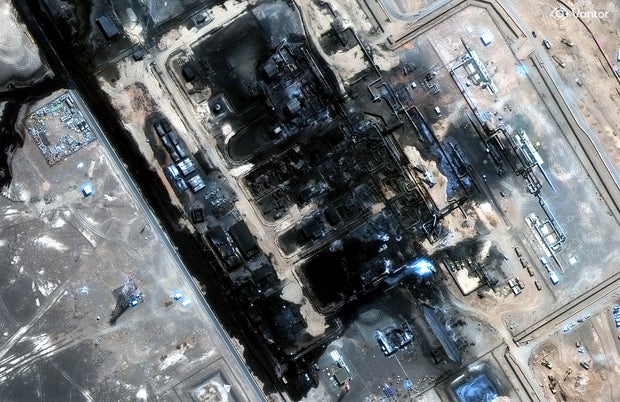
Wright also said 18 million barrels of oil and oil products made it through the Strait of Hormuz on Tuesday with protection from the U.S. military.
"We are pushing now to get more refined products to come out of the Strait of Hormuz," Wright told Fox. "So, all my numbers are the combination of the two. The seven-day running average that's always reported — that's the most important number — is today at about 11 million barrels a day between crude and refined products. But that will continue to go up."
Before the war, about 18 million barrels of oil per day would typically transit the strait.
Trump to hold Iran talks with Gulf leaders, Axios reports
President Trump is set to meet with leaders from Persian Gulf States during the U.N. General Assembly in New York on Tuesday to discuss the war with Iran, Axios reported Thursday.
The meeting is expected to focus on U.S. plans for a post-war strategy, the outlet reported, despite there being no indication of any new deal emerging to end the conflict.
Israeli Prime Minister Benjamin Netanyahu is also hoping to meet with Mr. Trump, an Israeli source told Axios, but nothing has been scheduled.
The Gulf states, many of which host U.S. military bases, were pummeled by missiles and drones for months as Iran retaliated for American and Israeli airstrikes.
Mr. Trump said Wednesday that Iran wanted to make a deal, something he has insisted repeatedly, adding: "Hopefully we are towards the end of the war."
Iranian officials have consistently denied any interest in a peace agreement until the U.S. accepts its conditions, which focus on a return to the principles of a memorandum of understanding signed in June by Mr. Trump and his Iranian counterpart. Tehran accused the U.S. of violating that agreement immediately by leaving its naval blockade in place, and the agreement fell apart within several weeks.
U.N. experts say "reasonable grounds" to believe U.S. committed war crimes with 2 strikes in Iran
Human rights experts commissioned by the U.N. say they have found "reasonable grounds" to believe the United States committed war crimes in two strikes in Iran, including on a school in the southern city of Minab.
The international fact-finding mission on Iran says the findings center on a pair of airstrikes which killed at least 178 civilians, including women and children.
"Following the United States and Israeli attacks on 28 February, the mission found reasonable grounds to believe the United States committed the war crime of launching indiscriminate attacks resulting in the loss of life or injury to civilians or damage to civilian objects," the fact-finding team said in a statement.
The team also said that killings by Iranian state security forces occurred on a "staggering scale" in Iran.
At the start of the war in February, at least one U.S. missile hit the Shajareh Tayyebeh in Minab, according to an investigation by The Associated Press. Iranian state media have said 168 people were killed in the strike, most of them children.
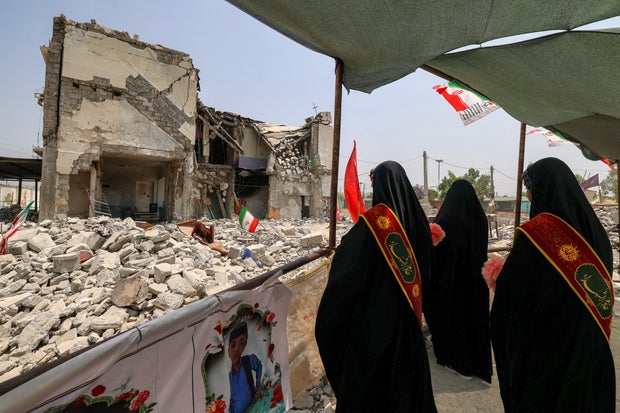
The U.S. was "likely" responsible for the bombing, sources told CBS News in March, citing a preliminary U.S. assessment, but it did not intentionally target the school and may have hit it in error, possibly due to the use of dated intelligence which wrongly identified the area as still being part of an Iranian military installation.
The other incident cited by the U.N. rights experts was an attack using precision strike missiles that dispersed tungsten pellets over a "clearly identifiable sports complex and residential area" in the southern city of Lamerd, also on Feb. 28.
There was no immediate reaction from the White House or U.S. military on Thursday to the claim of possible war crimes, but Central Command has repeatedly rejected such accusations by Iran and said the U.S. military never targets civilians, which it accuses Iranian forces of doing regularly.
CBS/AP
Houthis say Saudi strikes killed one, targeted telecom towers
Saudi strikes in Yemen killed one person and targeted three telecommunications towers on Thursday, Houthi media said, in the latest attacks since the Iran-backed rebel group seized control of the entire Red Sea coast.
"Saudi enemy warplanes targeted three telecommunications towers" in Taiz province, while one civilian was killed and another injured in strikes on the town of Abs, Almasirah television said.
On Wednesday, Riyadh accused the Houthis of launching a "cowardly" attack targeting Islam's holy city of Mecca, a claim they denied.
The Houthis have been reporting dozens of daily Saudi strikes since they seized control of strategic coastal areas overlooking the Bab al-Mandeb Strait from Saudi-backed government forces.
Their latest territorial gains cement the hold of Iran and its allies on the two waterways that the wider Gulf, including top crude exporter Saudi Arabia, relies on to ship its oil.
In July, a fragile 2022 truce between the Houthis and the government fell apart after the group welcomed an Iranian plane to Sanaa in defiance of Riyadh's control over Yemeni airspace, setting off a spate of attacks.
They later announced a maritime blockade of Saudi Arabia and began hitting its ships and territory.
The conflict in the Arabian Peninsula's poorest country has forced more than 100,000 people to flee their homes, according to the United Nations.
Trump says Iran wants to make a deal: "Hopefully we're toward the end of the war"
During a midterm campaign appearance in North Carolina on Wednesday night, President Trump again claimed Iran wants to make a deal.
"Hopefully we're toward the end of the war. They want to make a deal. We'll see how that works out," Mr. Trump told the crowd at Republican Senate nominee Michael Whatley's rally in the city of Gastonia, a 30-minute drive east of Charlotte.
Mr. Trump has frequently insisted that Iran is looking to make a deal, though negotiations between the U.S. and Iran have stalled in recent months.
Growing voter concerns over rising prices, tariffs and the cost of fuel, triggered by the war and the closure of the Strait of Hormuz, have presented a challenge for many Republican candidates ahead of the elections in November.
World would be plunged into energy crisis if U.S. leaves Middle East, Vance says
Vice President JD Vance said the world would be plunged into an energy crisis if the U.S. decides to end its involvement with the war in Iran and leave the region.
"What I would say to anybody who's frustrated right now is the alternative here, which is the United States effectively says to the Middle East, 'You're on your own,' would mean necessarily a worldwide energy crisis, so long as the Iranians keep on shooting at shipping, which we know that's exactly what they would do," Vance said when calling in Wednesday morning to the All-In Summit, a convention for "thinkers, investors, founders and leaders," according to the group.
Iran began targeting ships in the Strait of Hormuz only after the U.S. and Israel began their bombing campaign on Feb. 28. The strait was free to transit up until that point, but the Iranians' retaliation against the U.S. and Israeli strikes reduced tanker traffic through the vital chokepoint for 20% of the world's oil and gas to a fraction of its typical prewar level.
"I think the president is taking the responsible course of action," Vance said. "He's protecting America's assets in the region while also ensuring that world energy markets continue to get a supply of oil and natural gas."
Oil and gas prices have spiked since the U.S. war with Iran began. Brent crude, the international standard for oil, hit $108 a barrel on Tuesday. It has fallen back slightly since then but was still selling for over $103 on Thursday - more than 50% higher than the price a year ago.
House Speaker Mike Johnson declares nuclear issue "taken care of," blames Democrats for gas prices
The speaker of the House, Mike Johnson, said Wednesday the issue of Iran getting a nuclear weapon is "taken care of" and now they need to get gas prices down. He also simultaneously blamed Democrats and former President Biden for the high prices.
"Iran will not have a nuclear weapon. That was an important objective of American foreign policy for the last half-century," he said during a press conference where he announced the House would go home until the midterm elections after today. "That's taken care of, and now we got to get gas prices down. But I want to remind you as well: There's another big factor of why gas prices are high. This is the result of bad Democrat policy."
The price for a gallon of regular gas currently costs $4.37, about 30 cents more than a month ago and well over the $3.19 a gallon from a year ago, according to AAA.
"[The Democrats] want to squeeze production of U.S. oil and gas, and that is a disaster for the American people," Johnson said. "And so you have to keep the right people in charge to make sure that your fuel prices come down."
The average price for gas in January 2025, Biden's last month in office, was $3.08, according to the Bureau of Transportation Statistics.