Live Updates: Trump says he sees no reason to escalate war with Iran, touts his long-term goals in the conflict
What to know about the Iran war today:
- In a 60 Minutes interview that aired Sunday, President Trump said he does not currently see "any reason" to escalate the war with Iran. However, he defended starting the conflict as "historically" a good decision, despite its economic impact.
- Mr. Trump will meet Monday with the prime minister of Qatar, whose country has mediated indirect talks between the U.S. and Iran aimed at reaching a deal.
- Secretary of State Marco Rubio curbed expectations late Sunday, saying talks are not "at the verge of a breakthrough" because Iran's demands are "unacceptable"
U.N. nuclear watchdog agency conducted inspection in Iran, foreign ministry says
The United Nations' international nuclear watchdog agency carried out an inspection of an Iranian nuclear site, the country's foreign ministry spokesperson said Monday.
Esmaeil Baqaei told Iranian journalists that the International Atomic Energy Agency conducted an inspection "a few days ago" in the city of Bushehr, which is home to the country's only civilian nuclear power plant.
President Trump has previously said he launched the war alongside Israel in February to prevent Iran from developing a nuclear weapon. Tehran, for its part, has repeatedly insisted it only uses nuclear materials for civilian purposes such as energy generation and medical work.
Iran suspended IAEA inspections at all of its facilities in the wake of June 2025 strikes on many sites by the U.S. and Israel.
Last week the U.S. military's Central Command announced a reward of up to $20 million for information about Iran's nuclear program.
Iran and U.S. continue to strike tankers in or near Strait of Hormuz
Iran's state broadcaster IRIB said Monday that four tankers had been "halted" in the Strait of Hormuz over the preceding 24 hours. In a post on X, IRIB said the ships were "brought to a standstill," without offering any further detail.
Both Iran and the U.S. have attacked ships in and around the Strait of Hormuz that they consider to be breaching their respective restrictions on the waterway.
Iran demands that all commercial vessels coordinate with its security forces to use shipping lanes in the north of the strait, close to its shores, and it has launched missiles at some it accuses of using southern routes that the U.S. insists are safe and open. Iranian authorities have claimed multiple times in recent weeks that ships using the southern routes have hit sea mines, causing fires.
The U.S. insists the southern routes are safe and open despite the ongoing attacks on ships using them, while American forces have attacked some commercial vessels accused of violating the U.S. military blockade of Iran's ports and vessels, intended to prevent the regime's sale of oil and gas.
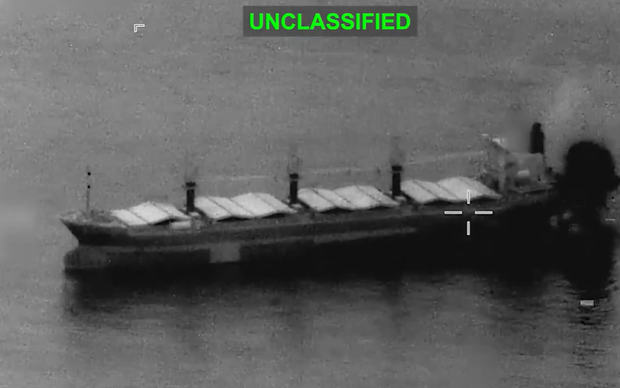
On Saturday, U.S. Central Command said it disabled a commercial vessel in the Gulf of Oman, just east of the strait, after the crew "ignored repeated warnings and attempted to violate the naval blockade against Iran multiple times."
Oil prices continue cautious descent as Trump casts doubt on return to large-scale fighting with Iran
The price of Brent crude oil, the international standard, fell 2% early Monday morning to $96.38 per barrel, continuing a downward trend seen for more than a week as markets appeared to take hope from President Trump casting doubt on a return to full-scale war with Iran.
U.S. benchmark crude also fell, down 1.5% early Monday to $89.56 per barrel.
Oil prices have been up significantly since the U.S. and Israel launched the war with Iran, and Iran responded by attacking and threatening commercial ships in the key energy supply routes of the Persian Gulf and Strait of Hormuz. They remain about 50% higher than a year ago, before the war began, but down from highs seen during the peak of fighting, when Brent crude soared to near $120 a barrel.
Iran calls its proposed shortening of the implementation period for potential peace deal a goodwill gesture
Iran's foreign ministry spokesman said Monday that Tehran's proposal to reduce the implementation period for a possible peace deal with the U.S. to two days from the previous seven was a "sign of goodwill."
Foreign Ministry Spokesman Esmaeil Baqaei told Iranian journalists that any deal with the U.S. must include the core conditions both sides agreed to under the previous, so-called Islamabad agreement in June. That deal called for the lifting of U.S. sanctions on Iran as well as the U.S. naval blockade of Iran's ports, unfreezing Iranian assets and a ceasefire on all fronts in the Middle East.
"If the other side is genuinely even minimally serious, Iran can fulfill its own commitments within two days," he added. "We have already demonstrated that we are serious about fulfilling our commitments."
The previous ceasefire fell apart after several weeks, as Iran declared the continuation of the U.S. naval blockade a violation of its terms.
On Sunday, Secretary of State Marco Rubio downplayed the likelihood of an imminent deal with Iran, calling Tehran's demands "unacceptable."
The Trump administration has been pushing for Iran to agree to conditions on its nuclear program as part of an initial peace agreement, but Tehran has long insisted discussion on the topic can begin only after fighting and threats cease.
Rubio says U.S. and Iran not "at the verge of a breakthrough" on deal
Secretary of State Marco Rubio tempered expectations of an imminent deal between Iran and the U.S. late Sunday.
Before departing to Paris for a G7 meeting, Rubio said the two sides are not "at the verge of a breakthrough, while reiterating the president prefers a diplomatic solution.
"Right now, it hasn't been very productive because the Iranian demands are simply not just unacceptable," Rubio told reporters.
He said he expects G7 allies to have a lot of questions about the conflict and next steps.
CBS/AFP
Trump expected to meet with Qatari mediator
President Trump is to meet with Qatari Prime Minister Sheikh Mohammed bin Abdulrahman Al Thani at the White House on Monday.
Qatar has been one of the key mediators in indirect talks between the U.S. and Iran aimed at reaching a deal to end the conflict.
According to sources cited by Axios, Al Thani, who is one of the key mediators in those talks, is looking to Mr. Trump to allow more time for diplomacy.
Trump says he sees no reason to escalate war on Iran
President Trump said in an interview aired on Sunday that he sees no reason to escalate the war on Iran and that he is "not looking" to do so.
"Well, I'm not looking to. I don't think there's any reason to," Mr. Trump told 60 Minutes when asked whether he was planning to intensify the war.
However, the president emphatically defended his decision to start the conflict in late February, while recognizing there have been negative impacts in the meantime.
"I think, historically, this will be a very good decision," Mr. Trump said. "Is it a good decision for today and tomorrow? Maybe not."
The president cited Iran's nuclear program as the main reason for starting the war, adding that he had done "what's right for our country."
See more from Mr. Trump's 60 Minutes interview and read the full transcript here.
Trump says new task force to extend naval blockade "is in full force and effect"
President Trump said Sunday that the new U.S. military task force to extend the Iran naval blockade "is in full force and effect."
"Task Force Iron Gate is in full force and effect in the Islamic Republic of Iran. Coupled with history's greatest Naval Blockade, very little gets into, or out of, Iran!" Mr. Trump said in a Truth Social post.
Task Force Iron Gate is aimed at extending the success of the naval blockade to overland routes of trade, U.S. Central Command announced Saturday.
The group will be tasked with preventing military technology and illegal revenue streams from entering or exiting Iranian borders, including via the Caspian Sea, but it was unclear if any military force would be brought to bear.