Iran War Updates: Tehran denounces U.S. for using AI in strikes it claims violate international law
What to know about the Iran war today:
- Iran's U.N. ambassador on Tuesday criticized the U.S. military's use of artificial intelligence systems in the nearly 9-month war, claiming American forces leveraged the technology to plan and carry out some 2,000 attacks over just four days.
- The Iran-backed Houthi group claimed an attack on the financial district of Saudi Arabia's capital on Wednesday, as well on a sprawling oil refinery in the country's east.
- Israeli Defense Minister Israel Katz said on Tuesday that Iran is developing chemical weapons and vowed to stop Tehran from obtaining them. Iran has repeatedly denied it is developing chemical weapons.
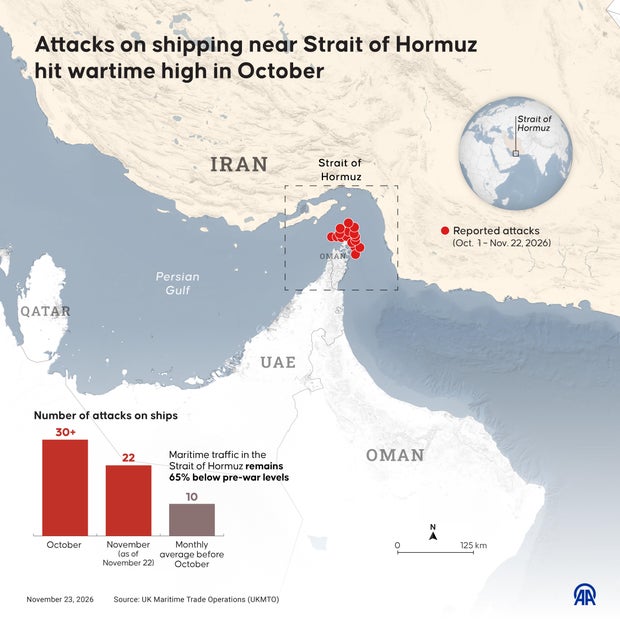
Iran claims it has tightened its control over Strait of Hormuz
Iranian army spokesperson Brig. Gen. Mohammad Akraminia said the military had tightened its control and monitoring of the Strait of Hormuz on the orders of the army's commander-in-chief.
Ships attempting to transit the waterway without coordinating with Iran's armed forces have faced greater risks in recent weeks, including sea mines, Akraminia was quoted as saying Wednesday by the semi-official Tasnim news agency.
President Trump has dismissed Iran's claims attacks on ships and sea mines being laid in the strait as lies intended to inflate global energy prices, and the U.S. military declared international shipping lanes through the waterway free of mines at the end of October.
Without offering any evidence, however, Akraminia claimed Iranian forces had upgraded their monitoring capabilities by introducing new systems, improving existing ones and strengthening their combat abilities, and he said the measures would continue.
Iran's Persian Gulf Strait Authority (PGSA) said Tuesday that 26 tugboats had been added to the country's "Non-Compliance List," for providing services to non-compliant vessels, indicating they could be targeted.
Iran issues daily claims of commercial vessels striking mines in and near the strait, few of which are ever corroborated, but independent monitors do report frequent incidents involving "unknown projectiles" striking ships in the region.
Iran criticizes U.S. for using artificial intelligence for deadly attacks
Iran has denounced the U.S. military's use of artificial intelligence to plan and carry out attacks.
Speaking at a U.N. Security Council meeting Tuesday, Iranian Ambassador Gholamhossein Darzi said the weaponization of AI "raises serious concerns."
Darzi claimed U.S. forces used the technology to deploy more than 2,000 munitions to hit 2,000 distinct targets within 96 hours. He said Palantir's Maven and Anthropic's Claude system were used to analyze intelligence, identify and prioritize targets and provide strike coordinates.
"Neither advanced technology nor the involvement of private companies can shield the United States or the Israeli regime from accountability for flagrant violations of their obligations under international law," Darzi told the council meeting.
"Those responsible for the commission of atrocious crimes against Iranian people, including deliberate attacks against civilians and civilian objects, must face individual criminal accountability," he added.
In March 2026, the Commander of U.S. Central Command Adm. Brad Cooper confirmed American forces had used a "variety of advanced AI tools" in order to "cut through the noise and make smarter decisions faster than the enemy can react."
While the Pentagon has not said exactly how AI tools are being deployed, CBS News spoke in March with several experts with knowledge of military operations who described the likely scenarios.
"The military is now processing roughly a thousand potential targets a day and striking the majority of them, with turnaround time for the next strike potentially under four hours," said retired Navy Admiral Mark Montgomery, senior director of the Foundation for Defense of Democracy's Center on Cyber and Technology Innovation. "A human is still in the loop, but AI is doing the work that used to take days of analysis — and doing it at a scale no previous campaign has matched."
Iran-backed Houthis and Saudi forces intensify attacks
Yemen's Iran-backed Houthis on Wednesday claimed attacks targeting the financial district in the Saudi capital and the sprawling Ras Tanura refinery in the kingdom's oil-rich east, in retaliation for strikes on their territory.
Houthi military spokesman Yahya Saree described the attack targeting the refinery as "accurate and direct", saying it "caused fires to break out at the facility". He said the attack on Riyadh was "carried out in three phases, with strikes hitting their targets accurately".
In separate attacks, Saudi's forces said they had struck the city of Hodeida on Wednesday, after the Houthis said they would retaliate if that attack took place.
The Houthis have been locked in grueling, more than decade-long civil war against Yemen's government forces, who are backed by Saudi Arabia. Recent Houthi gains have consolidated the group's control of the Bab el-Mandeb Strait, which the group has tried to use to disrupt Saudi oil exports.
CBS/AFP
Iran developing chemical weapons, Israeli defense minister says, warns of possible preemptive strike
Israeli Defense Minister Israel Katz said on Tuesday that Iran is developing chemical weapons, and vowed to stop Tehran from obtaining them.
"Iran is in the process of developing chemical weapons," Katz said in a briefing to Israeli reporters, according to public broadcaster KAN and other national outlets. "The state of Israel will not allow them to reach that capability."
In his briefing on Tuesday, Katz floated the possibility of a preemptive strike against Tehran, if necessary.
"If we recognize that the Iranians intend to attack Israel, can't we tell the army to attack earlier and thwart the threat?" he said, according to a transcript from Israel's Channel 12. "If the Iranians attack us first, it will be a failure."
Katz's comments came at the same time as Iranian Foreign Minister Abbas Araghchi criticized the U.S. government for not funding the Organisation for the Prohibition of Chemical Weapons, the international body that monitors and combats chemical weapons use at The Hague. The organization is facing a budget crisis because the U.S. has pulled funding, according to a Reuters report.
"The U.S. is so concerned about chemical arms that it's crippling the world's chemical weapons watchdog," Araghchi wrote Tuesday on X. "OPCW may be forced to suspend work and scale back vital programs. By obstructing its mandate, the U.S. is deliberately putting global peace and security at risk. Shameful."
The OPCW won the Nobel Peace Prize in 2013 for its work in Syria.
CBS/AFP
Jury convicts Chinese tech giant Huawei over business with Iran, other conspiracy charges
A U.S. jury convicted Chinese tech giant Huawei Technologies on Tuesday of conspiring to steal trade secrets and doing business in countries subject to U.S. sanctions, including Iran.
In all, Huawei was convicted on 10 of 12 counts. The case in Brooklyn federal court involved no human defendants, but the company could be made to pay billions of dollars in penalties when it is sentenced next September.
The Department of Justice said Huawei and its subsidiaries assisted an Iranian intelligence apparatus called Zaeim in monitoring and censoring internet access. The company also provided surveillance cameras that helped Tehran monitor protest activity, according to the DOJ.
"Huawei repeatedly lied about the nature of its business in Iran, falsely telling banks, journalists, and the U.S. government that it did not assist Iran's government, military, or intelligence community; that it began restricting its business in Iran in 2011; that Skycom was a business partner, rather than a wholly-owned subsidiary; and that Huawei complied with all applicable sanctions," the DOJ said. "Huawei knew that all of those statements were materially false and misleading."
CBS/AP