University of Colorado professor works with Northern Arapaho to revitalize and teach the language
Fewer than 100 people remain in the world who speak Arapaho. A University of Colorado Boulder professor has worked for two decades with the Northern Arapaho to ensure the language is not forgotten.
Raphael Young-Chief teaches the Arapaho language to middle and high school students at Wyoming Indian Schools. He said, "One thing my grandpa and my grandma always said was 'How can you call yourself Arapaho if you don't know the language?' The language is what makes us who we are. It holds us together."

Young-Chief is also helping CU Linguistics Professor Andrew Cowell, who he met years ago through his grandparents. Through that partnership, Cowell has made it his mission to preserve and revitalize the Arapaho language.
Professor Cowell, also Director of the CU Center for Native American and Indigenous Studies said, "My number one task has been to try to document as much of the language as possible before those people leave us, and there's no more native speakers that we can record the language with."
Cowell recorded native speakers, in scene after scene, and developed a database of more than 100,000 sentences of natural Arapaho speech -- transcribed, translated and analyzed.
"Most of my work now is actually focused on helping younger people learn the language and helping teachers develop materials and curriculum and so forth for the kids in schools," said Cowell.
A major difference between Arapaho and English is the length of words. A single Arapaho word combines several pre-fixes and suffixes. It can translate to an entire sentence in English.
"We can say happy. We can say unhappy, unhappiness so we can add on to a word," said Cowell. "In that way, Arapaho does the same thing, except it has 3, 4, 5, prefixes and 2, 3 or 4 suffixes. So it adds a huge amount of information."
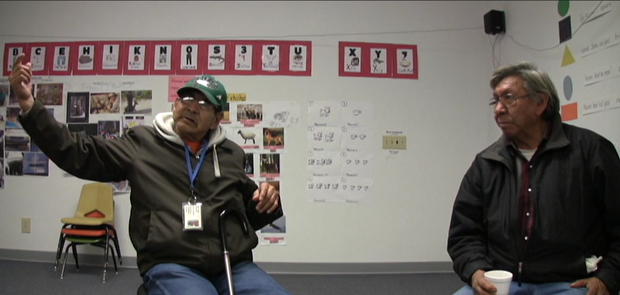
The challenge for young people eager to learn Arapaho -- says Cowell -- is the difficulty of the language, and the lack of textbooks or graded materials.
"So we've now got a really, really detailed understanding of the sequences that people need to use to learn the language," said Cowell.
Cowell's devotion to revitalizing the language earned him acceptance and formal adoption by an Arapaho family.
"Stayed with us, worked with us, did all this and basically became Arapaho," said Young-Chief.

Cowell was given an Arapaho name: Co'ouu3ii'eihii, which translates to "High Eagle."
"It's a pretty good name, in my opinion," said Cowell.
Now his mission is to work with educators to teach Arapaho to the tribe's children.
"He's a person that I can really rely on to have a conversation with about the language," said Young-Chief.
Cowell says he never imagined his research would lead him here, but he's glad it did.
"If you ask most Arapaho people, they would say it is the most important thing to do right now, because they see language as fundamental to their identity," added Cowell.
To learn more about the revitalization of the Arapaho language, and find resources for Arapaho language learners, visit: Arapaho Language Project and Arapaho Lexical Dictionary