Gunnison Tunnel in western Colorado brought water to the Uncompahgre Valley, and it brought farming to life

Duane Vandenbusche picks his way along a path above the deep and foreboding Black Canyon of the Gunnison. A retired professor of history at Western Colorado College, (now Western Colorado University) where he built up the school's legendary track and field and cross-country program as coach, he is a Colorado version of a Renaissance man.
"We always thought we were the first to go all the way. We were the second," said Vendenbusche of his journey through the canyon in the 1970s.
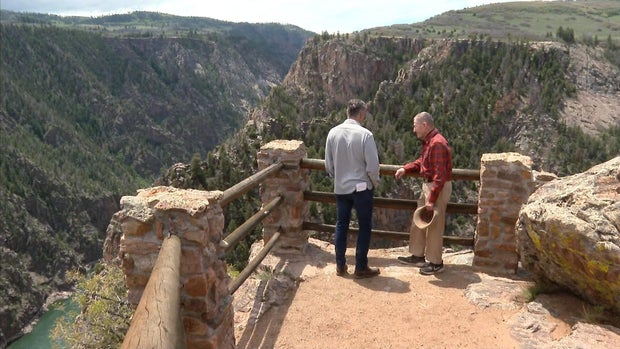
"But it's very exciting. There's a lot of places you can't run. There's big waterfalls down there, there's a lot of rocks down there and you've got to be careful."
It turns out two men did make it through before Vandenbusche and a friend, back in the 1930s. Nonetheless, getting through put him in an exclusive club decades ago.
"You don't want to get hurt in the bottom of the Black Canyon because it would be hell to get a guy out of there," he explains.
What still amazes a man who has to be hard to impress is the Gunnison Tunnel. It's still the longest in the United States, surpassed in more recent history by tunnels in Sri Lanka and China. The idea that it could have been built in the early 1900s is stunning.
"And when they finished the building in 1909 they were 11/100ths of an inch off," observed Vendenbusche.
The tunnel was constructed to bring water to the vast Uncompahgre Valley, including towns like Montrose, Olathe, Delta and Ridgway.
"In 1853 John Gunnison who came through referred to it as a desert and therefore uninhabitable," explained Vandenbusche. "It was a desert. It was sagebrush. It was just arid."
Farmers attracted to the land saw a water source: the Uncompahgre River.
The movement of farmers and the railroad into the valley, however, meant Native Americans were forced from their land.
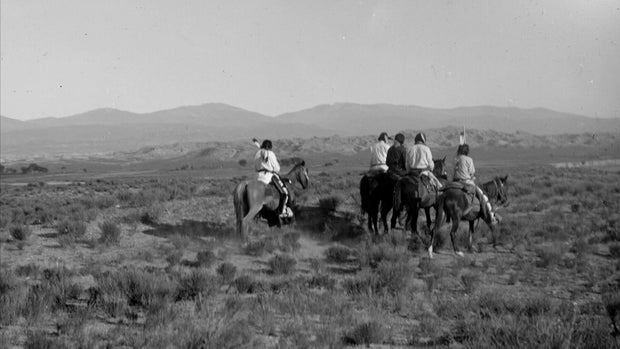
"They were moved out from Colona in 1881 to Utah and then settlers began to come in because they thought with the Uncompahgre River they'd have plenty of water for irrigation."
But the farmers soon learned the Uncompahgre, even in wet years, did not have enough water.
In 1894, a rancher in Montrose looking at levels discovered the water in the Gunnison River was higher than the valley. That was the seed of a greater idea that soon grew.
The first thing to do was figure out how in the world they could start a tunnel in the towering Black Canyon.
"In 1900 a guy named John Pelton Montrose, a rancher, brought five men in with two wooden boats," said Vandenbusche.
The boats weighed about 300 pounds. In 21 days they went 14 miles. One of the boats was gone.
"Kindling wood crushed by the rapids on the second day," Vandenbusche explained. "They stopped, got a great picture of them with bandages around their head and they worked their way up 2,000 feet up the canyon. Very lucky to get out alive."
The next journey was two men on foot.
"In 1901 Abraham Lincoln Fellows was over at Mancos working for the U.S. Geological Survey. He was hired by the newly created Bureau of Reclamation and he and an assistant named William Torrance went through the canyon."
It was Fellows and Torrance who figured out where the canyon wall could be breached for a tunnel leading down to the Uncompahgre Valley. It would mean digging and blasting a tunnel under the Vernal Mesa nearly six miles to the Uncompahgre Valley.
"The Bureau of Reclamation started building the Gunnison Tunnel from two sites. One was called Lewanee or the West Portal eight miles from Montrose. And the other was called East Portal or river portal down in the canyon along the Gunnison River."
It was tough work. Workers often didn't last long; once on the job they'd realize the difficulty and hardship and quit. A total of 24 died over the years the tunnel was built.
"Some of the men got killed in a rock fall," began Vandenbusche. "Others mostly by explosions, accidents... and one guy got kicked in the head by a mule."
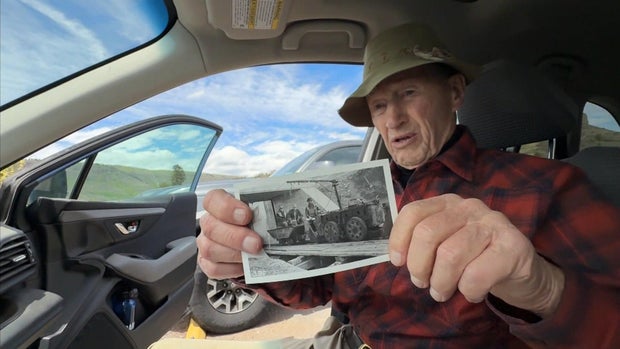
It was the first major project for the newly created Bureau of Reclamation.
"If you give money for river and harbor builds, taxpayer money for river and harbor builds for the East, then you damn well should be able to spend taxpayer money to create arid lands into irrigated lands that you can raise stuff on."
The tunnel would move millions of acre feet of water per year to the big valley.
"It was a fantastic achievement and it provided irrigation for the Uncompahgre Valley and saved six towns."
In 1909, it was done. President Taft came to throw the switch.
"And it started the water flowing into the Uncompahgre River Valley into 600 miles of laterals, ditches and canals. Saving the towns of Ridgeway, Colona, Montrose, Peagreen, Olathe and Delta," said Vandenbusche.
At first it was lined with timber, but later that was replaced with concrete. Vandenbusche was able to ride a vehicle up the tunnel when the water was shut off for work one year in the 70s. It's barely a car width wide. But it carries a critical supply to a huge valley, responsible for vast settlements and generations of farming and ranching.
"Without irrigation, you're not going to have those beautiful hay fields that you see today. And you're not going to have cows grazing on the land," Vandenbusche explained.