Denver air quality program hopes to expand its services to reach more people

Bad air quality has unfortunately become a familiar issue in Colorado. At a few points last year, Denver's skyline was completely blanketed with smoke, whether from wildfires in the state or nearby areas, as well as other sources.
Back in 2019, Denver launched a program called Love My Air. In its simplest form, it rates air quality as good, moderate, or hazardous. It's a tool that lets people in the Denver area look up air quality in real time and decide how they'll spend time outdoors.
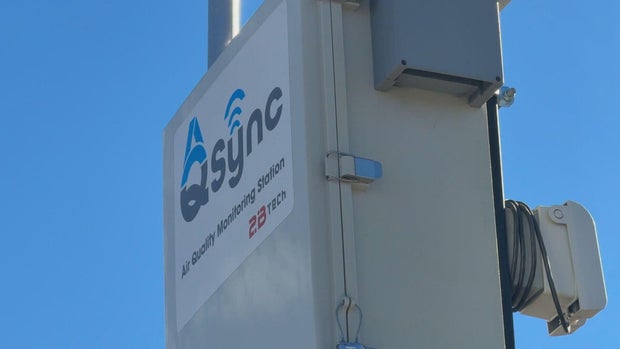
Across the city, little boxes provide important information.
"We measure a couple of different pollutants you see up here," said Ephraim Milton, a coordinator with the Love My Air program. "Ozone is a big one here in Colorado. PM2.5 is very common."
Real-time information on air quality and how it affects different individuals is gathered through a network of 80 sensors, a combination of the program's sensors and the state's.
"It's just very hyperlocal," said Milton. "I mean, you go to the weather app and that, yeah, sure, that'll tell you the general, you know, air quality for the area. But you go here to ours, and it's definitely going to be more local."
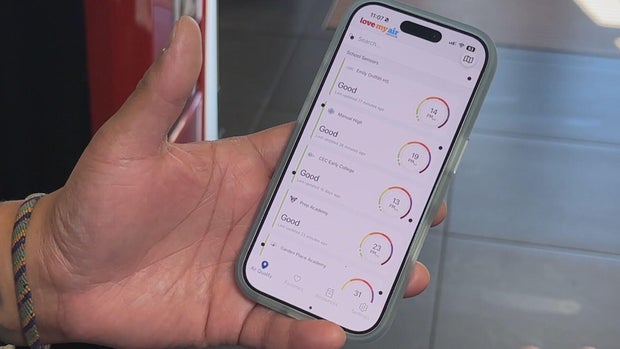
The program has expanded over the years and is now in Jefferson and Adams Counties, with sensors across the state and even into Wisconsin.
"They think they have six sensors in Milwaukee," said Milton. "They're really great partners."
Inner City Health, a non-profit providing healthcare to underserved individuals, is a partner here in Denver.
"The technology that they're providing affords us the ability to inform our patients and the community at large [that] today may be a good day to go outside and exercise, and today may actually be of danger," said Charles Gilford III, the non-profit's CEO. "Because we have folks who have asthma or COPD or different conditions that pose a risk to their safety and to their well-being."
They have an interactive kiosk in their waiting room, but hope the program continues to evolve.
"To send a text message to our patient base and give them updates and say, 'Hey, just as a heads up, we saw you the other day and today would be a good day to take that walk," said Gilford. "What are the other iterations of this technology that folks can have? How can we make sure that in a society where everything is competing for our attention, we can just be that one little nudge to give people good information while they're going about their lives, and not just in the clinic?"
This tool can also be useful in the event of a fire or nearby construction, for example. Love My Air hosts community workshops focused on education, in addition to their online resources, and the information is also used for policy and rulemaking across the state. They plan on adding multiple healthcare partners in 2026 and hope to continue expanding their reach.