Some Colorado voters will see a ballot question in 2026 that's not supposed to be there

Some voters in four Colorado counties are receiving ballots asking them to weigh in on a proposed tax increase for Colorado's Front Range Passenger Rail system, even though their communities were removed from the district's boundaries before the measure was placed on the ballot.
The issue involves Ballot Issue 7A, which would increase taxes to fund the Front Range Passenger Rail District and its proposed Colorado Connector (CoCo) passenger rail service.
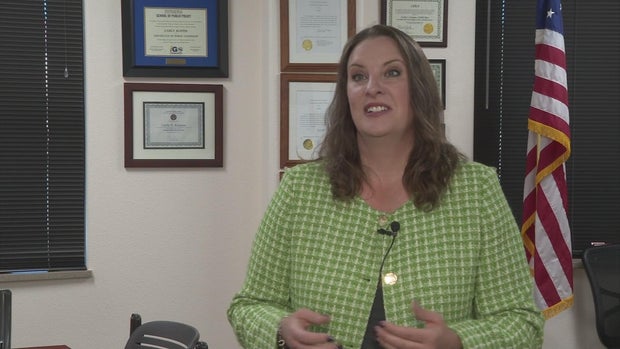
Carly Koppes, the Weld County Clerk and Recorder, said it is an issue her office recently learned about.
"There are potentially voters that got the question that should have not received that question," Koppes told CBS Colorado.
The confusion appears to stem from a change to the Front Range Passenger Rail District's boundaries.
Koppes said the district originally included the town of Erie, meaning voters there would have been eligible to vote on 7A. But the district's boundaries were adjusted before Gov. Jared Polis signed the legislation establishing the new boundaries.
Koppes said those updated boundaries do not appear to have been properly conveyed to all county clerks and recorders.
"There's a legal question out there now," Koppes said.
The issue affects some voters in Weld, Adams, Arapahoe and Douglas counties, who received ballots containing the 7A question, Koppes said.
The Front Range Passenger Rail District has acknowledged the confusion.
In a statement to CBS Colorado, the district's general manager said, "We regret that there has been some confusion about who is eligible to vote on Ballot Issue 7A. When the legislature updated the District's boundaries this spring, we should have walked every county clerk through the change. Although we weren't legally obligated to do so, it would have helped avoid the confusion that followed."
With ballots already printed and distributed, Koppes said county election officials will continue processing ballots as they are returned.
"We're going to still count the ballot exactly how it comes in," Koppes said.
Koppes said election officials have multiple safeguards in place to make sure voters' ballots are properly counted.
"We have a lot of checks and balances throughout our process to verify that what is on your ballot is what is supposed to be there," Koppes said.
If election officials receive a directive to invalidate votes on 7A from voters who were not eligible to participate in that question, Koppes said they can isolate that portion of the ballot without affecting the rest of the voter's selections.
Election officials can use the timing marks and barcodes printed around ballots to identify the different ballot styles and determine which ballots contain the disputed 7A question.
"These are not just for show. These are actual timing marks," Koppes said. "That's how we know where the target marks are and all the different types of ballot styles that we have because we've got a lot throughout the county and the state."
Koppes said that means officials can report the results of the other races and questions on a ballot while voiding only an ineligible vote on 7A, if they are directed to do so.
"At the end of the day, we've got it handled, and all voters can be confident that your whole ballot and everything you're supposed to be voting on is going to be counted properly, however you decide to mark it," Koppes said.
In a letter to county clerks, Judd Choate, the director of elections in Colorado, said, "This means that, with some exceptions, ballots can be processed normally and the voting system will differentiate between those where the race can and cannot be counted. However, there are at least two jurisdictions, Bow Mar in Arapahoe County and the Sterling Ranch in Douglas County, where voters in the same precinct or those receiving the same style of ballot are not uniformly eligible. For this small universe of precinct splits or ballot styles where everyone within a jurisdiction received the same question, the county will set the ballot sorter to out-stack each of those envelopes for hand review. Those eligible to vote in the race will be processed as normal. Those ineligible will be signature verified, deconstructed, and then duplicated onto a ballot style that does not include 7A."


