Colorado U.S. congressmen take a force-of-nature approach to problem solving; 'be like water'

As our state of Colorado approaches its 150th birthday and our nation turns 250 years old, many Americans are disillusioned by this grand experiment in democracy.
Trust in United States Congress is the lowest in decades, and the partisan divide is deeper than ever. It's as though Republicans and Democrats can't even bare to breath the same air as each other, let alone work together for the greater good.
But Democratic U.S. Rep. Joe Neguse and Republican U.S. Rep. Jeff Hurd have found a way to transcend the division, distrust and dysfunction.
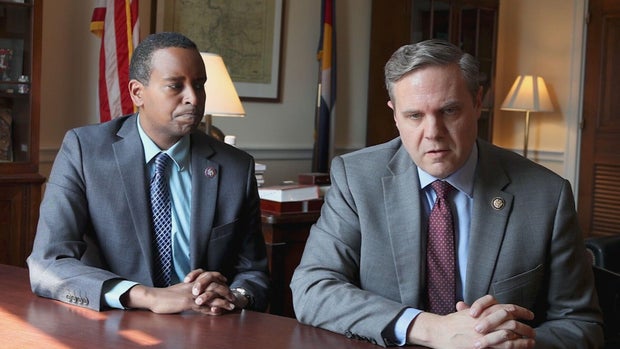
When President Trump vetoed a bill in January to finish the Arkansas Valley Conduit — a project providing clean water for thousands of Coloradans in Hurd's district and Republican U.S. Rep. Lauren Boebert's district, Neguse stepped in. The U.S. House Assistant Minority Leader, Neguse took the floor and asked Democrats to help his Republican colleagues override the veto.
"I'm speaking to my Democratic colleagues, to be clear, that it is important in this moment for members to support this override," Neguse said in Washington D.C.
Three months later, Hurd would come to Neguse's aid, signing on to a letter to protect funding for the National Center for Atmospheric Research in Boulder.
The congressmen have also co-sponsored legislation to improve snowpack monitoring, fought to prevent the sale of public lands in Colorado, and pushed for the rehiring of thousands of forest service workers who fight wildfires.
"Irrespective of where the political winds are shifting in Washington, it's important that we have, I think, good faith actors here in our nation's capital who are going to fight for our state's interests," Neguse told CBS Colorado. "My job is to work with anybody and everybody in good faith, who's willing to try and solve a problem."
Perhaps the biggest problem facing Colorado today is a lack of water. Neguse and Hurd penned an op-ed about their efforts to protect the Colorado River, including securing funding to acquire some of the oldest and largest water rights on the river. Last year, Xcel agreed to sell rights to 1 million-acre feet of water used for the Shoshone Hydroelectric Plant. The deal will maintain the current flow of water, which impacts up to 3 million Coloradans. The state and local governments raised $57 million for the purchase. Congress approved the other $40 million. But the U.S. Department of Interior is now refusing to release the money without giving a reason.
"Fundamentally, I think there is a responsibility that we have as Congress to ensure the laws that we pass and the funding decisions that we made are implemented faithfully," Hurd told CBS Colorado.
Hurd and Neguse are also working behind the scenes to ensure the dwindling supply of water from the Colorado River is divided fairly among the seven states that rely on it. The century old Colorado River Compact expires in October. If the upper basin and lower basin states can't agree on a new compact, the federal government will impose one.
"We need to stand together as a state," Hurd said. "If we do not stand together as Republicans as Democrats, we do not stand together as as Western Slopers and Front Rangers, we are going to lose this battle."
At a time of gridlock so crippling Congress can't even manage its core function to fund the government, Hurd and Neguse have found a way to rise above the tribalism, pandering and incivility to find common ground and a shared purpose.
"Our politics, as you know, has gotten very performative tragically," Neguse said. "But we've got to resist that temptation and find a way to ultimately achieve common ground and get things done."
Hurd says the way to do that is to be like water.
"When water meets an obstacle, it either goes around it or wears it down," Hurd said. "That's what I'm committed to doing, and I know Joe is as well. When it comes to these problems, we're going to be like water. We're either going to go around it, or we're going to wear it down."