Colorado aerial fire spotters detect record number of lightning-caused wildfire starts in July

Colorado's wildfire fight is increasingly beginning from the air -- sometimes before a fire is even visible to the naked eye.
State fire officials say two Pilatus single engine aircraft searching for lightning-caused fire starts detected 164 in Colorado during July, potentially a record number for a single month. Most of those fires never grew into large wildfires. That, state officials say, is the point.
The aircraft are part of Colorado's aerial fire-detection program, which sends planes over the state looking for the heat signatures of new fires, particularly those sparked by lightning.

"We found 25 in one flight," said Andrea Drinkhouse, one of the state's aerial fire spotters. "Last shift they found 23 and 22. That's quite a few fires to call in."
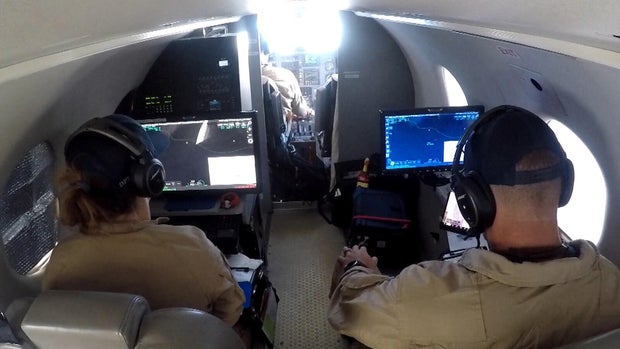
Drinkhouse spends hours in the back of one of the state's aircraft, scanning the landscape with an infrared camera. Fires that are nearly impossible to see from the air with the naked eye can stand out clearly through the camera.
Once a fire is detected, the spotters can quickly send its location, photographs and video to fire managers on the ground. Those managers then determine whether firefighters and other resources need to be dispatched.
Drinkhouse, a former hotshot firefighter, has been working as an airborne fire spotter for the Colorado Division of Fire Prevention & Control for eight seasons. She said there is a particular satisfaction in finding a fire while it is still small.
"I love searching for fires and it feels so good when you find a fire," she said. "It's so cool to find them small."
Many of the fires detected in July were extremely small.
Jesse Moreng, crew chief for the state's fire-spotting aircraft, told CBS Colorado, "I'd say we're finding the majority of fires out there at a dinner-plate size."
But the sheer number of fire starts can make the work challenging.
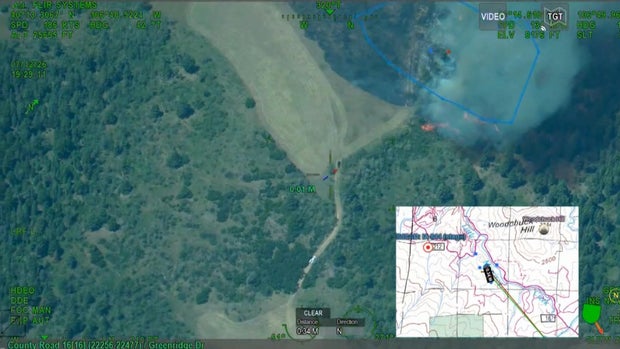
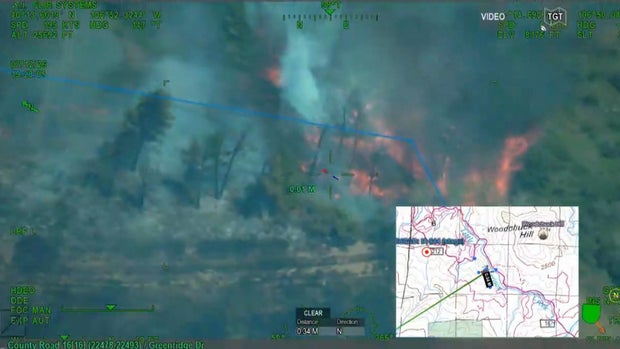
There have been so many this summer, the aircraft may have only a few minutes to spend over each fire, mapping its location, documenting what they see and relaying the information to firefighters on the ground before moving on to search for the next potential fire.
Drinkhouse said the work can be exhausting, but finding a fire before it has a chance to grow remains the motivation.
"We in the plane get super excited," she said. "It's the purpose of our job."
The aerial crews are also seeing fire in places where they say it was once less common at this time of year.
Drinkhouse said lightning-caused fires are increasingly appearing at higher elevations -- areas that historically would have been protected by snow during the summer.
"Fires are actually going higher up in elevation," she said. "That wasn't something we worried about in the past."
The strategy of detecting fires early does not mean every fire can be stopped. Many lightning-caused fires burn themselves out. Others are quickly extinguished by firefighters on the ground after being spotted from the air. But some escape initial suppression efforts and grow into major wildfires.
The Elk Fire in Hinsdale County, for example, has now burned over 7,000 acres.
For the aerial fire spotters, the goal remains simple: find those fires while they are still small enough to stop.


