Colorado's hot, dry climate could be ideal for growing one of the world's most expensive spices

Colorado's hot, dry summers and cold winters can make growing crops challenging. But researchers at Colorado State University are studying whether those same conditions could make the state an ideal place to grow one of the world's most valuable spices: saffron.
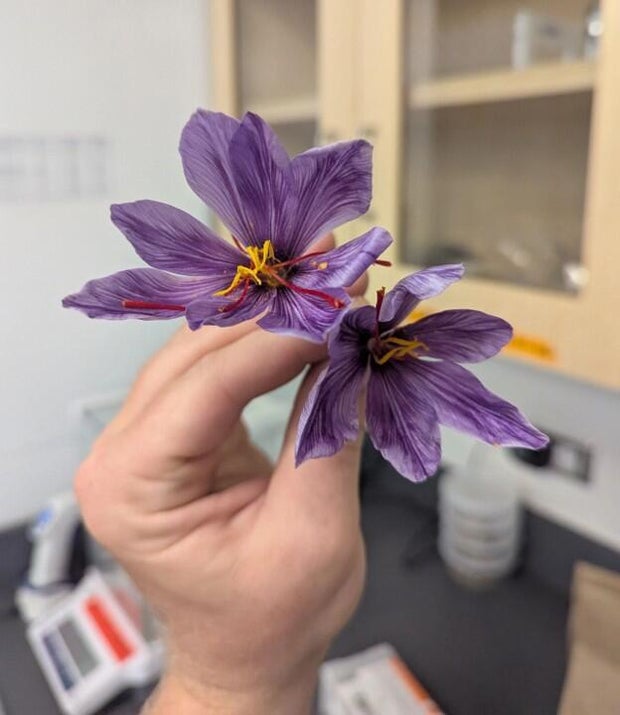
Often called "red gold," saffron is prized for its flavor, color and rarity. It can also yield significant returns for growers, with current market prices around $10,000 per pound.
For CSU master's student Reece Bailey, Colorado's challenging climate may actually be part of the opportunity.
"Colorado's climate is a very tough climate to grow a lot of crops in," Bailey said. "And if we look at saffron and where it evolved, it actually evolved in a climate very similar to ours in Greece and Iran, where they have long, hot, dry summers and then cold, wetter winters."
Saffron has adapted to survive those conditions. The stems grow underground, which helps protect them from large seasonal temperature swings, while their long, thin leaves help limit water loss.
Colorado's dry climate could provide another benefit.
"Our dry conditions help it avoid corm rot, which is one of the top diseases that actually limits saffron production," Bailey said.
Saffron could also help Colorado farmers extend their growing season. While many crops are winding down in October and November, saffron flowers begin to emerge. Harvesting can continue through early December.
That timing could provide farmers with another source of income during a quieter part of the growing season while also helping keep farm workers employed.
"Saffron is typically harvested from October to the beginning of December," Bailey said. "During that time, farmers here aren't putting a lot of crops in the ground."
The crop's high value could make it especially attractive to smaller and specialty producers.
"If you are growing it locally or organically here, I've seen people charge up to $50 per gram," Bailey said.
Harvesting, however, is a labor-intensive process. Each flower must be picked and carefully dissected to remove three tiny red threads, known as stigmas. Those stigmas are the saffron spice.
The process is still largely done by hand because machines have not been developed that can efficiently remove the delicate threads without damaging the product. Bailey said he often uses tweezers to remove the thin strands.
Water was another major consideration for Bailey's research.
"Water is king out here in the West," he said.
Bailey said they only watered their saffron three times during the past year.
"I really didn't want to introduce a crop that was going to suck down a lot of water," he said. "When I saw saffron, and I saw how little water it used, I thought that is the perfect crop to try to introduce here."
The research is also looking beyond traditional farmland.
Bailey's project began with what he describes as a "hairbrained idea" during an internship: What if saffron could grow on green roofs? Green roofs can be expensive to install, and researchers have found that not all plants perform well in those conditions. But saffron appears to thrive there.
One of the biggest surprises from the research was how well saffron performed on rooftops.
"What surprised me the most is that saffron performed the same on the roofs that it did on the ground," Bailey said.
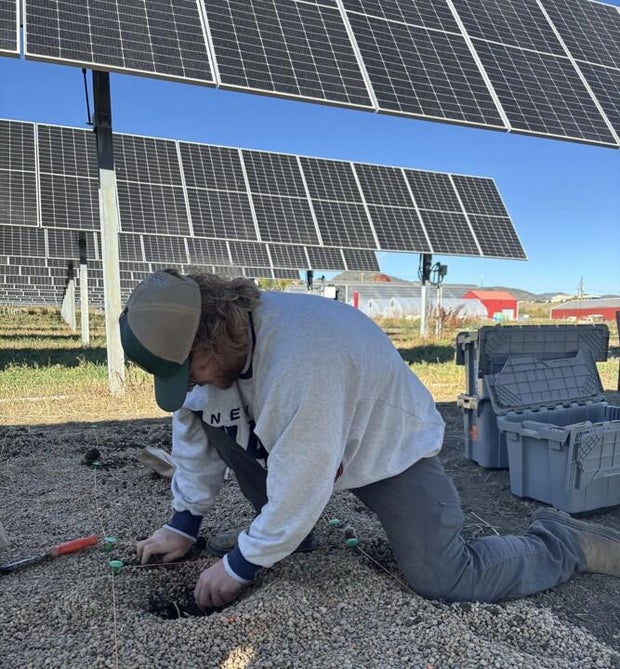
Researchers also tested saffron under semi-transparent photovoltaic panels that provided 40% shade. The results were even more promising.
"When we grew it under 40% shade, semi-transparent photovoltaic panels, we actually got double the amount of stigma yield that we got from full sun treatments," Bailey said.
Researchers are now entering the final growing season of the study.
Bailey said the team will harvest saffron from around 3,000 plants that were planted over the past year. Researchers will collect and analyze the data before releasing a report on their findings.
Looking ahead, Bailey hopes saffron could become a new specialty crop across parts of eastern Colorado.
"Five to 10 years from now, hopefully, if all things continue to go well, we will continue to see small specialty crop producers along the eastern half of the state producing saffron in its sandy soils over there," Bailey said.
For a state facing persistent challenges from drought, heat and limited water, researchers hope one of the world's most valuable spices could offer Colorado farmers a new opportunity—one uniquely suited to the state's climate.


