Colorado brothers launch startup to improve geolocation, keep firefighters safe

The recent line-of-duty deaths of three firefighters in Colorado serve as a reminder to Rod Goossen about why he began his mission to help keep them safe.
"I couldn't imagine being in a situation where I know I was trapped and see the end coming and all hope is lost," said Goossen, CEO of RoGO Communications. "That sort of event is what we're trying to prevent in the future."
It's a mission he took up in 2013 after 19 of the Granite Mountain Hotshots were killed fighting the Yarnell Hill Fire in Arizona.
"It makes me very sad thinking about the Yarnell Hotshots and how they passed," Rod said. "I was confused, mad and frustrated. How this event could have happened? How could Incident command not even know where they were located at? Could not warn them that the winds were shifting radically."
He turned to his firefighter brother, Derek Goossen, to understand what went wrong.
"My brother, being an aeronautical engineer, called and said, 'How are you guys tracked?' And I said, 'We're not,' and he said, 'We could do better,'" said Derek, training and safety captain at Red, White & Blue Fire Protection District and Summit Fire & EMS.
"The Granite Mountain guys had paper maps, compasses and two-way radios," Rod said.
From there, the brothers used their tech and firefighting knowledge to launch RoGO Communications and a satellite location device for wildland fire crews. The company's DropBlock device transmits over the Iridium satellite constellation at a lower frequency than Starlink, allowing it to penetrate through the tree canopy.
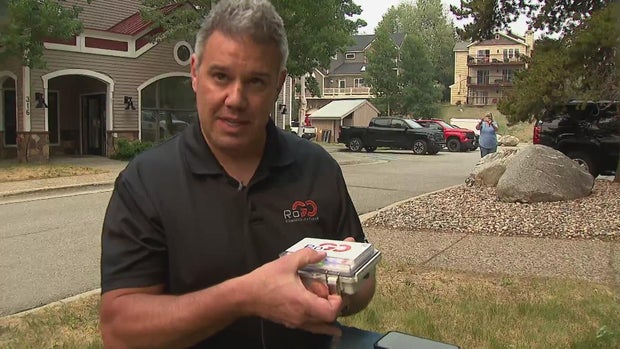
"This is the DropBlock. It is in an IP67-rated case, so weatherproof, waterproof, dustproof. Open up the lid, and this device runs off eight AA batteries," Rod said.
The DropBlock shares GPS locations, messages and fire weather data between fire crews without cell service via the RoGO app.
"On this map right here is us. I put us there as a hand crew, and this engine is actually a firefighting buggy that was deployed earlier this morning, so we can track its exact GPS location and see where they're at," Rod said. "With our devices now, incident command can get a very granular picture of exactly where people are at, exactly where the fire is at, exactly what the fire weather is doing and how that might change fire tactical decisions, and it might be a possible danger, so you can get them out of the way before."
"Anyone on the fire can pull up a tablet or a phone and see where everyone's at on that fire. Obviously, the wilderness that we typically fight fires in is so vast it's hard to know exactly where everyone's at, and this gives that instant capability," Derek said.
This week, on the 13th anniversary of the Granite Mountain Hotshot tragedy, RoGO launched the DropBlock 2.0 and began testing it at Red, White & Blue Fire Protection District in Breckenridge.
"Accountability and finding our people, knowing where they are, is a key part of fire management, especially in the wildfire world, where people are strewn throughout the woods, and we don't always have eyes on them. We don't necessarily know where they are exactly, so a product like DropBlock gives us an idea on one platform where all of our resources are," said Matthew Benedict, wildfire division chief at Red, White & Blue Fire Protection District. "It gives us the ability to text between each other with absolutely no service at all. So that's a pretty awesome feature, and it's very portable. It's super small. We love that."
Benedict is excited about the potential new technology like this can bring to the firefighting industry.
"Public-private partnerships is not traditionally something the fire industry has embraced very well, and we just understand that we need all of the solutions at this point," Benedict said. "Red, White, and Blue Fire has been approached by several startups and tech companies, and basically private industry looking to make a difference in the wildfire industry, and we're open to this, to say the least. So a lot of these ideas that come out can increase our effectiveness and efficiency, and so we're open to this one. We've looked at several other companies, from exterior home sprinklers to insurance companies to drone companies, and then now RoGO."
The first version is already in use in Arizona. RoGO hopes to take the new model nationwide to protect those who protect us all.
"We're starting here at my brother's firehouse, since I have an in. And then after this, the next firehouse we're going to deploy to is the Colorado River Fire [Rescue] in Rifle, Colorado," Rod said.
RoGO Communications is hoping to hard launch version 2.0 in September.
"I love my department, and I love this technology because I know it'll help save lives in the future and make us more efficient," Derek said. "I just can't wait for it to get out there and be in use and actually start helping people out and hopefully preventing some disasters in the future, which is what it's all about."
"Make sure firefighters, when they're deployed on fire, that everybody comes home. That's our mission, and that's our goal," Rod said.


