Authorities in Southern Colorado lift more evacuation orders near Aspen Acres Fire
On Sunday, officials in southern Colorado said more residents will be allowed to return home soon as they continue to lift evacuation orders near the Aspen Acres Fire.
The Custer County Sheriff's Office says residents in Zone C4 will be able to return beginning at 8 a.m. Monday. Zone C9B was reopened to residents on Saturday.
The sheriff's office shared a reminder that re-entry cards are required to pass through traffic control points and advised residents who have not yet picked up a card to visit the Disaster Assistance Center.
The reopened zones will be under a pre-evacuation notice for now, as conditions can quickly change.
"Stay alert, keep your emergency notifications on, and be prepared to leave again if unsafe conditions return," the sheriff's office said.
Dumpsters for residents to dispose of spoiled food are available at McKenzie Junction at the intersection of Highway 96 and Highway 165. The sheriff's office said the dumpsters are for spoiled food only, and residents should not dispose of other trash or debris in these dumpsters.
Custer County Sheriff Rich Smith says zones C2 and C3 are still "heavily involved in firefighting efforts," and crews are conducting backburning operations to contain the fire in that area. He said it will still be a while before those residents will be able to return.
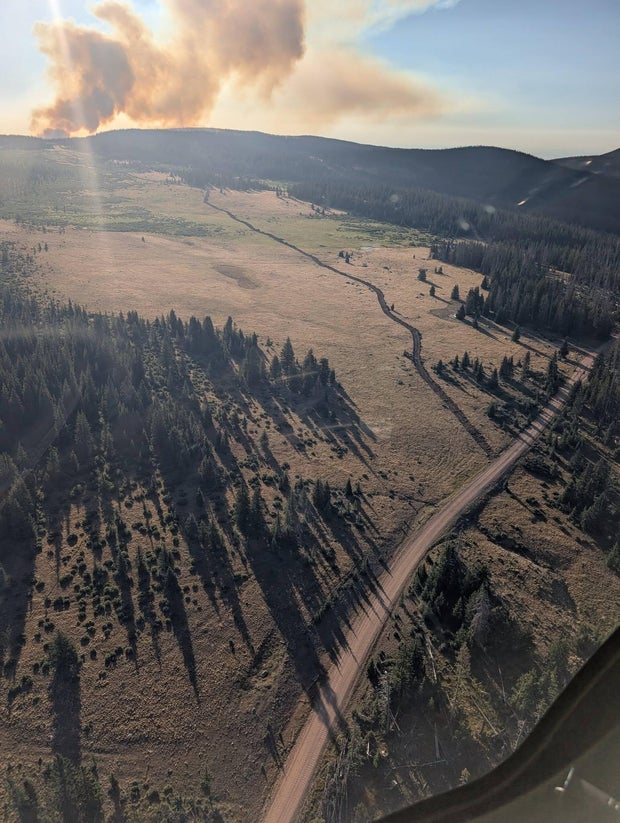
In an update on Sunday, Northern Rockies Team 6 Operations Section Chief Ben Wagner said crews have made progress on containment efforts in the area northwest of the Town of Rye. They're also working to protect properties around San Isabel. The crews also recently conducted firing operations along the northwestern edge of the fire, which Wagner says have significantly aided their containment efforts.
The fire has burned approximately 100,224 acres so far, making it the sixth-largest wildfire in the state's history, according to the Colorado Division of Fire Prevention and Control. Crews have reached 61% containment of the fire.
The Beulah Fire Protection and Ambulance District said there have been some problems with visitors and sightseers trespassing on private property in the burned areas and advised everyone not to enter private land. They warned that doing so can interfere with cleanup and recovery efforts.
Also beginning Monday, the Custer County Sheriff's Office will begin a series of educational presentations on wildfire mitigation to help the community improve fire readiness.
In a letter to the community, Smith made a plea for the community to focus on fire mitigation:
"From both ground and aerial observations, it has been frustrating to see a lack of adequate fire mitigation efforts in some of our more densely populated subdivisions. This is not a criticism made lightly—it is a reality that directly affects the safety of our community and the ability of firefighters to defend homes.
This fire must serve as a turning point. Fire mitigation can no longer be optional or secondary. It must become a priority for every branch of county government and every resident of Custer County. Creating defensible space, managing vegetation, and supporting responsible land stewardship are essential steps in reducing the impact of future fires. I look forward to working with the Commissioners to hold workshops for the community and to apply for urgently needed grants to build our capabilities."
He said that recovery will take time, and the community must come together to help one another.
Smith also warned of the dangers of flash flooding in burn scar areas and said they're working to identify high-risk zones and develop strategies to respond.


