Wellesley family grows spectacular flowers and tomatoes and gives them away to build community

A family of gardeners in Wellesley, Massachusetts, is sharing their incredible bounty with the community.
Don can teach you a lot about dahlias. In his yard, he points out a few of the 350 varieties he grows. Pooh. Ketchup and mustard. Valley porcupine. His garden is a wonderland ablaze in bright, joyful hues. And yet he constantly muses about how to make it better.
"The amount of learning you do each year to improve for the next year is fantastic," he explains. "I learn something every day from different people."
Don and his family compete (and win) in flower shows. He calls it "friendly competition," a supportive community in which people share information and encourage one another.
"When you do a show, you're actually competing against a perfect flower," he said. "You're not competing against another person. You're competing against perfection."
Don's passion for gardening deepened in retirement. Now, it's a "family affair." His wife Peggy plans the garden's colors and competes in shows. His daughter Elizabeth helps him stake the plants, keep them healthy, and cut them when they bloom. "I could not do this without him. If I was out here by myself," she laughs, "probably half these plants would be on the ground — or not even blooming. I think learning from him is really still special even when I'm growing older."
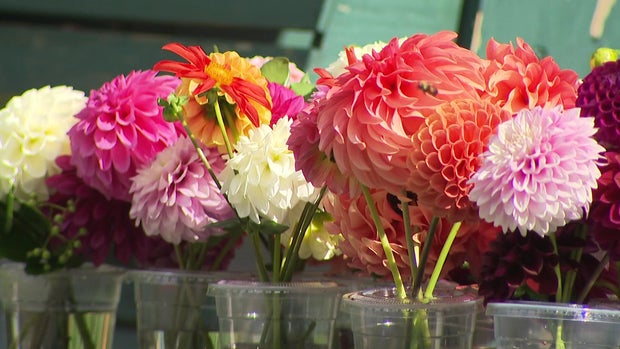
In the early fall, when the flowers are at their peak, they work side by side almost every day. Elizabeth cuts the stems and hands them to Don, who places them in a bucket of water to keep them fresh. "The more you cut, the more flowers you get," Don explains. "Nature says, 'I need to reproduce.' And when they know that there's not a flower there, they push another flower quickly."
These flowers will brighten homes all over the neighborhood. In stores, dahlia bouquets of a half-dozen blooms sell for $30 to $40. But Don and his family have no interest in selling their flowers. "This isn't a money-making endeavor for us. This is a bonding experience and a labor of love," he said.
What they love most is giving them away. Most days, they make dozens of bouquets, arranging them on a cart at the end of the driveway. Passing drivers often do a double take. Some stop, spend a few minutes asking about the flowers, and leave with a bouquet and a smile.
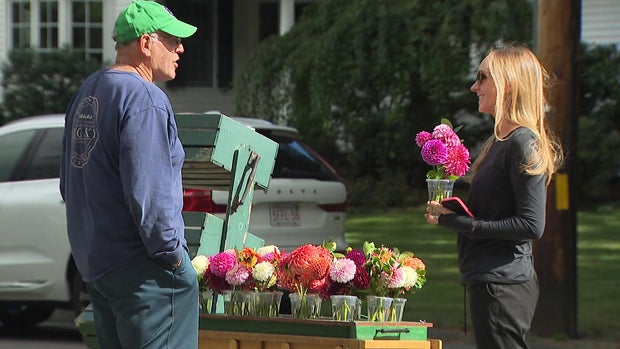
On a Wednesday in early fall, a neighbor named Mark is the first to approach the cart. He greets Don warmly and explains that he and his wife always appreciate the gesture. "There's not a lot of neighborly things these days it seems," Mark said. "For somebody to be such a good neighbor and allow people to do this and spread the joy is awesome."
In offering flowers, and 20 to 40 pounds of tomatoes every day, Don and his family are also building community. Their driveway has become a neighborhood social hub where people catch up, exchange hugs, and choose their bouquets and tomatoes.
"You really get to know people," Don explains. "Not superficially. You get to know about their family, what they're doing, where their children are getting married or going to school. What they're interested in. And that's really nice."
His neighbors agree. "We love it," a woman named Kathleen said smiling. "My kids have referred to him as 'Dahlia Don.' It's really meant a lot."
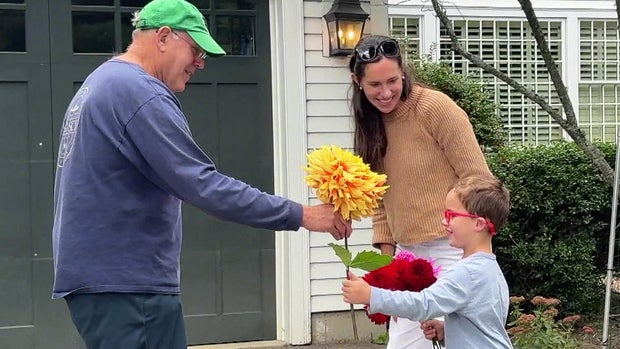
Another neighbor, a second Mark, describes how welcome he and his wife felt moving into the neighborhood a few years ago. "They dropped off flowers, tomatoes, and all sorts of good stuff. They've been the best," Mark said.
It is the kind of environment Don remembers from his childhood and hoped he would find in the MetroWest. "When we first moved to Wellesley, I was a little skeptical because I thought it might be a little foo-foo, you know? And I was completely wrong," Don said. "We know all our neighbors."
Looking around at the friends gathered in his driveway enjoying his family's bounty, he says he couldn't ask for more. "It just makes me feel good that people feel comfortable enough to stop and have a conversation and take something," Don said.


