Tropical fish in Massachusetts waters? Warming ocean temperatures are changing the catch

When you think of tropical fish, Massachusetts probably isn't the first place that comes to mind. But fishermen are finding some unexpected species in New England waters, and warming ocean temperatures may be playing a role.
Max Harvey has spent decades on the water, and he's noticed some unusual catches.
"There was a cubera snapper caught on Nantucket like last week. And it's happened before, but it's very uncommon," Harvey said.
The cubera snapper is typically associated with warmer waters farther south. But it's not the only surprising fish to turn up off the Massachusetts coast.
"Four or five years ago there was a rush of king mackerel in Vineyard Sound. And you could go out and actually realistically catch one," Harvey said.
Warm water species have occasionally made their way into New England waters for decades. Harvey says the Gulf Stream, which carries warm water north along the East Coast, has been getting closer to shore, allowing pockets of warmer water to break off and bring different species into the region.
The Gulf of Maine is warming rapidly
The Gulf of Maine is one of the fastest warming ocean regions on Earth.
Since 1982, its surface temperature has increased by approximately 0.84 degrees Fahrenheit per decade, nearly three times the global ocean average.
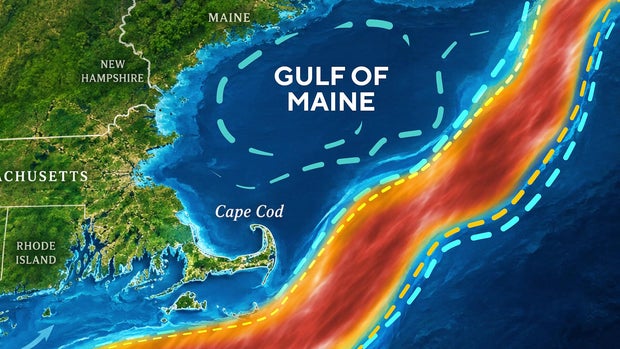
Even relatively small changes in water temperature can have significant consequences for marine ecosystems. Fish are sensitive to temperature, and as the ocean warms, some species may expand their ranges northward in search of suitable conditions.
Those changes can also affect what fishermen catch and what eventually ends up at seafood distributors like Wulf's Fish in Boston's Seaport.
But there's an important distinction. While warming ocean temperatures can contribute to long-term changes in where fish live, an individual tropical fish appearing off Massachusetts doesn't necessarily mean an entire population has moved north. Seasonal currents and unusual ocean conditions can also carry fish into unfamiliar waters.
Fish are moving, but regulations take time to catch up
For fishermen, the changing mix of species presents another challenge.
Fish don't need permits to cross state lines, but commercial fishermen need the appropriate permits and quotas to harvest them.
At Boston Provisions, Alisha Lumea, director of sustainability and education, says fishermen are increasingly encountering species they aren't necessarily authorized to catch commercially.
Some are asking whether fishing regulations should be updated to reflect what is happening beneath the surface.
But establishing new fishing quotas isn't as simple as identifying a new species in local waters.
"Right now, we have a lot more questions than answers. What is in the water? Well, to find that out, you have to be doing the science," Lumea said.
Scientists must determine whether unusual catches represent isolated occurrences, seasonal visitors or evidence of a larger population shifting its range.
That requires monitoring fish populations, studying migration patterns, and gathering enough data to understand whether those changes are temporary or part of a longer-term trend.
The research can take years, particularly when ocean conditions vary from one season to the next. Regulators then need that information to determine whether commercial fishing rules should change.
For an industry built around knowing where to find fish, the warming ocean is creating new opportunities, but also new uncertainty.
And as Lumea puts it, the challenge is keeping pace with an environment that's already changing.
"I think the science you know I think moves a little bit slower than the fish," she said.