Is Massachusetts ready to join other states in allowing cash-saving "plug-in" solar panels?

The sun is shining and the tomatoes are ripening up in Andre's backyard in Fitchburg, Massachusetts, where that sun equals savings thanks to his latest DIY project: plug-in solar panels.
"I want to get my bills down. That's the main reason that I went this route," Andre said.
Andre had been thinking about solar for a while and one shocking electric bill set things in motion. "Last summer when it got to $1,200 for a month, that's when I started looking a lot harder," he said.
Plug-in vs. rooftop solar cost
Rooftop solar was about $30,000. Plug-in solar was a fraction of that, so he joined a growing movement of people plugging in and saving cash. For about $1,500 Andre bought his first two panels, an inverter and mounting equipment. Then, he just plugged it into a standard outlet.
"The best way to think of it is it's another appliance like a refrigerator or TV, but instead of pulling power from the road, it's pushing it into the house and something else is using it," he said.
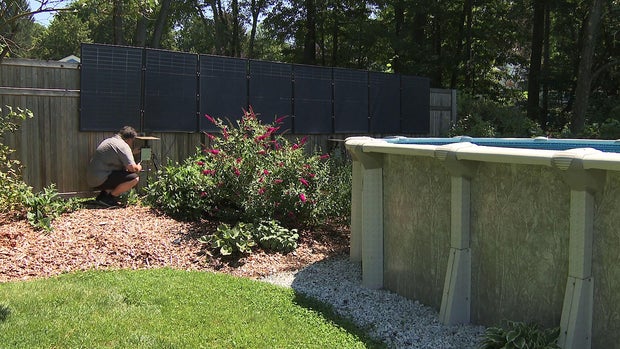
Andre bought his panels from a company called Craftstrom, which says sales are up 50% this year as eight states have recently passed laws allowing plug-in panels, including Maine, New Hampshire, Vermont and Connecticut. More than a dozen other states are now debating doing the same.
It looks like Massachusetts might be next to pass a law clearly spelling out how residents would be able to use plug-in solar. Legislation has passed the House and Senate and now a committee is ironing out the differences between their versions. Gov. Maura Healey's Office of Energy and Environmental Affairs told WBZ: "Solar is one of the fastest and cheapest ways we can lower energy bills, and plug-in solar is an exciting new development that will help make solar an option for more people."
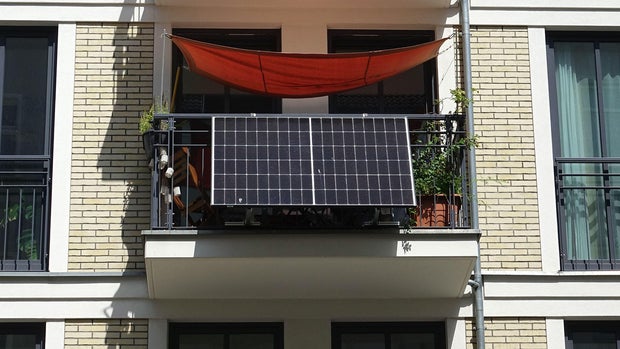
"Balcony solar" in Europe
More people like renters. The technology is also called "balcony solar" because you don't need a roof. In most cases, you also don't need an electrician or permission from your electric company. There would just be rules surrounding wattage and safety protocols.
It seems America is just catching on. There are about 6 million homes in America with rooftop solar. But in Europe, plug-in solar has taken off. So many people live in apartments, condos and rentals that so-called "balcony solar" just makes sense. And they've made it so easy in Europe that you can walk into a nearby IKEA and buy a panel for a couple hundred dollars.
"It has grown very rapidly, in particular in Germany," said Dr. Tanja Srebotnjak, executive director of the Center for Environmental Studies at Williams College in western Massachusetts.
She says this is a way for people to chip away at their electric bills while also helping the climate.
"It really empowers people to both take more control of their electricity bill, but also contribute to the common good, right?" she said.
What's the downside? Utility companies worry about safety. In a power outage, plug-in systems could potentially send power back to power lines, putting workers in danger. It's why most new laws require the panels to be certified and have built-in safeguards.
Solar savings
As for the savings, Andre has been keeping track of his first string of panels, called an array, on an app.
"It shows what's coming in from the road and what my arrays are producing now," he said while showing the app.
He has seen a difference. "So far, I'm down about 10%, maybe a little bit more. But that's just the first array," Andre said.
He thinks his second set will save him another 10%. Overall, he'll be saving about $1,000 per year, though he admits he uses more electricity than most.
But he didn't take loans, like he would have to afford rooftop solar, and he will pay off his investment in plug-in solar quickly. Sunny days indeed.
If you have a question you'd like us to look into, please email questioneverything@cbsboston.com.


