Where do the fish at the New England Aquarium in Boston come from? They're not plucked from the ocean.
Have you ever wondered where all the fish in the New England Aquarium in Boston come from? If you think they're all just plucked from the ocean, think again.
Twelve miles down the road, away from the hustle and bustle of the city, you'll find a quiet aquaculture center located in Quincy.
"Our giant ocean tank is our largest exhibit at the aquarium and 80% of the population in that tank was raised here in Quincy," says Monika Schmuck, the Manager of Sustainability in the Fishes Department.
Raising fish in Quincy
Sustainability is a top priority at this facility. And it's her job to make sure that happens.
"The whole program is to bolster fish in our own exhibits and pick species that we like to display for the public, but also take less from the wild and be able to do things sustainably behind the scenes," Schmuck said.
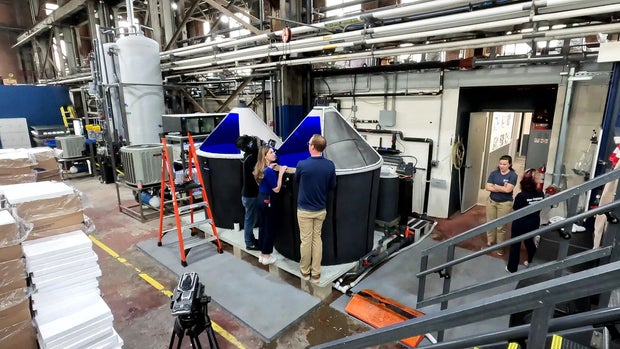
Plenty of firsts happen here in Quincy. Right now, they're working on becoming the first team to raise Creole Wrasse fish.
As the Curator of Aquatic Collections, Michael O'Neill is working through questions that nobody has the answer to yet. With over 35 thousand species of fish, there's a lot left to discover.
"In our spare time, we're going to focus our efforts on a species that's never been done before, but folks would love to be able to show in their exhibits. And so we are chipping away at learning what it takes to raise this species," O'Neill said.
Creating breeding conditions for fish
It's an incredibly precise craft to create the best breeding conditions possible. Something the ocean does naturally with ease.
"The long process that it takes to raise an animal from egg to adulthood, it takes years. And it takes a lot of really tiny little food. It takes a lot of people, you know, tinkering and trying to understand the science behind it and trying again and again," Schmuck said. "There's a lot of failures."
And some conditions just can't be replicated. While you can control for the temperature, food and lighting, some fish need a specific season to mate. Or even the correct moon phase.
"When we have a full moon, and around the full moon, we're going to start to see more breeding activity from this group of fish. So we'll come in next morning and check the screens and if we have a bunch of eggs, we'll move them along," O'Neill said.
All of the planning pays off in the end when they get to send the fish off to the aquarium and add to aquaculture research.
"It definitely is hard to raise fish from eggs, but it adds to the science for other public aquariums to use, and also other researchers. It adds to being able to understand fish in the wild better, because we understand where they come from, where their life history is, as we see how they progress through larvae," Schmuck said. "And then when we get to put them back on exhibit, it's really rewarding."


