New England Aquarium's Sea Turtle Hospital gives hundreds a second chance at survival

The New England Aquarium entertains, educates and even runs a hospital that helps save the lives of sea creatures.
During feeding time inside the New England Aquarium's Sea Turtle Hospital, some turtles eagerly swim to the surface searching for food, while others seem curious about their caretakers.
A few turtles, however, need a little extra help. "Each one of theses turtles is just an amazing story," said Adam Kennedy, director of the aquarium's Sea Turtle Hospital.
Many of the young sea turtles recovering in the Quincy-based hospital could one day grow to impressive sizes and live for decades.
If you've ever visited the New England Aquarium and seen Myrtle, the famous green sea turtle who has lived there since the 1970s, Kennedy says many of these young patients are essentially seeing their own future.
"If you visit the aquarium and you see Myrtle, this was her 80, 90 years ago," Kennedy said.
But first, they have to survive.
A growing rescue effort
The New England Aquarium opened its Sea Turtle Hospital in 2010. At the time, Kennedy says the facility typically cared for 40 to 50 turtles each year. Today, that number has increased dramatically.
"With the warming of the Gulf of Maine, we are now seeing over 400 turtles annually," Kennedy said.
The Gulf of Maine is one of the fastest warming bodies of water in the world. As ocean temperatures rise, young sea turtles are increasingly venturing farther north into New England waters during the summer months.
The problem comes when fall turns to winter. As water temperatures rapidly cool, many turtles become trapped in Cape Cod Bay. The cold-blooded reptiles can suffer from a condition known as cold stunning, a type of hypothermia that leaves them weak, unable to swim and often near death.
"These turtles should actually be dead from being so cold when they stranded," Kennedy said. "If this was one of us, we're not surviving that."
Instead, volunteers search Cape Cod beaches for stranded turtles and bring them to Quincy for treatment.
Meet Magneto
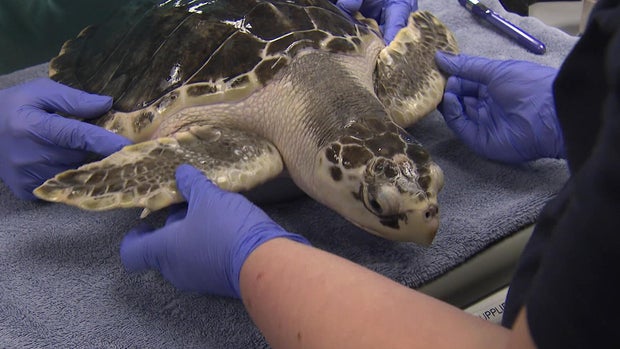
One of those patients is Magneto, a loggerhead sea turtle in her early teens. Unlike many of the other turtles in the hospital, Magneto can't eat on her own.
Veterinary staff carefully tube-feed her a nutrient-rich mixture designed to help her regain strength and continue fighting infection.
Months of care
For many sea turtles, the road back to health can take much longer than expected. "Anywhere between three and eight months for most," Kennedy said.
During that time, staff treat a wide range of medical issues. "A lot of them have pneumonia. We do see blood septic turtles. We do see some boat strikes as well," Kennedy said.
The hospital's veterinary team performs countless examinations, treatments and checkups while monitoring each turtle's progress.
The best day
Despite the hardships and challenges, Kennedy says the reward is worth it.
"Every single one of those turtles that come into this facility, we want to get back into the ocean," he said.
That mission reaches its peak on release day, when after months of treatment and rehabilitation, healthy turtles are returned to the ocean where they truly belong.


