"St. Patrick's Day every day": How the World Cup created an economic boom for Boston

As Boston's run as a FIFA World Cup host city comes to an end, local businesses are reflecting on what many describe as a once in a generation economic windfall.
For Aidan McGee, a partner at The Dubliner in Boston, the tournament was one of the pub's busiest stretches ever. "I think it's once in a lifetime. In a 20-year lease, it's once in a lifetime for sure," said McGee.
Preparing for the influx of soccer fans, McGee and his staff expected large crowds but were still surprised by the turnout.
"Meetings internally was very much like, 'Let's treat it like St. Patrick's Day every day, and surely it will not be like that.' But it was. It literally was St. Patrick's Day every day for two and a half weeks," he said.
28% increase in spending
Boston hosted seven World Cup matches at Gillette Stadium in Foxboro, drawing fans from around the world and providing a significant boost to the local economy.
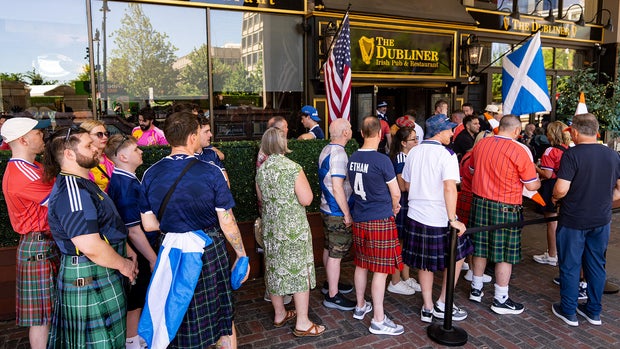
According to the Boston Business Journal, restaurants and bars in Boston experienced a 28% increase in spending during the tournament's final two weeks, the largest increase among all World Cup host cities.
McGee said beer sales at The Dubliner soared during the tournament. "Beer sales were maybe about 200% more than normal would be, but that's down to the fine people of Scotland," he said.
The tournament also provided a major lift for Boston's tourism industry. According to Axios Boston, early estimates indicate the World Cup generated an unprecedented tourism impact for the city, helping offset a broader decline in international visitors to the United States.
World Cup return on investment
Andrew Giuliani, Executive Director of the White House Task Force on the World Cup, said the tournament's return on investment has exceeded expectations.
"In terms of what we've laid down as a federal government, you're talking about a couple billion dollars for about a $50 billion cash injection here into the economy," Giuliani said. "When you think about other World Cups that have cost host countries $50 billion, $70 billion, or Olympics kind of in that range right there, it shows you that logistically the United States, it's just second to none in terms of being able to host these."
McGee hopes the tournament's success will encourage city leaders to keep the late-night last calls.
"I think for the city it shows what we can do and maybe it's time to take off some of the shackles and red tape and try and let the city go party," he said.


