American service member killed in Iraq; U.S. strikes Iran for 9th straight night
Follow updates on the war in the Middle East for Monday, July 20, here. See earlier developments below.
What to know about the Iran war:
- A U.S. service member was killed in action in Iraq on Saturday, bringing the death toll among U.S. service members in the war with Iran to 17, the U.S. Central Command said Sunday. More than 400 U.S. troops have been wounded.
- The U.S. conducted a ninth straight night of strikes on Iran, the U.S. Central Command said Monday.
- As part of those strikes, the U.S. targeted Iranian Revolutionary Guard forces who were believed to have launched Iran's attack Friday on a Jordanian military base that killed at least two U.S. troops, the Pentagon said. A third U.S. troop was missing in action following Iran's attack. CENTCOM said Sunday that unidentified remains were found where the U.S. service member went missing.
At least 1 vessel attacked at Strait of Hormuz, British military says
The United Kingdom Maritime Trade Operations Centre, a monitoring agency run by the British military, said late Sunday it received a report that a vessel was on fire close to Oman's coast.
UKMTO later classified the incident as an attack, saying the vessel had been hit by an unknown projectile. The crew abandoned the vessel and was picked up by a tug boat, and the fire continued to burn and the vessel was adrift, UKMTO said.
Iran's Revolutionary Guards said Monday that a second oil tanker had been struck and immobilized at the Strait of Hormuz, the Reuters news agency reported, adding that it couldn't immediately verify that claim.
U.S. strikes hit Iranian city that's home to nuclear plant, state media say
U.S. strikes hit several locations in Iran's southern port city of Bushehr, home to the country's only civilian nuclear plant, state media reported Monday.
"A few minutes ago, several locations in Bushehr city were hit by American enemy's projectiles," said Bushehr governor Mohammad Mozaffari, as quoted by official state news agency IRNA.
Explosions heard in Bahrain's capital
Explosions were heard in the Bahrain capital of Manama Monday morning after air raid sirens were triggered, AFP journalists said.
"The siren has been sounded, citizens and residents are urged to remain calm and head to the nearest safe place," the Gulf state's interior ministry wrote on X.
Bahrain is where the U.S. Navy's 5th Fleet is based.
CBS/AFP
Kuwait army says it's intercepting Iranian drone attacks
Kuwaiti air defenses were "engaging hostile drone attacks" from Iran, the Gulf state's military said Monday.
"The General Staff of the Army notes that any explosions heard are a result of air defense systems intercepting the hostile attacks," the Kuwait Army said in a post on its official X account.
Iran's Revolutionary Guard said earlier Monday it had hit U.S. military targets in Kuwait.
U.S. completes 9th straight night of attacks, CENTCOM says
The U.S. completed a ninth straight night of strikes against Iran at 10 p.m. ET on Sunday, U.S. Central Command said.
"CENTCOM assets targeted Iranian military command centers, air defense and coastal surveillance sites, maritime capabilities, missile and drone launch sites, and communications networks to further diminish Iran's ability to attack commercial vessels and civilian mariners transiting the Strait of Hormuz," the military said.
U.N.'s nuclear watchdog calls for restraint near nuclear sites as U.S. and Iran trade strikes
The U.N.'s nuclear watchdog called for restraint after Iranian authorities said the United States had attacked an under-construction nuclear power plant in the country's southwest, in Darkhovin.
The head of the IAEA, Rafael Grossi, said in a statement on X that no nuclear material had been stored at the site and the incident was "not believed to pose any radiological risk."
U.S. service member killed in Iraq; Unidentified remains found where American soldier went missing
A U.S. service member was killed in action in Iraq on July 18, bringing the death toll among U.S. service members in the war with Iran to 17, U.S. Central Command said Sunday.
The American soldier in northern Iraq died following "a controlled detonation of unexploded ordnance from a downed Iranian one-way attack drone," CENTCOM said in a statement.
Another service member was wounded and received medical treatment for a minor injury.
CENTCOM also announced Sunday that unidentified remains were found in Jordan at the location where a U.S. service member went missing and two others were killed following an Iranian strike.
"An examination process to verify the remains is ongoing," the U.S. military said.
Israeli officials say country will respond to any Iranian attacks with "full force"
Israeli defense minister Israel Katz said Sunday that his country would respond powerfully to any attack by Iran, after Israeli and Jordanian forces intercepted an Iranian missile launched towards the Jordanian city of Aqaba.
"If Iran fires missiles at Israel, we will attack them with full force," Katz said during a visit to a rescue service facility.
"If the United States changes its policy, which is also something that could happen, we are prepared for both defensive and offensive" action against Tehran, he added.
Aqaba lies just across the border from the Israeli city of Eilat.
Later, Israeli military chief Lieutenant General Eyal Zamir also vowed to retaliate with "determination" if Iran attacked Israel.
"We monitored today's launch toward the Aqaba area, and our Aerial Defence Array remains on alert to protect Israeli civilians," Zamir told military commanders in the occupied West Bank, according to a statement issued by the military.
"We are prepared to immediately resume combat and will act with great determination against anyone who harms us."
Rubio hails Lebanon for "move towards peace" after meeting with president
After meeting with Lebanese President Joseph Aoun in Washington, D.C. on Sunday, Secretary of State Marco Rubio applauded the country for its "move towards peace" after the latest round of Lebanon-Israel talks.
Rubio "commended the courage of the Government of Lebanon, under President Aoun's leadership, for their determined effort to reclaim Lebanon's sovereignty, disarm Hezbollah and dismantle its terrorist infrastructure, and move towards peace," the State Department said.
Sen. Mark Warner says Middle East bases have been "on and off under attack" since Iran war began
Sen. Mark Warner of Virginia, the top Democrat on the Senate Intelligence Committee, called the conflict in Iran "a war of choice" that has resulted in Middle East bases being "on and off under attack" during the past five months.
"It's remarkable in many ways that we've not had more casualties," Warner said on "Face the Nation with Margaret Brennan."
Asked whether the direct hit signals that Iran is getting targeting help from U.S. adversaries, Warner said he has not been briefed on whether they're receiving targeting help, though he noted that the bases have been intermittently under attack since the war began.
Warner said he would argue that "this is what happens when you start a war of choice, and as a member of the Gang of Eight, I can say unequivocally there was no imminent threat from Iran" when the conflict began in February.
Lebanon's president meets with Rubio in Washington, D.C.
Secretary of State Marco Rubio met with Lebanese President Joseph Aoun in Washington on Sunday, a State Department official told AFP, after the latest round of Lebanon-Israel talks wrapped up in Italy.
It is the first trip to Washington by a Lebanese head of state since Michel Sleiman was received by former president Barack Obama in 2009.
The Lebanese president's office said Aoun would meet with President Trump on Tuesday.
Aoun planned talks "on the situation in Lebanon and ways to strengthen the ceasefire" as well as on "the withdrawal of Israel from the Lebanese regions it occupies," his office said.
Israel and Lebanon — which do not have formal diplomatic relations — began U.S.-sponsored negotiations in April aimed at reaching a peace deal and permanently ending the Israel-Hezbollah war.
Israel says Iranian missile towards Jordan's Aqaba intercepted
Israeli and Jordanian forces intercepted an Iranian missile aimed at the Jordanian city of Aqaba on Sunday, the Israeli military said, after Amman denied the city's airport and seaport were evacuated over a threat.
When asked by AFP about reports of explosions near the Israeli city of Eilat, an Israeli military spokeswoman said both Israeli and Jordanian forces had intercepted a projectile.
Minutes before the interception, the Israeli military said it had detected missiles launched from Iran towards Aqaba and warned of the possibility of "spillover" into Israeli territory.
The Jordanian military meanwhile said it had downed "three Iranian missiles that targeted the kingdom's territory," while a fourth fell in a deserted area, without specifying where.
Air raid sirens were also activated in the Jordanian capital, Amman, and other parts of the kingdom.
However, the Jordanian government had earlier denied reports that authorities ordered the evacuation of Aqaba's airport and seaport, after the U.S. embassy said they had been evacuated over a "credible threat."
IDF warns of possible "spillover" into Israel as Iran targets Jordan
The U.S. Embassy in Jordan reported a "specific and credible threat" at the international airport and seaport in Aqaba, a port city in the country's south. The embassy said it strongly advised Americans avoid traveling to either site.
The Israel Defense Forces said Sunday it had identified missiles launched from Iran towards Aqaba. The area is "adjacent to Israeli territory," the IDF said, and warned that "as a result of the fire, there will be spillover into Israeli territory."
Israel, which joined the United States in launching the war with airstrikes on Iran on Feb. 28, has refrained from reentering the fighting since it reignited.
Since its ceasefire with the United States collapsed last week, Iran has focused its attacks on U.S.-allied Arab states in the Gulf as well as Jordan, rather than Israel. But an Iranian strike on Israeli territory could risk widening the conflict once again.
Iran says U.S. strikes targeted planned nuclear power plant site
Iran's atomic energy agency said that U.S. strikes early on Sunday morning targeted a construction site of a planned nuclear power plant in southwest Iran, according to Iranian state television.
Satellite images from Planet Labs PBC of the planned site of the Darkhovin Nuclear Power Plant show earth clearing but very little construction having taken place there as of July 9.
There is no radiological material known to be at the site, which Iran had not previously announced as targeted throughout the war.
Tehran has provided no overall information on its material losses in the American campaign. Iranian authorities said Sunday that the latest U.S. strikes have killed at least 50 people and injured over 500 more.
U.S. Central Command carried out its eighth round of strikes on Saturday night after an Iranian attack killed at least two U.S. soldiers on a Jordanian military base. CENTCOM said the strikes targeted Iranian Revolutionary Guard forces believed to have launched the Jordan attack. Also hit were "Iranian military coastal surveillance and air defense facilities, maritime capabilities, and missile and drone storage sites to continue degrading Iranian military capabilities," CENTCOM said.
Kuwait says another Iranian attack on water, power plant causes fire
An Iranian attack on a power and water plant in Kuwait caused a fire for the second day in a row on Sunday, Kuwaiti authorities said, as Tehran retaliates to days of U.S. strikes with attacks across the Gulf region.
"As a result of the heinous Iranian aggression on Kuwait, a power and water distillation plant, for the second time in two days, has been subjected to an attack that caused a fire in some facilities of the station," the Kuwaiti ministry of electricity, water and renewable energy said in a statement on X.
The ministry said that firefighters are working to extinguish the blaze.
U.S. concludes eighth straight night of strikes on Iran, Pentagon says
The U.S. has concluded its eighth straight night of strikes on Iran, U.S. Central Command said.
As part of the latest round of strikes, the U.S. specifically targeted Iranian Revolutionary Guard forces that were believed to have launched Friday's attack that killed at least two U.S. soldiers on a Jordanian military base, CENTCOM reported.
The U.S. also "successfully hit Iranian military coastal surveillance and air defense facilities, maritime capabilities, and missile and drone storage sites to continue degrading Iranian military capabilities," CENTCOM added.
The strikes ended at around 11:30 p.m. ET, according to CENTCOM.
Iranian strike that killed 2 U.S. soldiers was on Muwaffaq Salti Air Base in Jordan, source say
The Iranian missile and drone attack that killed at least two U.S. service members on Friday occurred at Muwaffaq Salti Air Base in Jordan, a U.S. official confirmed to CBS.
The location of the strike was first reported by the Wall Street Journal.
A third soldier remains missing in action following the Iranian strike, U.S. Central Command previously reported, and four other soldiers were treated and released from a hospital in Jordan.
U.S. launches new strikes on Iran after attack on Jordan base kills 2 U.S. soldiers
U.S. forces have launched a fresh round of strikes on Iran after an Iranian attack on a Jordanian military base killed at least two U.S. soldiers.
At the direction of President Trump, U.S. forces "began launching new airstrikes against Iran," U.S. Central Command said in a social media post. The strikes got underway at 6 p.m. ET Saturday.
"The strikes are designed to further degrade Iran's ability to threaten commercial shipping in the Strait of Hormuz and swiftly punish Islamic Revolutionary Guard Corps forces who launched attacks against American service members in Jordan last night," CENTCOM said.
This marks the eighth straight night of strikes on Iran since ceasefire talks broke down.
State Department issues new travel advisory, tells Americans worldwide to "exercise increased caution"
The State Department on Saturday issued a new travel advisory to Americans across the globe, telling them to "exercise increased caution" due to the war in the Middle East.
"We remind Americans in the region of the continued need for caution and encourage them to monitor the news for breaking developments," the advisory said. "The Department of State advises Americans worldwide, and especially in the Middle East, to exercise increased caution. Americans abroad should follow the guidance in security alerts issued by the nearest U.S. embassy or consulate."
The agency warned of flight interruptions and said that U.S. diplomatic facilities have been targeted, including those outside the Middle East, but didn't provide specific details.
"Groups supportive of Iran may target other U.S. interests overseas or locations associated with the United States and/or Americans throughout the world," the advisory said.
Hegseth reacts to U.S. service member fatalities in Iran strikes: "Godspeed, heroes"
Defense Secretary Pete Hegseth reacted to the deaths of two U.S. service members in Jordan following Iranian strikes overnight, saying Saturday in a social media post, "Godspeed, heroes."
"Their sacrifice only stiffens our resolve," Hegseth said on X.
Israel takes out Hezbollah drone unit in southern Lebanon, IDF says
The Israeli military launched a strike against a Hezbollah drone unit in southern Lebanon on Saturday, according to the Israel Defense Forces.
A drone was spotted in the area of Tebnit, outside the major southern city of Nabatieh, and determined to belong to Hezbollah.
"Following the identification, the Israeli Air Force conducted searches in the area and identified a Hezbollah terrorist cell that had been operating drones and taking cover near the Security Zone and IDF soldiers," the Israeli military said in a statement.
"Shortly after, the IDF struck the terrorists in order to remove the threat posed to the IDF soldiers operating nearby," it continued.
Despite a ceasefire, Israel has continued to strike Hezbollah forces in southern Lebanon it has deemed a risk to troops. Hezbollah has recently rejected multiple ceasefire deals negotiated between Lebanon and Israel, while they were not a party to the talks.
Hezbollah has increasingly targeted Israeli forces with drones over the last several months, many using fiber optic cables that prevent them from crashing after being jammed by Israeli forces.
2 U.S. service members killed in Iran's strike on Jordan, another missing in action, U.S. military says
Two U.S. service members were killed in a strike on a base in Jordan overnight, according to U.S. Central Command.
A third service member is missing in action, CENTCOM said.
Four other U.S. service members were medically evacuated to hospital in Jordan, and have since been discharged. There were other service members treated for minor injuries, CENTCOM said.
The deaths were the 15th and 16th among U.S. service members in the current war with Iran. Six service members were killed in an Iranian attack on a base in Kuwait in March. Also in March, six were killed when a refueling plane crashed in Iraq and one was killed in an Iranian strike on the Prince Sultan Air Base in Saudi Arabia.
In the most recent death, a U.S. Navy pilot died when his MH-60S helicopter made an emergency landing at sea last month.
Iran will deliver "unforgettable lessons" to U.S., new ayatollah says
Iranian Supreme Leader Mojtaba Khamenei called President Trump's signature "utterly worthless and devoid of credibility" and warned of "unforgettable lessons" if the U.S. continues its attacks.
"Now that the American enemy is seeking to escalate the conflict thereby incurring even heavier costs and further humiliation, it should know that the noble nation of Iran and the Resistance Front have unforgettable lessons in store for it," Khamenei said in a statement.
Mojtaba Khamenei is the son of the former ayatollah, Ali Khamenei, who was killed in a massive strike by the U.S. and Israel on the first day of the war. Mojtaba Khamenei still has not been seen in public since the war began. He was reportedly seriously injured in the same strike that killed his father and several other family members.
"The repeated breaches of the agreement by the Great Satan [the US] regarding the MOU signed by the Presidents of Iran and the US have once again laid bare a fundamental truth: the signature of the US President is utterly worthless and devoid of credibility," Khamenei said in the statement, which was read by a spokesperson on Iranian state TV.
It was not clear what the ayatollah was referring to by teaching the U.S. "unforgettable lessons," but its military is greatly diminished by American strikes. It has resorted to strikes on commercial vessels in the Strait of Hormuz, effectively shutting down the major oil artery, and drone and missile strikes on U.S. allies in the Middle East.
The new supreme leader last released a statement a week ago, July 11, when the U.S. began intense strikes again on Iran and Mr. Trump said the MOU was dead.
Kuwait brings fires from Iran strikes under control
Some seven hours after being struck by Iran in retaliation for U.S. attacks, firefighters have gotten several fires under control, according to the Kuwait Fire Force.
The first fire broke out following an attack at an oil facility. That fire has now been brought under control, according to the fire service, but not before several firefighters and an oil sector worker suffered injuries.
Then, three other fires have now been put out in residential areas caused by falling debris from attacks. There was damage reported to buildings, but no one was injured, the fire service said.
Iran says it is suspending commitments to interim deal
Iran says it has suspended its commitments under an interim peace deal with the U.S. as the countries have exchanged strikes targeting infrastructure and military sites.
The U.S. has violated its commitments under the deal that was signed about a month ago and now Iran is "no longer implementing them," Kazem Gharibabadi, Iran's deputy foreign minister, told state TV.
The announcement was largely unnecessary as President Trump said last week the deal was dead, however, Iran had claimed it was still interested in returning to the 14-point memorandum of understanding, even as the country targeted U.S. allies in the Middle East and ships in the Strait of Hormuz.
Reza Amiri Moghadam, the Iranian ambassador to Pakistan, which was the key mediator in the negotiating process, made similar comments as Gharibabadi on Saturday.
"[The] US interpreted MOU contrary to its terms and gained control over parts of Strait Hormuz to obtain what it couldn't in the battlefield," Moghadam said on X. "It was obvious that the Iranian side would not accept this arbitrary interpretation which blatantly violated the MOU."
"Now, the US has started a war contrary to the terms of MOU and international principles destroying the infrastructures," he added. "The international community is expected to strongly condemn this aggressive and reckless act."
U.S.-aligned Gulf Cooperation Council leader accuses Iran of "war crimes"
Jasem Mohamed Albudaiwi, the secretary general of the Gulf Cooperation Council, has condemned Iranian attacks on members of the group, referring to them as "war crimes."
"Iran's actions constitute a highly dangerous escalation, a grave violation of international law and the United Nations (UN) Charter, as well as war crimes requiring international accountability and prosecution, given the deliberate targeting of infrastructure and civilian facilities in flagrant violation of all international norms and conventions, and a persistent determination to destabilise regional security and stability," Albudaiwi said in a statement Saturday.
The GCC is comprised of Bahrain, Kuwait, Oman, Qatar, Saudi Arabia, and the United Arab Emirates. All six countries are allies of the U.S., with Secretary of State Marco Rubio attending a meeting of the countries several weeks ago.
Iran has targeted all six countries at various times throughout the war in retaliation for strikes by the U.S. and Israel. Kuwait, especially, came under strong fire from Iran overnight. Albudaiwi offered his support to Bahrain, Kuwait and Jordan, which came under attack overnight, while "expressing his wishes for a speedy recovery to the injured individuals in the State of Kuwait."
Lebanese president leaves for U.S. summit on same day soldier dies in explosion
President Joseph Aoun left for the U.S. on Saturday, along with first lady Nehmat Aoun, to hold a summit with President Trump on the conflict between Israel and the Lebanon-based, Iran-backed Hezbollah militia.
"A Lebanese-U.S. summit will be held at the White House," according to a readout from the president's office. "President Aoun is also scheduled to hold meetings and consultations with a number of U.S. officials to discuss the situation in Lebanon and ways to consolidate the ceasefire, restore security and stability across the country, particularly in the south, secure Israel's withdrawal from the Lebanese territories it occupies, and extend the authority of the Lebanese state over all parts of the country."
Mr. Trump, who has repeatedly praised Aoun, previously invited him for a meeting at the White House, which will take place on July 21.
Aoun's departure came on the same day a Lebanese soldier was killed and two others injured when a device exploded near an army vehicle in the town of Al-Mansouri in southern Lebanon, according to the Lebanese army. It's not clear who placed the "suspicious object," as described by the army.
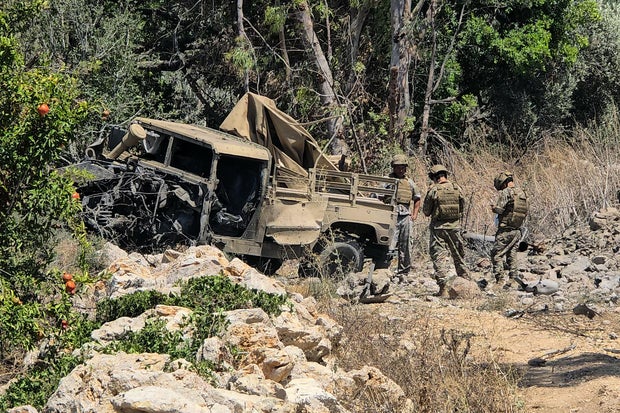
The Lebanese army is supposed to move into southern Lebanon to provide security once Israel exits the security zone, though Israel has said they will not leave until Hezbollah disarms and is eliminated from the territory, which does not seem to be in the near future.
At least 33 Lebanese soldiers have died since Israel began expanded operations in the southern part of the country on March 2, according to a July 15 release by the U.N. Security Council.
Kuwaiti foreign minister talks to Pakistani mediators after night of attacks
After a night of serious and damaging Iranian attacks on Kuwait, Kuwaiti Foreign Minister Sheikh Jarrah Jaber Al-Ahmad Al-Sabah spoke to his Pakistani counterpart, Foreign Minister Mohammad Ishaq Dar, on Saturday.
Pakistan has played an important role in peace negotiations between the U.S. and Iran, including the two ceasefires negotiated in April and June. Dar has been a key member of those negotiations.
"The two ministers discussed the latest regional developments, particularly the ongoing escalation and its repercussions, as well as efforts to reduce tensions, contain the crisis, and advance diplomatic solutions aimed at preserving regional security and stability," according to a readout from the Kuwaiti Ministry of Foreign Affairs.
Kuwait intercepted some missiles and drones early Saturday, but Iranian strikes also caused damage to a desalination plant and other pieces of infrastructure.
50 killed, over 500 injured in Iran by U.S. strikes, health ministry says
The death toll from June 27 to July 18 due to U.S. strikes in Iran has grown to 50, with more than 500 injured as well, according to Hossein Kermanpour, a spokesperson for the Iranian health ministry.
Five women and two children were among the dead, he said, while 32 women and 18 children have been injured. Thirty-seven people remain hospitalized, Kermanpour added.
The U.S. finished a seventh straight night of strikes on Saturday. Most of those strikes have come in the southern part of the country.
Kuwait reports strikes on water desalination plant, civilian infrastructure
Kuwait said Saturday it intercepted Iranian missiles and drones and that a water desalination plant was struck, causing a fire, the second such attack in two days in the tiny desert nation, which depends on desalination for 90% of its drinking water.
Several firefighters and a worker were injured while battling two other blazes sparked by Iranian strikes, according to the Kuwait Fire Force.
Kuwait also reported attacks on an oil facility. The country's foreign ministry accused Iran of targeting civilian sites and other key infrastructure.
"The repeated targeting of these vital facilities reveals a systematic hostile approach targeting civilian sites and vital infrastructure that endangers the lives and safety of civilians," the foreign ministry said.
Kuwait briefly closed its airspace in the morning due to missile threats, and Kuwait Airways said it was rescheduling most flights to and from the capital.
Iraq said it shot down attack drones over the city of Irbil. Jordan's state-run Petra news agency said that the kingdom's air defense systems had downed Iranian missiles, while air sirens sounded multiple times in Bahrain, according to the government.
Jordan says it shot down 10 Iranian missiles
Jordan's army said early Saturday local time that it had shot down 10 Iranian missiles with no casualties or damage.
"Air defense systems ... intercepted 10 Iranian missiles that had entered Jordanian airspace and were targeting the Kingdom's territory (which) were intercepted and shot down," the army said in a statement.
U.S. concludes 7th consecutive night of strikes on Iran, CENTCOM says
U.S. Central Command reported early Saturday morning local time that the U.S. has concluded its seventh consecutive night of military strikes on Iran.
CENTCOM said in a statement the latest strikes targeted "surveillance sites, military logistics infrastructure, underground weapons storage, and maritime capabilities."
Fighter jets, drones and warships were utilized in the attacks, CENTCOM said.
Several U.S. service members injured in Iranian attacks on Jordanian bases this week, sources say
Iran attacked at least two Jordanian bases this week, resulting in several American service members being injured in the attack after their facility was struck, multiple U.S. officials told CBS News, speaking under condition of anonymity because they were not authorized to speak publicly.
No fatalities have been reported among the Americans or the Jordanians at this time. The severity of those injured is not clear.
U.S. warplanes often use Jordanian military installations.
Tehran blamed for strike that killed several Iranian Kurdish rebels in Iraq
Drone and rocket strikes killed nine members of an Iranian Kurdish armed opposition group in Iraq's Kurdistan region on Friday, the exiled party said, blaming the attack on Iran.
In Erbil, the capital of Kurdistan, rebels shot down several drones, the group said, and Agence France-Presse journalists heard loud explosions in the city.
The Kurdish government also blamed the attacks on Tehran.
Idriss Kohlwazi from the exiled Komala Party of Iranian Kurdistan told AFP the strikes killed nine members of their party at their camp near the city of Sulaimaniyah.
Qatar's interior ministry said in a statement that it "strongly condemns the Iranian attack on Iraq's Kurdistan region, considering it a blatant violation of the sovereignty" of Iraq and Iraqi Kurdistan.
During the war, the Kurdistan region, which hosts U.S. troops and foreign oil companies as well as exiled Iranian Kurdish rebels, has been a target for attacks carried out by Iran and pro-Iran Iraqi armed groups.
Even after a ceasefire was announced in April, Iran continued to strike Kurdish opposition groups, which Tehran accuses of serving both Western and Israeli interests.
But Friday's attack marked the biggest escalation, with these groups having mostly evacuated their bases and camps since the war.
In early March, as the war was unfolding, President Trump said it would be "wonderful" if Iranian Kurds based in Iraq joined the war against the Tehran regime.
"I think it's wonderful that they would want to do that. I'd be all for it," Mr. Trump told Reuters at the time.
U.S. begins 7th consecutive night of strikes on Iran, CENTCOM says
The U.S. military's Central Command said it has begun a seventh consecutive night of attacks on Iran.
"The strikes are designed to continue degrading Iranian military capabilities at the Commander in Chief's direction," CENTCOM said on X.
CENTCOM also said Friday afternoon that it has redirected four commercial ships since President Trump ordered a blockade on Iranian ports to restart this week, up from three redirected ships a day earlier. One additional ship was disabled by firing a missile at its smokestack, and one was boarded Thursday "to ensure full compliance," it said.
Oil prices continue to rise amid renewed fighting
Brent crude, the international standard for oil prices, crossed $88 a barrel on Friday afternoon, up about $4 from the closing price on Thursday.
The price was the highest it has been in a month. Oil prices fell dramatically in the days after Iran and the U.S. signed a memorandum of understanding in mid-June. The cost for Brent crude fell to $71 a barrel on July 1, but has steadily climbed again as the MOU fell apart and the U.S. restarted strikes in Iran.
"As you know, the price of oil right now is approximately $80 a barrel, maybe a little less. Before I came out here, that's what it was at," White House press secretary Karoline Leavitt said on Thursday. "Gas prices are down approximately 60 cents a gallon off the peak of this conflict, and the president was honest with the American people from the beginning. There may be temporary disruptions in the oil market, but what we haven't seen is what all of the naysayers said, that there would be massive increases in the price of oil."
Prices are down significantly from the recent high on May 5 of $114 a barrel.
Strait of Hormuz transits drop to lowest level in 3 weeks, monitoring outlet says
The number of ships transiting the Strait of Hormuz dropped to their lowest level in three weeks as violence between the U.S. and Iran ramped up again.
Only eight ships passed through the strait on Thursday, according to data from maritime tracking firm Kpler.
Seven of the eight vessels used the Iranian route through the strait as opposed to the U.S.-supported route along the Omani coast — a sign of concern they will be targeted by Iranian missiles or drones if they don't follow Iran's orders.
There were 15 ships to cross the Strait of Hormuz on Wednesday, but one — the M/T Belma — came under fire from Iran, another sign ships either shouldn't cross at all or take the northern, Iranian route.
The outlet also noted there were no shadow fleet crossings of the strait. Shadow fleet ships conceal their cargo and where they are coming from or going to, often using old vessels susceptible to problems.
U.N. chief condemns attacks on civilian sites in Iran-U.S. war
U.N. chief Antonio Guterres said Friday that attacks on civilian infrastructure are "unacceptable," after Iran accused the United States of targeting bridges and transport hubs.
"The secretary-general remains deeply concerned by the continuing military escalation between Iran and the United States of America," spokesman Farhan Haq told reporters.
"He's particularly concerned about attacks on civilian infrastructure in Iran and across the region. Such attacks are unacceptable," he added.
The United States has not confirmed Iran's allegations that it targeted civilian sites, though President Trump has threatened to target them.
Iranian drone attack wounded several personnel, Kuwaiti army says
Iranian drone strikes wounded several Kuwaiti military personnel on Friday, according to the country's army.
In a post on X, the Kuwaiti army said the casualties were sustained when Iranian drones targeted "several facilities and camps" on Friday morning.
The post didn't give a number of wounded, but showed the country's chief of staff visiting four different people in hospital beds.
Kuwait's foreign affairs ministry condemned the Iranian strikes on the country Friday, as well as those on Bahrain, Qatar and Jordan, in a post on X.
U.S. military says it destroyed Iranian port surveillance tower on Gulf of Oman
The U.S. military destroyed an Iranian port surveillance tower in a Thursday strike, saying it had been used by Iran's paramilitary Revolutionary Guard for years.
The Chah Bahar Shahid Kalantari Port surveillance tower sat to the east of the Strait of Hormuz on Iran's south coast.
It was "used for decades by the Islamic Revolutionary Guard Corps (IRGC) to track and target commercial vessels transiting the Strait of Hormuz," U.S. Central Command wrote on X.
"The destruction of the tower directly degrades IRGC's ability to coordinate attacks on innocent civilian crew members," CENTCOM added.
U.S. military denies Iran killed American troops in Syria
The U.S. military has dismissed claims by Iran that they killed American troops on a base in southern Syria.
Iran's Revolutionary Guard said on Friday that it has struck Syria's Al-Tanf military base, which the U.S. military says its troops vacated in February.
The IRGC said the base was home to a U.S. special operations command center, and as well as destroying a radar system and several helicopters, they claimed to have sent "large numbers of criminal American forces to their deaths."
In a post on X Friday, U.S. Central Command said the claim was false: "No U.S. troops in the region have recently been killed or captured."
Iran urges citizens to reduce electricity usage after U.S. strikes on energy infrastructure
Iran's energy ministry has called on citizens to reduce electricity use after the power grid came under strain following the U.S. strikes on energy infrastructure in the south.
The ministry in a statement urged people to switch off air conditioners in peak hours "to help ensure a stable electricity supply in the southern provinces, which are currently facing extreme heat and attacks on electricity supply facilities."
Kuwait also called on people to ration electricity consumption after reporting an Iranian attack on a power and water plant.
AFP
Iranian commander says "targeted strikes … will continue"
Iran will continue with "effective and targeted strikes" against the U.S. until calm is restored, the commander of the paramilitary Revolutionary Guard's Aerospace Force said Friday.
"Every inch of territory is equally important," Brig. Gen. Seyyed Majid Mousavi said Friday. "Our effective and targeted strikes against the enemy, launched from across Iran, will continue until security and calm are restored along the southern coastline and in the Strait of Hormuz."
Syria denies Iran's claim to have bombed a military base used by U.S. forces
A Syrian military source told the AFP news agency Friday that Iran had not struck a military base in the country's southeast, after a claim from the Iranian Revolutionary Guard Corps to have hit the facility.
Iran's paramilitary IRGC claimed earlier that it had "carried out a surprise attack" on a U.S. special forces base in al-Tanf, southeast Syria, destroying helicopters and causing casualties in response to U.S. strikes.
"We deny any Iranian bombardment targeting the Al-Tanf area," the source told AFP, speaking on condition of anonymity.
The U.S. military said its forces withdrew from the base earlier this year, after a longtime deployment as part of a U.S.-led anti-terrorism coalition.
CBS/AFP
Iran says 38 people killed and 400 wounded in U.S. strikes over the past month
At least 38 people have been killed and 400 wounded in U.S. strikes since June 22, Iran's health ministry said Friday.
"Among the casualties are 22 injured women, three women killed, nine injured minors under the age of 18, and one child killed," Hossein Karmanpour, head of the ministry's information center, said Friday. "A total of 47 people remain hospitalized."
The U.S. has carried out six consecutive nights of strikes on Iran this week, targeting "dozens of Iranian military targets such as coastal surveillance and air defense sites, military logistics infrastructure, and maritime capabilities," according to the U.S. military.
The latest U.S. strikes killed eight and wounded 20, the Iran's official IRNA news agency reported.
Stocks slide, oil prices rise
Oil prices were up again Friday, with international benchmark Brent crude powering above $85 a barrel, as the United States and Iran traded fresh attacks.
"Developments in the Middle East are getting worse by the hour," noted Ipek Ozkardeskaya, senior analyst at Swissquote bank.
Asian and European stock markets took their cue from Wall Street, where sharp falls in Nvidia and Amazon helped drag down the Nasdaq by more than 1 percent Thursday.
There were steep losses also in Hong Kong, Shanghai, Singapore and Sydney, though Bangkok, Manila and Mumbai rose.
Europe's main stock markets were all in the red, though London held up reasonably well as the U.K. prepared for its new prime minister, Andy Burnham.
Shares in British energy giants Shell and BP climbed thanks to rising oil prices.
AFP
U.S. strike severely wounds 1-year-old child in Iran, Iranian news agency says
Shrapnel from a U.S. strike on southern Iran severely wounded a 1-year-old child and killed their mother, Iran's semi-official Fars news agency reported Friday.
Fars said the woman died in hospital after sustaining severe wounds in a U.S. strike on a telecommunications tower in Bandar Abbas, a southern port city on the Strait of Hormuz.
The child was in intensive care after reportedly losing a hand and sustaining serious chest wounds.
The U.S. has carried out repeated strikes across Iran this week, including attacks on infrastructure in and around Bandar Abbas. Central Command said earlier Friday that U.S. forces had concluded a sixth consecutive night of strikes, targeting "dozens of Iranian military targets such as coastal surveillance and air defense sites, military logistics infrastructure, and maritime capabilities."
Iran claims series of strikes on U.S. military sites across Middle East
Iran's Islamic Revolutionary Guard Corps claimed a new series of strikes targeting U.S. military facilities across the Middle East on Friday, though there was no immediate confirmation from U.S. officials on any actual impacts.
The IRGC claimed it "carried out a surprise attack" on a U.S. special forces base in al-Tanf, Syria, destroying helicopters and causing casualties, and that it struck an American base in Kuwait with surface-to-surface missiles, causing a "massive fire" that "engulfed the base."
The powerful paramilitary force also claimed to have destroyed U.S. radar facilities on Oman's Salamah Rocks, in the Strait of Hormuz, as well as targeting U.S. logistical support centers in Kuwait with drones and a U.S. army base in Bahrain.
In another statement, the IRGC said it had destroyed several U.S. "refuelling aircraft and fighter jets" in Jordan and caused "serious damage to many more."
The U.S. military did not immediately comment on the IRGC's latest claims, which are often exaggerated.
Kuwait's Ministry of Electricity, Water and Renewable Energy said on Friday that Iranian strikes had hit power and water desalination stations.
In Qatar, a child was wounded by shrapnel after an Iranian weapon was intercepted, the country's interior ministry said Friday.
"Back to the worst case scenario" for shippers in Strait of Hormuz, analyst says
Since the breakdown of the U.S.-Iran memorandum of understanding, ship crews around the Strait of Hormuz are unwilling to make the risky trip, Dimitris Maniatis, CEO of the Greek maritime risk management company Marisks, said Thursday.
"Vessels that were trapped inside the Persian Gulf for a very long time, belonging to owners that were extremely risk averse, managed to exit, and everybody was very joyful about that," he said during a briefing for the Lloyd's List intelligence group.
"With the recent events, everything has changed. We've gone back to the worst case scenario. Nobody is willing to move."
He pointed to the collapse in transits through the strait itself, as well as more deadly attacks on commercial vessels since the ceasefire ended.
"All this resonates with crews, and right now they're just not very happy to go through, no matter what is promised to them," Maniatis said. "It's not about money anymore, it's not about any other higher calling, it's purely about the fear that is governing the decision-making right now."
The concerns have pushed oil prices to their highest level in a month, with a barrel of Brent crude, the international standard, up about 1% Thursday to trade around $85 a barrel. U.S. benchmark crude oil was up a similar amount, trading just under $80 per barrel.
U.S. completes its 6th consecutive night of strikes on Iran, CENTCOM says
The U.S. completed another round of strikes on Iran early Friday morning local time, U.S. Central Command said in a statement.
This marked the sixth straight night of U.S. strikes on Iran since a fragile ceasefire between the two countries fell apart last week.
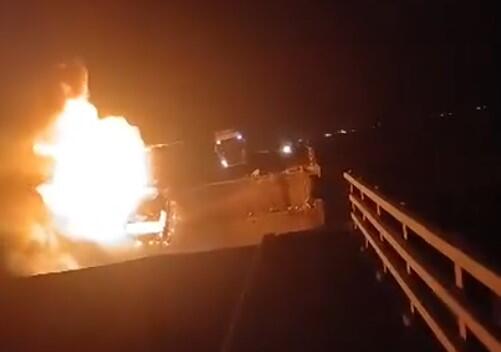
Friday's strikes were conducted by fighter jets, aerial drones and warships that targeted "dozens of Iranian military targets such as coastal surveillance and air defense sites, military logistics infrastructure, and maritime capabilities," CENTCOM said.
More than 50,000 U.S. military personnel are currently deployed across the Middle East, CENTCOM added.
U.S. strikes hit airport, bridges and railway station in Iran, state media says
Deadly U.S. strikes early Friday morning local time hit an airport, a railway station and two bridges in Iran, killing three people, Iranian state media reported.
A U.S. strike on two bridges in the Hormozgan province killed three people and wounded nine, state TV wrote on Telegram, updating an earlier toll.
"Three explosions were heard around the airport and at least one American enemy projectile hit Iranshahr airport," in the southeast, state television agency IRIB said on Telegram.
"A few minutes ago, the Bandar Abbas Railway Junction Station was targeted by the American enemy. According to this report, two Iranians were injured in the attack," the Mehr news agency said on Telegram.
Another U.S. attack wounded one person in the western port city of Bushehr, Iranian state media posted on Telegram.
AFP
Marines board commercial vessel in Gulf of Oman
U.S. Marines boarded a commercial vessel in the Gulf of Oman Thursday, U.S. Central Command reported.
CENTCOM said on X that it boarded the M/T Wen Yao "to ensure full compliance" with the U.S. naval blockade of Iranian ports that President Trump reinstituted earlier this week as fighting resumed between the two countries.
According to CENTCOM, since the blockade began on Tuesday, the U.S. has redirected three commercial vessels that tried to dodge it. It has also disabled one oil tanker, the Curacao-flagged M/T Belma.
"The Strait of Hormuz and the surrounding waters remain free and open, except for vessels attempting to violate America's steel wall blockade," CENTCOM said.
White House still talking with Iran, doesn't answer if talks are at standstill
White House press secretary Karoline Leavitt would not answer whether President Trump believes the talks with Iran are at a standstill, or even dead, though she did say the administration is still holding peace talks.
"Iran very much continues to talk to the United States of America and express that they want to make a deal with us because they are suffering devastating blows on behalf of our United States military."
Leavitt emphasized the strikes that have occurred every day this week are a direct result of Iran breaking the agreement signed in mid-June.
"The reason for the recent strikes over the course of the last several days is because Iran violated the memorandum of understanding that we struck with them," Leavitt said. "Specifically, in the memorandum of understanding that they signed, they were not to fire on commercial vessels moving through the Strait of Hormuz and unfortunately they have made the tragic decision, for them, to do that."
"President Trump is not going to sit by and allow these acts of terrorism to take place in the strait without ensuring Iran pays consequences for that. And that's what we are witnessing now."